



Often what is hidden in our world is so simply because no cares or thinks to look. Yes, a fair amount of attention has recently been given to the staggering new Pentagon budget request, the largest since World War II, that the Bush administration has just submitted to Congress for fiscal year 2009. It comes in at $515.4 billion – a 7.5 percent hike for an already bloated Pentagon – and that doesn’t include all sorts of Defense Department funds that will be stowed away elsewhere (even if in plain sight), nor does it include the couple of hundred billion dollars or more in funds to be appropriated largely via “supplemental” requests for the ongoing military disasters in Iraq and Afghanistan. Even the official budget, however, includes staggering sums for procuring major new weapons systems and for R&D leading to ever more such big-ticket items in the future. According to Steve Kosiak, vice president of budget studies at the Center for Strategic and Budgetary Assessments, “The fiscal year 2009 budget may be about as good as it gets for defense contractors.” When all is said and done, this will probably be a trillion dollar “defense” budget.
As it happens, military budgets like this have a multiplier effect globally. After all, there’s no such thing as a one-nation arms race. It’s just that no one here thinking about what we’re about to feed the Pentagon pays much attention to such things. Fortunately, John Feffer, an expert on military policy and Asia, has been doing just that. He is the co-director of a particularly interesting Web site, Foreign Policy in Focus at the Institute for Policy Studies in Washington, with which TomDispatch hopes to collaborate on projects in the future. (To subscribe to FPIF’s e-news service, click here.) In the following piece, he brings genuine arms-race news to all of us. Yes, Virginia, there is indeed an arms race underway; it’s taking off in Northeast Asia; and it’s dangerous. Tom
Asia’s Hidden Arms Race
Six countries talk peace while preparing for war
by John Feffer
Read all about it! Diplomats remain upbeat about solving the nuclear standoff with North Korea; optimists envision a peace treaty to replace the armistice that halted, but failed to formally end, the Korean War 55 years ago. Some leaders and scholars are even urging the transformation of the Six Party Talks over the Korean nuclear issue, involving the United States, Japan, China, Russia, and the two Koreas, into a permanent peace structure in Northeast Asia.
The countries in the region all seem determined to make nice right now. Yasuo Fukuda, the new Japanese prime minister, is considerably more pacific than his predecessor, the ultra-nationalist Shinzo Abe. The new South Korean president, Lee Myung-bak, despite his conservative credentials, is committed to continuing the previous president’s engagement policy with North Korea and plans to reach out to Japan via his first post-inaugural state visit. The party that won the recent Taiwanese parliamentary elections, the Kuomintang, wants to rebuild bridges to the Mainland and, when it comes to the Communist Party there, mend fences the ruling Democratic Progressive Party tried to pull down. Beijing, for its part, is being super-conciliatory toward practically everyone in this Olympic year.
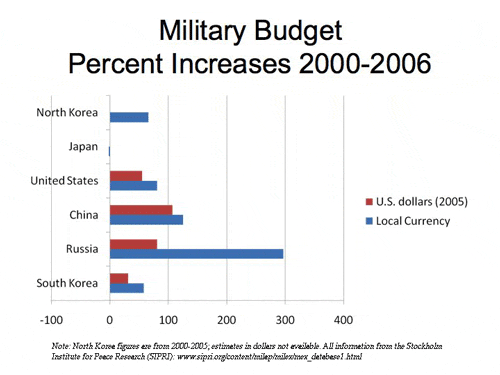
Despite all this peace-talk, something else, quite momentous and hardly noticed, is underway in the region. The real money in Northeast Asia is going elsewhere. While in the news sunshine prevails, in the shadows an already massive regional arms race is threatening to shift into overdrive. Since the dawn of the 21st century, five of the six countries involved in the Six Party Talks have increased their military spending by 50 percent or more. The sixth, Japan, has maintained a steady, if sizable military budget while nonetheless aspiring to keep pace. Every country in the region is now eagerly investing staggering amounts of money in new weapons systems and new offensive capabilities.
The arms race in Northeast Asia undercuts all talk of peace in the region. It also sustains a growing global military-industrial complex. Northeast Asia is where four of the world’s largest militaries – those of the United States, China, Russia, and Japan – confront each other. Together, the countries participating in the Six Party Talks account for approximately 65 percent of world military expenditures, with the United States responsible for roughly half the global total.
Here is the real news that should hit the front pages of papers today: Wars grip Iraq, Afghanistan, and large swathes of Africa, but the heart of the global military-industrial complex lies in Northeast Asia. Any attempt to drive a stake through this potentially destabilizing monster must start with the militaries that face one another there.
The Japanese Reversal
The Northeast Asian arms buildup – a three-tiered scramble to dominate the seas, beef up air forces, and control the next frontier of space – runs counter to conventional wisdom. After all, isn’t Japan still operating under a “peace constitution”? Hasn’t South Korea committed to the peaceful reunification of the Korean peninsula? Didn’t China recently wake up to the virtues of soft power? And how could North Korea and Russia, both of which suffered disastrous economic reversals in the 1990s, have had the wherewithal to compete in an arms race? As it turns out, these obstacles have proved little more than speed bumps on the road to regional hyper-militarism.
Perhaps the most paradoxical participant in this new arms race is Japan. Its famous peace constitution has traditionally been one of the few brakes on arms spending in the region. The country has long limited its military expenditures to an informal ceiling of 1 percent of its overall budget. As that budget grew, however, so did military spending. Japan’s army is now larger than Britain’s, and the country spends more on its military than all but four other nations. (China surpassed Japan in military spending for the first time in 2006.) Nonetheless, for decades, the provisions of its peace constitution at least put limits on the offensive capabilities of the Japanese military, which is still referred to as its Self-Defense Forces.
These days, however, even the definition of “offensive” is changing. In 1999, the country’s Self-Defense Forces first used offensive force when its naval vessels fired on suspected North Korean spy ships. Less than a decade later, Japan provides support far from its “defensive” zone for U.S. wars, including providing fuel to coalition forces in Afghanistan and transport in Iraq.
Japan was once incapable of bombing other countries largely because its air force didn’t have an in-air refueling capability. Thanks to Boeing, however, the first KC-767 tanker aircraft will arrive in Japan later this year, providing government officials, who occasionally assert the country’s right to launch preemptive strikes, with the means to do so. This is not happy news for Japan’s neighbors, who retain vivid memories of the 1930s and 1940s, when its military went on an imperial rampage throughout the region.
Tokyo already has among the best air forces and naval fighting forces in the world, trailing only the United States. But leading Japanese officials have displayed an even larger appetite. Some Japanese politicians are lobbying to amend the peace constitution or even scrap it entirely, while sending military spending skyrocketing. To promote these ideas, they use the thin rationale that Japan should be participating regularly in “international peacekeeping missions.”
The Japanese Defense Agency – their Pentagon – which was upgraded to ministry level last year, wants more goodies like an aircraft carrier, nuclear-powered submarines, and long-range missiles. A light aircraft carrier, which the government has coyly labeled a “destroyer,” will be ready in 2009. The subs and missiles, however, will have to wait. So, too, will Tokyo’s attempt to take a quantum leap forward in air-fighting capabilities by importing advanced U.S. F-22 stealth planes. Concerned about releasing latest-generation technology to the outside world, Congress scotched this deal at the last moment in August 2007.
Washington has been a good deal more accommodating when it comes to missile defense. Japan has been a far more enthusiastic supporter of missile defense than any of America’s European allies. In fact, the United States and Japan are spending billions of dollars to set up an early-warning-and-response prototype of such an advanced missile system. Part of this missile shield is land-based. Last month, Japan installed its third Patriot Advanced Capability-3 (PAC-3) surface-to-air interceptor and plans on nine more by 2011. The more ambitious part of the program, however, is based at sea. In December, Japan conducted its first sea-based interceptor test.
With Japan and the United States in the lead, a space race is also on in Northeast Asia. Last year, China tested its own anti-ballistic missile system by shooting down one of its old weather satellites. While at present this is far from an actual missile-defense system, China effectively served notice that it is up to the technological challenge of hitting a bullet with a bullet in space. Meanwhile, thanks to U.S. pressure Russia too is upgrading its missile defense systems, while pouring money into the development of new missiles that can bypass any putative shield the U.S. and its allies can develop.
Give Me Peace, but Not Just Yet
The two most recent South Korean presidents, Nobel Peace Prize winner Kim Dae-Jung and the left-leaning Roh Moo-Hyun, have been well-known for their efforts to foster reconciliation with North Korea. Less well-known have been their programs to beef up South Korea’s military. The dark side of their engagement policy has been its unstated quid pro quo of satisfying the security concerns of South Korean hawks by giving their military everything it wants – and then some. Between 1999 and 2006, South Korean military spending jumped more than 70 percent. In 2007, at the launching ceremony for a new Aegis-equipped destroyer, which brought South Korea into an elite club of just five countries with such technology, President Roh Moo-Hyun declared, “At the present time, Northeast Asia is still in an arms race, and we cannot just sit back and watch.” By 2020, the South Korean navy wants to build three more Aegis destroyers at a cost of $1 billion each.
South Korean hawks are not only responding to concerns about North Korea, the traditional threat around which the South has organized its military. They are concerned about a declining military commitment from the United States, which has reduced the levels of American troops that traditionally garrison the country and pushed hard for greater military “burden-sharing.”
South Korea’s leaders and military officials are anxious that the Pentagon may continue to focus on the Middle East and Central Asia to the exclusion of its Pacific commitments. To prepare for the contingency of going it alone, South Korea has embarked on an ambitious $665 billion Defense Reform 2020 initiative, which will increase the military budget by roughly 10 percent a year until 2020. In those years, while troop levels will actually fall, most of the extra money will go to a host of expensive, high-tech systems such as new F-15K fighters from Boeing, SM-6 ship-to-air missiles that can form a low-altitude missile shield, and Global Hawk unmanned aerial vehicles.
If South Korea’s spending spree remains largely under the radar, China’s military expenditures have received considerable media scrutiny. Newspaper accounts have focused on China’s military spending, which officially rose to $45 billion for 2007. However, that public figure, according to U.S. intelligence estimates, tells only half the story. Beijing’s spending, claim these sources, is really in the $100 billion range. With this money, China is pushing forward with an ambitious naval program that will include the addition to its naval forces of five new nuclear-powered attack subs, a mid-sized aircraft carrier, and – clandestinely – the supposed construction of a huge 93,000-ton nuclear-powered carrier by 2020.
Lost in the hype around China’s apparent quest for a world-class military to match its world-class economy are the gaps in the country’s offensive capabilities. It has only a couple of hundred nuclear weapons and fewer than two dozen ICBMs pointed at the United States. Its navy doesn’t have a “blue-water” capability, lacking (as yet) any aircraft carriers, a large force of nuclear-powered submarines, and the overseas basing infrastructure to support them. It relies heavily on imports and can’t yet build the sort of aircraft that would allow it to project serious force over large distances.
China, however, has been the only modestly credible threat on the horizon that the Pentagon has been able to wield to justify military spending at levels not seen since World War II. The Pentagon can’t use its big naval destroyers against al-Qaeda; Virginia-class subs can’t do much to fight the Taliban or insurgents in Iraq. Yet these systems figure prominently in the Pentagon’s long-range plans to build a 313-ship navy. Congressman John Murtha (D-Pa.), who made headlines back in 2005 with his newfound opposition to the Iraq War, is typical of congressional hawks when he warns of the need to prepare for a coming conflict with China. “We’ve got to be able to have a military that can deploy to stop China or Russia or any other country that challenges us,” he recently told Reuters. “I’ve felt we had to be concerned about the direction China was going.” To counter China, the United States has pursued a classic containment strategy of strengthening military ties with India, Australia, the Philippines, and Japan.
The Bush administration trumpets its accomplishment of increasing military spending 74 percent since 2001. In addition to the $12.7 billion for new warships, there’s $17 billion for new aircraft and over $10 billion for missile defense. The administration wants to increase the Army from 482,400 to 547,400 troops by 2012. A sizable portion of the administration’s $607 billion Pentagon budget request for 2009, which doesn’t even include massive supplemental funding for the wars in Iraq and Afghanistan, will go to maintaining and expanding the U.S. military presence in the Pacific. The Democratic front-runners for the presidential nomination have also called for troop increases and have said nothing about slowing, freezing, or even cutting the military budget. No matter who is elected, under the next administration, as under the last one, the United States will surely continue to be the chief driver of global arms spending.
The Armies of Austerity
Increased military spending is not always just a function of affluence. As the Russian economy contracted in the 1990s, the arms export industry became an ever more critical way for the faltering country to earn hard currency. Today, flush with oil and natural gas revenues, Russia has regained its place as the world’s second largest arms dealer by almost doubling its arms exports since 2000. Washington’s moves to establish a global missile defense system and encroach on Russian interests in Central Asia have only encouraged Moscow to boost its military spending in an effort to recover its lost superpower status.
With the renewed growth of the Russian economy on the strength of energy sales, Russian arms expenditures began to take off again in the new millennium, increasing nearly fourfold between 2000 and 2006. The Russian government, which projected a 29 percent increase in spending for 2007, plans to replace nearly half its arsenal with new weaponry by 2015.
Compared to Russia, North Korea has had the full experience of economic collapse with very little subsequent recovery. Yet, despite its woefully limited means, it has tried to keep up with the great powers that surround it. By many estimates, Pyongyang devotes as much as a quarter of its budget to the military (even though prosperous South Korea still spends as much, or more, on its military than the North’s entire gross domestic product). North Korea’s failure to match the conventional military spending of South Korea, much less Japan or the United States, was what made the building of a “nuclear deterrent” increasingly attractive to its leaders. In other words, the current nuclear crisis that sucks up so much diplomatic attention in Northeast Asia today is at least partly a result of the region’s accelerating conventional arms race and North Korea’s inability to keep pace.
Critics of the North Korean regime often point out that its military spending is ultimately a human rights violation, because the government essentially takes food out of the mouths of its people to spend on armaments. North Korea is, however, just a particularly gross example of an expanding global problem. Each of the six countries in the new Pacific arms race has devised a wealth of rationales for its military spending – and each has ignored significant domestic needs in the process.
Given the sums that would be necessary to address the decommissioning of nuclear weapons, the looming crisis of climate change, and the destabilizing gap between rich and poor, such spending priorities are in themselves a threat to humanity. The world put 37 percent more into military spending in 2006 than in 1997. If the “peace dividend” that was to follow the end of the Cold War never quite appeared, a decade later the world finds itself burdened with quite the opposite: a genuine peace deficit.
John Feffer is the co-director of Foreign Policy in Focus at the Institute for Policy Studies in Washington, D.C. He is the author of North Korea, South Korea: U.S. Policy at a Time of Crisis (Seven Stories, 2003), among other books.
Copyright 2008 John Feffer
