



The RAND Corporation was the ur-think tank, the Cold War granddaddy of them all, and it’s still with us. In the 1950s, nuclear war-gaming a conflagration for which the usual war games would have been ludicrous, it took the U.S. military into virtuality and science fiction long before there was an Internet to play with. (And it had a hand in creating the Internet, too!) In the 1960s, it helped several administrations plan and fight the Vietnam War, making antiseptic theory into an all-too-grim reality. And that’s just the beginning of the work RAND did on a range of hot-button imperial issues.
For a brief period in the 1960s, Chalmers Johnson was a RAND consultant. Now, the author of the prophetic pre-9/11 book Blowback and, most recently, of Nemesis, The Last Days of the Republic, which every news day seems to make more relevant, turns to the think tank that did it all. Tom
A Litany of Horrors
America’s university of imperialism
by Chalmers Johnson
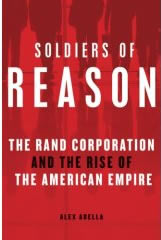
Soldiers of Reason: The RAND Corporation and the Rise of the American Empire
Alex Abella
Harcourt, 2008
400 pp.
The RAND Corporation of Santa Monica, Calif., was set up immediately after World War II by the U.S. Army Air Corps (soon to become the U.S. Air Force). The Air Force generals who had the idea were trying to perpetuate the wartime relationship that had developed between the scientific and intellectual communities and the American military, as exemplified by the Manhattan Project to develop and build the atomic bomb.
 Soon enough, however, RAND became a key institutional building block of the Cold War American empire. As the premier think tank for the U.S.’ role as hegemon of the Western world, RAND was instrumental in giving that empire the militaristic cast it retains to this day and in hugely enlarging official demands for atomic bombs, nuclear submarines, intercontinental ballistic missiles, and long-range bombers. Without RAND, our military-industrial complex, as well as our democracy, would look quite different.
Alex Abella, the author of Soldiers of Reason, is a Cuban-American living in Los Angeles who has written several well-received action and adventure novels set in Cuba and a less successful nonfiction account of attempted Nazi sabotage within the United States during World War II. The publisher of his latest book claims that it is “the first history of the shadowy think tank that reshaped the modern world.” Such a history is long overdue. Unfortunately, this book does not exhaust the demand. We still need a less hagiographic, more critical, more penetrating analysis of RAND’s peculiar contributions to the modern world.
Abella has nonetheless made a valiant, often revealing and original effort to uncover RAND’s internal struggles – not least of which involved the decision of analyst Daniel Ellsberg, in 1971, to leak the Department of Defense’s top secret history of the Vietnam War, known as The Pentagon Papers to Congress and the press. But Abella’s book is profoundly schizophrenic. On the one hand, the author is breathlessly captivated by RAND’s fast-talking economists, mathematicians, and thinkers-about-the-unthinkable; on the other hand, he agrees with Yale historian John Lewis Gaddis’ assessment in his book, The Cold War: A New History, that, in promoting the interests of the Air Force, RAND concocted an “unnecessary Cold War” that gave the dying Soviet empire an extra 30 years of life.
We need a study that really lives up to Abella’s subtitle and takes a more jaundiced view of RAND’s geniuses, Nobel prize winners, egghead gourmands and wine connoisseurs, Laurel Canyon swimming pool parties, and self-professed saviors of the Western world. It is likely that, after the American empire has gone the way of all previous empires, the RAND Corporation will be more accurately seen as a handmaiden of the government that was always super-cautious about speaking truth to power. Meanwhile, Soldiers of Reason is a serviceable, if often overwrought, guide to how strategy has been formulated in the post-World War II American empire.
The Air Force Creates a Think Tank
RAND was the brainchild of General H. H. “Hap” Arnold, chief of staff of the Army Air Corps from 1941 until it became the Air Force in 1947, and his chief wartime scientific adviser, the aeronautical engineer Theodore von Kármán. In the beginning, RAND was a freestanding division within the Douglas Aircraft Company which, after 1967, merged with McDonnell Aviation to form the McDonnell-Douglas Aircraft Corporation and, after 1997, was absorbed by Boeing. Its first head was Franklin R. Collbohm, a Douglas engineer and test pilot.
In May 1948, RAND was incorporated as a not-for-profit entity independent of Douglas, but it continued to receive the bulk of its funding from the Air Force. The think tank did, however, begin to accept extensive support from the Ford Foundation, marking it as a quintessential member of the American establishment.
Collbohm stayed on as chief executive officer until 1966, when he was forced out in the disputes then raging within the Pentagon between the Air Force and Secretary of Defense Robert McNamara. McNamara’s “whiz kids” were Defense intellectuals, many of whom had worked at RAND and were determined to restructure the armed forces to cut costs and curb interservice rivalries. Always loyal to the Air Force and hostile to the whiz kids, Collbohm was replaced by Henry S. Rowan, an MIT-educated engineer turned economist and strategist who was himself forced to resign during the Ellsberg-Pentagon Papers scandal.
Collbohm and other pioneer managers at Douglas gave RAND its commitment to interdisciplinary work and limited its product to written reports, avoiding applied or laboratory research, or actual manufacturing. RAND’s golden age of creativity lasted from approximately 1950 to 1970. During that period its theorists worked diligently on such new analytical techniques and inventions as systems analysis, game theory, reconnaissance satellites, the Internet, advanced computers, digital communications, missile defense, and intercontinental ballistic missiles. During the 1970s, RAND began to turn to projects in the civilian world, such as health financing systems, insurance, and urban governance.
Much of RAND’s work was always ideological, designed to support the American values of individualism and personal gratification as well as to counter Marxism, but its ideological bent was disguised in statistics and equations, which allegedly made its analyses “rational” and “scientific.” Abella writes:
“If a subject could not be measured, ranged, or classified, it was of little consequence in systems analysis, for it was not rational. Numbers were all – the human factor was a mere adjunct to the empirical.”
In my opinion, Abella here confuses numerical with empirical. Most RAND analyses were formal, deductive, and mathematical but rarely based on concrete research into actually functioning societies. RAND never devoted itself to the ethnographic and linguistic knowledge necessary to do truly empirical research on societies that its administrators and researchers, in any case, thought they already understood.
For example, RAND’s research conclusions on the Third World, limited war, and counterinsurgency during the Vietnam War were notably wrong-headed. It argued that the United States should support “military modernization” in underdeveloped countries, that military takeovers and military rule were good things, that we could work with military officers in other countries, where democracy was best honored in the breach. The result was that virtually every government in East Asia during the 1960s and 1970s was a U.S.-backed military dictatorship, including South Vietnam, South Korea, Thailand, the Philippines, Indonesia, and Taiwan.
It is also important to note that RAND’s analytical errors were not just those of commission – excessive mathematical reductionism – but also of omission. As Abella notes, “In spite of the collective brilliance of RAND there would be one area of science that would forever elude it, one whose absence would time and again expose the organization to peril: the knowledge of the human psyche.”
Following the axioms of mathematical economics, RAND researchers tended to lump all human motives under what the Canadian political scientist C. B. Macpherson called “possessive individualism” and not to analyze them further. Therefore, they often misunderstood mass political movements, failing to appreciate the strength of organizations like the Vietcong and its resistance to the RAND-conceived Vietnam War strategy of “escalated” bombing of military and civilian targets.
Similarly, RAND researchers saw Soviet motives in the blackest, most unnuanced terms, leading them to oppose the détente that President Richard Nixon and his National Security Adviser Henry Kissinger sought and, in the 1980s, vastly to overestimate the Soviet threat. Abella observes, “For a place where thinking the unthinkable was supposed to be the common coin, strangely enough there was virtually no internal RAND debate on the nature of the Soviet Union or on the validity of existing American policies to contain it. RANDites took their cues from the military’s top echelons.” A typical RAND product of those years was Nathan Leites’ The Operational Code of the Politburo (1951), a fairly mechanistic study of Soviet military strategy and doctrine and the organization and operation of the Soviet economy.
Collbohm and his colleagues recruited a truly glittering array of intellectuals for RAND, even if skewed toward mathematical economists rather than people with historical knowledge or extensive experience in other countries. Among the notables who worked for the think tank were the economists and mathematicians Kenneth Arrow, a pioneer of game theory; John Forbes Nash, Jr., later the subject of the Hollywood film A Beautiful Mind (01); Herbert Simon, an authority on bureaucratic organization; Paul Samuelson, author of Foundations of Economic Analysis (1947); and Edmund Phelps, a specialist on economic growth. Each one became a Nobel Laureate in economics.
Other major figures were Bruno Augenstein, who, according to Abella, made what is “arguably RAND’s greatest known – which is to say declassified – contribution to American national security: … the development of the ICBM as a weapon of war” (he invented the multiple independently targetable reentry vehicle, or MIRV); Paul Baran, who, in studying communications systems that could survive a nuclear attack, made major contributions to the development of the Internet and digital circuits; and Charles Hitch, head of RAND’s Economics Division from 1948 to 1961 and president of the University of California from 1967 to 1975.
Among more ordinary mortals, workers in the vineyard, and hangers-on at RAND were Donald Rumsfeld, a trustee of the Rand Corporation from 1977 to 2001; Condoleezza Rice, a trustee from 1991 to 1997; Francis Fukuyama, a RAND researcher from 1979 to 1980 and again from 1983 to 1989, as well as the author of the thesis that history ended when the United States outlasted the Soviet Union; Zalmay Khalilzad, the second President Bush’s ambassador to Afghanistan, Iraq, and the United Nations; and Samuel Cohen, inventor of the neutron bomb (although the French military perfected its tactical use).
Thinking the Unthinkable
The most notorious of RAND’s writers and theorists were the nuclear war strategists, all of whom were often quoted in newspapers and some of whom were caricatured in Stanley Kubrick’s 1964 film Dr. Strangelove, Or: How I Learned to Stop Worrying and Love the Bomb. (One of them, Herman Kahn, demanded royalties from Kubrick, to which Kubrick responded, “That’s not the way it works, Herman.”) RAND’s group of nuclear war strategists was dominated by Bernard Brodie, one of the earliest analysts of nuclear deterrence and author of Strategy in the Missile Age (1959); Thomas Schelling, a pioneer in the study of strategic bargaining, Nobel Laureate in economics, and author of The Strategy of Conflict (1960); James Schlesinger, secretary of defense from 1973 to 1975, who was fired by President Ford for insubordination; Kahn, author of On Thermonuclear War (1960); and last but not least, Albert Wohlstetter, easily the best known of all RAND researchers.
Abella calls Wohlstetter “the leading intellectual figure at RAND,” and describes him as “self-assured to the point of arrogance.” Wohlstetter, he adds, “personified the imperial ethos of the mandarins who made America the center of power and culture in the postwar Western world.”
While Abella does an excellent job ferreting out details of Wohlstetter’s background, his treatment comes across as a virtual paean to the man, including Wohlstetter’s late-in-life turn to the political right and his support for the neoconservatives. Abella believes that Wohlstetter’s “basing study,” which made both RAND and him famous (and which I discuss below), “changed history.”
Starting in 1967, I was, for a few years – my records are imprecise on this point – a consultant for RAND (although it did not consult me often) and became personally acquainted with Albert Wohlstetter. In 1967, he and I attended a meeting in New Delhi of the Institute of Strategic Studies to help promote the Nuclear Non-Proliferation Treaty (NPT), which was being opened for signature in 1968, and would be in force from 1970. There, Wohlstetter gave a display of his well-known arrogance by announcing to the delegates that he did not believe India, as a civilization, “deserved an atom bomb.” As I looked at the smoldering faces of Indian scientists and strategists around the room, I knew right then and there that India would join the nuclear club, which it did in 1974. (India remains one of four major nations that have not signed the NPT. The others are North Korea, which ratified the treaty but subsequently withdrew, Israel, and Pakistan. Some 189 nations have signed and ratified it.) My last contact with Wohlstetter was late in his life – he died in 1997 at the age of 83 – when he telephoned me to complain that I was too “soft” on the threats of communism and the former Soviet Union.
Albert Wohlstetter was born and raised in Manhattan and studied mathematics at the City College of New York and Columbia University. Like many others of that generation, he was very much on the Left and, according to research by Abella, was briefly a member of a Communist splinter group, the League for a Revolutionary Workers Party. He avoided being ruined in later years by Sen. Joseph McCarthy and J. Edgar Hoover’s FBI because, as Daniel Ellsberg told Abella, the evidence had disappeared. In 1934, the leader of the group was moving the Party’s records to new offices and had rented a horse-drawn cart to do so. At a Manhattan intersection, the horse died, and the leader promptly fled the scene, leaving all the records to be picked up and disposed of by the New York City sanitation department.
After World War II, Wohlstetter moved to southern California, and his wife Roberta began work on her pathbreaking RAND study, Pearl Harbor: Warning and Decision (1962), exploring why the U.S. had missed all the signs that a Japanese “surprise attack” was imminent. In 1951, he was recruited by Charles Hitch for RAND’s Mathematics Division, where he worked on methodological studies in mathematical logic until Hitch posed a question to him: “How should you base the Strategic Air Command?”
Wohlstetter then became intrigued by the many issues involved in providing airbases for Strategic Air Command (SAC) bombers, the country’s primary retaliatory force in case of nuclear attack by the Soviet Union. What he came up with was a comprehensive and theoretically sophisticated basing study. It ran directly counter to the ideas of Gen. Curtis LeMay, then the head of SAC, who, in 1945, had encouraged the creation of RAND and was often spoken of as its “Godfather.”
In 1951, there were a total of 32 SAC bases in Europe and Asia, all located close to the borders of the Soviet Union. Wohlstetter’s team discovered that they were, for all intents and purposes, undefended – the bombers parked out in the open, without fortified hangars – and that SAC’s radar defenses could easily be circumvented by low-flying Soviet bombers. RAND calculated that the USSR would need “only” 120 tactical nuclear bombs of 40 kilotons each to destroy up to 85 percent of SAC’s European-based fleet. LeMay, who had long favored a preemptive attack on the Soviet Union, claimed he did not care. He reasoned that the loss of his bombers would only mean that – even in the wake of a devastating nuclear attack – they could be replaced with newer, more modern aircraft. He also believed that the appropriate retaliatory strategy for the United States involved what he called a “Sunday punch,” massive retaliation using all available American nuclear weapons. According to Abella, SAC planners proposed annihilating three-quarters of the population in each of 188 Russian cities. Total casualties would be in excess of 77 million people in the Soviet Union and Eastern Europe alone.
Wohlstetter’s answer to this holocaust was to start thinking about how a country might actually wage a nuclear war. He is credited with coming up with a number of concepts, all now accepted U.S. military doctrine. One is “second-strike capability,” meaning a capacity to retaliate even after a nuclear attack, which is considered the ultimate deterrent against an enemy nation launching a first-strike. Another is “fail-safe procedures,” or the ability to recall nuclear bombers after they have been dispatched on their missions, thereby providing some protection against accidental war. Wohlstetter also championed the idea that all retaliatory bombers should be based in the continental United States and able to carry out their missions via aerial refueling, although he did not advocate closing overseas military bases or shrinking the perimeters of the American empire. To do so, he contended, would be to abandon territory and countries to Soviet expansionism.
Wohlstetter’s ideas put an end to the strategy of terror attacks on Soviet cities in favor of a “counter-force strategy” that targeted Soviet military installations. He also promoted the dispersal and “hardening” of SAC bases to make them less susceptible to preemptive attacks and strongly supported using high-altitude reconnaissance aircraft such as the U-2 and orbiting satellites to acquire accurate intelligence on Soviet bomber and missile strength.
In selling these ideas Wohlstetter had to do an end-run around SAC’s LeMay and go directly to the Air Force chief of staff. In late 1952 and 1953, he and his team gave some 92 briefings to high-ranking Air Force officers in Washington, D.C. By October 1953, the Air Force had accepted most of Wohlstetter’s recommendations.
Abella believes that most of us are alive today because of Wohlstetter’s intellectually and politically difficult project to prevent a possible nuclear first strike by the Soviet Union. He writes:
“Wohlstetter’s triumphs with the basing study and fail-safe not only earned him the respect and admiration of fellow analysts at RAND but also gained him entry to the top strata of government that very few military analysts enjoyed. His work had pointed out a fatal deficiency in the nation’s war plans, and he had saved the Air Force several billion dollars in potential losses.”
A few years later, Wohlstetter wrote an updated version of the basing study and personally briefed Secretary of Defense Charles Wilson on it, with Gen. Thomas D. White, the Air Force chief of staff, and Gen. Nathan Twining, chairman of the Joint Chiefs of Staff, in attendance.
Despite these achievements in toning down the official Air Force doctrine of “mutually assured destruction” (MAD), few at RAND were pleased by Wohlstetter’s eminence. Bernard Brodie had always resented his influence and was forever plotting to bring him down. Still, Wohlstetter was popular compared to Herman Kahn. All the nuclear strategists were irritated by Kahn, who ultimately left RAND and created his own think tank, the Hudson Institute, with a million-dollar grant from the Rockefeller Foundation.
RAND chief Frank Collbohm opposed Wohlstetter because his ideas ran counter to those of the Air Force, not to speak of the fact that he had backed John F. Kennedy instead of Richard Nixon for president in 1960 and then compounded his sin by backing Robert McNamara for secretary of defense over the objections of the high command. Worse yet, Wohlstetter had criticized the stultifying environment that had begun to envelop RAND.
In 1963, in a fit of pique and resentment fueled by Bernard Brodie, Collbohm called in Wohlstetter and asked for his resignation. When Wohlstetter refused, Collbohm fired him.
Wohlstetter went on to accept an appointment as a tenured professor of political science at the University of Chicago. From this secure position, he launched vitriolic campaigns against whatever administration was in office “for its obsession with Vietnam at the expense of the current Soviet threat.” He, in turn, continued to vastly overstate the threat of Soviet power and enthusiastically backed every movement that came along calling for stepped up war preparations against the USSR – from members of the Committee on the Present Danger between 1972 to 1981 to the neoconservatives in the 1990s and 2000s.
Naturally, he supported the creation of “Team B” when George H. W. Bush was head of the CIA in 1976. Team B consisted of a group of anti-Soviet professors and polemicists who were convinced that the CIA was “far too forgiving of the Soviet Union.” With that in mind, they were authorized to review all the intelligence that lay behind the CIA’s National Intelligence Estimates on Soviet military strength. Actually, Team B and similar right-wing ad hoc policy committees had their evidence exactly backwards: By the late 1970s and 1980s, the fatal sclerosis of the Soviet economy was well underway. But Team B set the stage for the Reagan administration to do what it most wanted to do, expend massive sums on arms; in return, Ronald Reagan bestowed the Presidential Medal of Freedom on Wohlstetter in November 1985.
Imperial U.
Wohlstetter’s activism on behalf of American imperialism and militarism lasted well into the 1990s. According to Abella, the rise to prominence of Ahmed Chalabi – the Iraqi exile and endless source of false intelligence to the Pentagon – “in Washington circles came about at the instigation of Albert Wohlstetter, who met Chalabi in Paul Wolfowitz’s office.” (In the incestuous world of the neocons, Wolfowitz had been Wohlstetter’s student at the University of Chicago.) In short, it is not accidental that the American Enterprise Institute, the current chief institutional manifestation of neoconservative thought in Washington, named its auditorium the Wohlstetter Conference Center. Albert Wohlstetter’s legacy is, to say the least, ambiguous.
Needless to say, there is much more to RAND’s work than the strategic thought of Albert Wohlstetter, and Abella’s book is an introduction to the broad range of ideas RAND has espoused – from “rational choice theory” (explaining all human behavior in terms of self-interest) to the systematic execution of Vietnamese in the CIA’s Phoenix Program during the Vietnam War. As an institution, the RAND Corporation remains one of the most potent and complex purveyors of American imperialism. A full assessment of its influence, both positive and sinister, must await the elimination of the secrecy surrounding its activities and further historical and biographical analysis of the many people who worked there.
The RAND Corporation is surely one of the world’s most unusual, Cold War-bred private organizations in the field of international relations. While it has attracted and supported some of the most distinguished analysts of war and weaponry, it has not stood for the highest standards of intellectual inquiry and debate. While RAND has an unparalleled record of providing unbiased, unblinking analyses of technical and carefully limited problems involved in waging contemporary war, its record of advice on cardinal policies involving war and peace, the protection of civilians in wartime, arms races, and decisions to resort to armed force has been abysmal.
For example, Abella credits RAND with “creating the discipline of terrorist studies,” but its analysts seem never to have noticed the phenomenon of state terrorism as it was practiced in the 1970s and 1980s in Latin America by American-backed military dictatorships. Similarly, admirers of Albert Wohlstetter’s reformulations of nuclear war ignore the fact that that these led to a “constant escalation of the nuclear arms race.” By 1967, the U.S. possessed a stockpile of 32,500 atomic and hydrogen bombs.
In Vietnam, RAND invented the theories that led two administrations to military escalation against North Vietnam – and even after the think tank’s strategy had obviously failed and the secretary of defense had disowned it, RAND never publicly acknowledged that it had been wrong. Abella comments, “RAND found itself bound by the power of the purse wielded by its patron, whether it be the Air Force or the Office of the Secretary of Defense.” And it has always relied on classifying its research to protect itself, even when no military secrets were involved.
In my opinion, these issues come to a head over one of RAND’s most unusual initiatives – its creation of an in-house, fully accredited graduate school of public policy that offers Ph.D. degrees to American and foreign students. Founded in 1970 as the RAND Graduate Institute and today known as the Frederick S. Pardee RAND Graduate School (PRGS), it had, by January 2006, awarded over 180 Ph.D.s in microeconomics, statistics, and econometrics, social and behavioral sciences, and operations research. Its faculty numbers 54 professors drawn principally from the staffs of RAND’s research units, and it has an annual student body of approximately 900. In addition to coursework, qualifying examinations, and a dissertation, PRGS students are required to spend 400 days working on RAND projects. How RAND and the Air Force can classify the research projects of foreign and American interns is unclear; nor does it seem appropriate for an open university to allow dissertation research, which will ultimately be available to the general public, to be done in the hothouse atmosphere of a secret strategic institute. 
Perhaps the greatest act of political and moral courage involving RAND was Daniel Ellsberg’s release to the public of the secret record of lying by every president from Dwight D. Eisenhower to Lyndon Johnson about the U.S. involvement in Vietnam. However, RAND itself was and remains adamantly hostile to what Ellsberg did.
Abella reports that Charles Wolf Jr. the chairman of RAND’s Economics Department from 1967 to 1982 and the first dean of the RAND Graduate School from 1970 to 1997, “dripped venom when interviewed about the [Ellsberg] incident more than thirty years after the fact.” Such behavior suggests that secrecy and toeing the line are far more important at RAND than independent intellectual inquiry and that the products of its research should be viewed with great skepticism and care.
Chalmers Johnson’s latest book is Nemesis: The Last Days of the American Republic, now available in a Holt Paperback. It is the third volume of his Blowback Trilogy. To view a short video of Johnson discussing military Keynesianism and imperial bankruptcy, click here.
Copyright 2008 Chalmers Johnson
