



Last fall was a great time for official optimism when it came to Iraq. The military “metrics” looked ever better and, as had happened at crucial moments in 2003, 2004, 2005, 2006, and 2007, Bush administration and military statements turned practically peachy with the blush of “success.” Progress was announced (repeatedly). Corners were once again about to be turned. Tipping points were on the absolute verge of being reached. “I’ve never been more optimistic than I am right now with the progress we’ve made in Iraq,” effused Maj. Gen. Rick Lynch, commander of the 3rd Infantry Division, late that October. Lt. Col. Val Keaveny, 3rd Batallion, 509th infantry, offered this over-the-top mixed metaphor: “[Iraqis] are fed up with fear. Once they hit that tipping point, they’re fed up, they come to realize we truly do provide them better hope for the future. What we’re seeing now is the beginning of a snowball.” That same month, Chairman of the Joint Chiefs Adm. Mike Mullen, citing a butcher in the suburbs of Baghdad who had seen his business rise from selling one sheep a week to one a day, said: “I don’t want to overly state it… but it’s starting to happen.”
And then there was George W. Bush, the man who, in November 2005, more than two and a half years after he ordered the invasion of Iraq, launched his “strategy for victory in Iraq” with a speech, wielding the word “victory” 15 times and who, in January 2007, launched his “new way forward in Iraq” (aka his “surge” strategy) in an address to the nation in which he used “victory” a mere two times. On November 2, 2007, the President offered this bit of good cheer to a gathering of 1,300 soldiers graduating from basic training at Fort Jackson, South Carolina, and likely headed for Iraq (or Afghanistan): “Slowly but surely, the people of Iraq are reclaiming a normal society.”
To celebrate that return to normalcy and, undoubtedly, all the corners so far turned and points tipped, the U.S. military has, in the last two months, fired at least 200 Hellfire missiles into the Iraqi capital, according to the Washington Post, most of them into Sadr City, the vast, heavily populated Shiite slum in east Baghdad. (“Just six” had been used in Baghdad in the previous three months.) Perhaps it was on the basis of such celebrations of normalcy that Senator John McCain recently promised Americans victory in Iraq in a mere four and a half years. He even offered a likely date: January 2013. Something to look forward to.
It takes an expert, of course, to make sense of these repeated demonstrations of Washingtonian and military expertise. Fortunately, Tomdispatch had two experts lurking in the wings, Christopher Cerf and former Nation editor and publisher Victor Navasky of the eminently respected and respectable Institute of Expertology. They have recently produced a rollicking ride through Bush administration expertise – a compendium of the quotes that launched a thousand ships and that you simply can’t believe anyone actually said. (“A turning point will come two weeks from today.” George W. Bush, June 16, 2004.) Its title: Mission Accomplished! Or How We Won the War in Iraq: The Experts Speak. They seemed the perfect duo to put Senator McCain’s particular brand of expertise in context. Tom
McCain (Mis)Speaks
How the Senator Won the War of Words in Iraq (again and again and again?)
By Christopher Cerf and Victor S. Navasky
The Iraq war was a disaster for Iraq, a disaster for the United States, a disaster for the Middle East, a disaster for the world community, but most of all, it was a disaster for the experts.
They were wrong about its difficulty. (It was to be either “a cakewalk” or “a walk in the park” – take your pick). They were wrong about how our troops would be greeted (“as liberators” said Vice President Dick Cheney on September, 14, 2003; “with kites and boom boxes” wrote Professor Fouad Ajami on October 7, 2002). They were wrong about weapons of mass destruction. (“Iraq not only hasn’t accounted for its weapons of mass destruction but without a doubt still retains them. Only a fool – or possibly a Frenchman – could conclude otherwise” wrote Washington Post columnist Richard Cohen on February 6, 2003.) They were wrong about how many troops would be needed. (“It’s hard to conceive that it would take more forces to provide stability in post-Saddam Iraq than it would take to conduct a war itself,” said Deputy Secretary of Defense Paul Wolfowitz on Feb 27, 2003.)
They were wrong about the number of casualties. (“…we’re not going to have any casualties,” said President George W. Bush in March, 2003). They were wrong about how much it would cost. (“The costs of any intervention would be very small,” according to White House economic advisor Glenn Hubbard on October 4, 2002). They were wrong about how long it would last. (“It isn’t going to be over in 24 hours, but it isn’t going to be months either,” claimed Richard Perle on July 11, 2002.) They were wrong about the “sinister nexus between Iraq and the Al Qaeda terrorist network,” as Secretary of State Colin Powell put it in addressing the UN Security Council on February 5, 2003. They were wrong about the likelihood of Iraq descending into civil war. (“[There is] a broad Iraqi consensus favoring the idea of pluralism,” insisted William Kristol and Robert Kagan on March 22, 2004.) There was, in fact, very little they were not wrong about.
Who are we to make such charges? Not to be boastful, we are, respectfully, the CEO and president – the founders, as it were – of the Institute of Expertology, which has been surveying expert opinion for almost 25 years. It is true that our initial study, The Experts Speak: The Definitive Guide to Authoritative Misinformation, came under attack back in 1990 because, at the time, we failed to find a single expert who was right, although we readily conceded that, in statistical theory, it was possible that the experts were right as much as half the time. It just proved exceedingly difficult to find evidence of that other 50%.
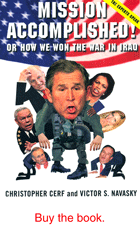 In Mission Accomplished!, our new study of the experts – people who, by virtue of their official status, formal title, academic degree, professional license, public office, journalistic beat, quantity of publications, experience, and/or use of highly technical jargon, are presumed to know what they are talking about – we once again came under attack from critics who claimed that our failure to include any misstatements by Senator Barack Obama betrayed a political bias. These allegations were quickly refuted. Everybody knows that Obama has no experience and therefore does not qualify as an expert. Senator Hillary Clinton, who voted to authorize the Iraq war, did make the cut, but the presidential candidate-cum-expert of genuine interest is Senator John McCain.
At first, we were impressed by the senator’s statements in Republican primary debates about how he had actually opposed the Bush administration’s conduct of the war from the start. As he told CNN’s Kiran Chetry, in August of 2007, “I was the greatest critic of the initial four years, three-and-a half years.”
Well, having dug into those missing years a bit, here, for the record, is what we found to be Senator McCain’s typical responses to some of the key questions posed above:
How would American troops be greeted?: “I believe? that the Iraqi people will greet us as liberators.” (March 20, 2003)
Did Saddam Hussein have a nuclear program that posed an imminent threat to the United States?: “Saddam Hussein is on a crash course to construct a nuclear weapon.” (October 10, 2002)
Will a war with Iraq be long or short?: “This conflict is? going to be relatively short.” (March 23, 2003)
How is the war going?: “I would argue that the next three to six months will be critical.” (September 10, 2003)
How is it going (almost two months later, from the war’s “greatest critic”)? “I think the initial phases of [the war] were so spectacularly successful that it took us all by surprise.” (October 31, 2003)
Is this war really necessary?: “Only the most deluded of us could doubt the necessity of this war.” (August 30, 2004)
How is it going? (Recurring question for the war’s “greatest critic”): “We will probably see significant progress in the next six months to a year.” (December 4, 2005)
Will the President’s “surge” of troops into Baghdad and surrounding areas that the senator had been calling for finally make the difference?: “We can know fairly well [whether the surge is working] in a few months.” (February 4, 2007)
In April 2007, accompanied by several members of Congress, Senator McCain made a surprise visit to Baghdad to assess the surge, had a “stroll” through a market in the Iraqi capital, and then held a news conference where he discussed what he found: “Things are better and there are encouraging signs. I’ve been here many times over the years. Never have I been able to drive from the airport. Never have I been able to go out into the city as I was today. The American people are not getting the full picture of what’s happening here today.”
The next evening, NBC’s Nightly News provided further details on that “stroll.” The Senator and Congressmen were accompanied by “100 American soldiers, with three Blackhawk helicopters, and two Apache gunships overhead.” (In addition, the network said, still photographs provided by the military revealed that McCain and his colleagues had been wearing body armor during their entire stroll.)
Reality check: Five months later, on September 12, 2007, McCain again observed that “the next six months are going to be critical.”
Six months later, McCain claimed that the U.S. had finally reached a genuine turning point in Iraq and that his faith in the surge was (once again) vindicated. On March 17, 2008, he reported: “We are succeeding. And we can succeed and American casualties overall are way down. That is in direct contradiction to predictions made by the Democrats and particularly Senator Obama and Senator Clinton. I will be glad to stake my campaign on the fact that this has succeeded and the American people appreciate it.”
Well, we at the Institute of Expertology appreciate it, too, and we are, of course, pleased to record the Senator’s ever-renewable faith in this latest turning point. As scrupulous scholars, however, we do feel compelled to add that the Senator is not the first to detect such a turning point. Indeed on July 7, 2003, Undersecretary of Defense for Policy Douglas J. Feith said: “This month will be a political turning point for Iraq.”
On November 6, 2003, President Bush observed: “We’ve reached another great turning point…” On June 16, 2004, President Bush claimed: “A turning point will come two weeks from today.”
That same day the Montreal Gazette headlined an editorial by neoconservative columnist Max Boot: “Despite the Negative Reaction by Much of the Media, U.S. Marines Did a Good Job in Fallujah, a Battle That Might Prove a Turning Point.” On February 2, 2005, Secretary of Defense Donald Rumsfeld stated: “On January 30th in Iraq, the world witnessed an important moment in the global struggle against tyranny, a moment that historians might one day call a major turning point.” On March 7, 2005 William Kristol wrote: “[T]he Iraqi election of January 30, 2005… will turn out to have been a genuine turning point.”
On December 18, as that year ended, Vice President Cheney, while conceding that “the level of violence has continued,” assured ABC News: “I do believe that when we look back on this period of time, 2005 will have been the turning point…”
The Institute continued to record turning points in remarkable numbers in 2006, and 2007, but perhaps in 2008 the surge will, indeed, turn out to be the turning point to end all turning points. After all, Senator McCain has staked his campaign on it.
Christopher Cerf and Victor S. Navasky are the co-authors of the recently published Mission Accomplished! Or How We Won the War in Iraq: The Experts Speak, which provided the basis for this essay. Their previous book, also a product of The Institute of Expertology, is The Experts Speak: The Definitive Compendium of Authoritative Misinformation. They appeared recently on Bill Moyers Journal.
Copyright 2008 Christopher Cerf and Victor S. Navasky
