



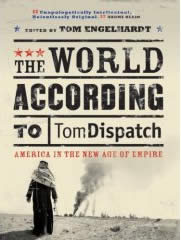
[Note for TomDispatch readers: It’s worth mentioning that the missing Iraqi oil story – see below – wasn’t missing online, and certainly not at TomDispatch. This site’s newest book, The World According to TomDispatch: America in the New Age of Empire, has a section labeled “The Petro-Industrial Complex and its Discontents,” including striking pieces by Michael Klare and Michael Schwartz on our gasoholic Pentagon and the prize of Iraqi oil. Again, I urge readers to consider supporting TomDispatch and its efforts by picking up a book that should, I think, be in any serious library of our mad age of Bush the Younger. Tom]
More than five years after the invasion of Iraq – just in case you were still waiting – the oil giants finally hit the front page…
Last Thursday, the New York Times led with this headline: “Deals With Iraq Are Set to Bring Oil Giants Back.” (Subhead: “Rare No-Bid Contracts, a Foothold for Western Companies Seeking Future Rewards.”) And who were these four giants? ExxonMobil, Shell, the French company Total, and BP (formerly British Petroleum). What these firms got were mere “service contracts” – as in servicing Iraq’s oil fields – not the sort of “production sharing agreements” that President Bush’s representatives in Baghdad once dreamed of, and that would have left them in charge of those fields. Still, it was clearly a start. The Times reporter, Andrew E. Kramer, added this little detail: “[The contracts] include a provision that could allow the companies to reap large profits at today’s prices: the [Iraqi oil] ministry and companies are negotiating payment in oil rather than cash.” And here’s the curious thing, exactly these four giants “lost their concessions in Iraq” back in 1972 when that country’s oil was nationalized. Hmmm.
You’d think the Times might have slapped some kind of “we wuz wrong” label on the piece. I mean, remember when the mainstream media, the Times included, seconded the idea that Bush’s invasion, whatever it was about – weapons of mass destruction or terrorism or liberation or democracy or bad dictators or… well, no matter – you could be sure of one thing: it wasn’t about oil. “Oil” wasn’t a word worth including in serious reporting on the invasion and its aftermath, not even after it turned out that American troops entering Baghdad guarded only the Oil and Interior Ministries, while the rest of the city was looted. Even then – and ever after – the idea that the Bush administration might have the slightest urge to control Iraqi oil (or the flow of Middle Eastern oil via a well-garrisoned Iraq) wasn’t worth spending a few paragraphs of valuable newsprint on.
I always thought that, if Iraq’s main product had been video games, sometime in the last five years the Times (and other major papers) would have had really tough, thoughtful pieces, asking really tough, thoughtful questions, about the effects of the invasion and ensuing chaos on our children’s lives and the like. But oil, well… After all, with global demand for energy on the rise, why would anybody want to invade, conquer, occupy, and garrison a country that, as Deputy Secretary of Defense Paul Wolfowitz once observed, “floats on a sea of oil”?
And let’s be fair. At the time of the impending invasion, reasonable people couldn’t possibly have imagined that it had anything to do with oil, not while George W. Bush was politely ignoring the subject, except when referring obliquely to Iraq’s “patrimony” of “natural resources.” Forget that our president had had an 11-year career in the energy business (and had been Arbusto-ed); or that his vice president had been the CEO of a giant energy services corporation, Halliburton – retiring during the presidential campaign of 2000 with a $34 million severance package; or that, back in those distant years, he had not hesitated to talk about the necessity of getting a tad more oil into the international pipeline. (As he told an oil industry crowd back in 1999, “By some estimates there will be an average of two percent annual growth in global oil demand over the years ahead along with conservatively a three percent natural decline in production from existing reserves. That means by 2010 we will need on the order of an additional 50 million barrels a day. So where is the oil going to come from?” Where indeed? He then answered his own question: “While many regions of the world offer great oil opportunities, the Middle East, with two-thirds of the world’s oil and the lowest cost, is still where the prize ultimately lies.”)
Or how about the president’s national security adviser, who was on the board of Chevron and had a double-hulled oil tanker, the Condoleezza Rice, named after her in the oh-so-innocent 1990s. Forget as well the veep’s secret energy task force of 2000 (also starring ExxonMobil and pals) which recommended that the new administration turn its good offices to convincing Middle Eastern countries “to open up areas of their energy sectors to foreign investment.” Forget it all and be fair.
After all, the only people who thought that oil might have something to do with the invasion of Iraq weren’t on the Times staff. They weren’t, in fact, in the mainstream at all. And, to put things into context, depending on your estimates, there were only somewhere between 11 million and 30 million of them marching around in the streets of cities and towns all over the planet before the invasion, carrying signs that said ludicrous, easily dismissible things like: “No Blood for Oil,” “How did USA’s oil get under Iraq’s sand?,” and “Don’t trade lives for oil!”
Let’s face it: Among those who counted, they – with their simpleminded slogans on hand-lettered placards – just didn’t count at all. Not when everyone who was anyone knew that the world was a much, much, much subtler and much, much more complicated place. No blood for oil? Sure, it was short and snappy and easy enough to get on a sign, but also about as absurdly reductionist, as unsubtle, as uncomplicated as possible.
 I mean, really! And, worse yet, that thoughtless crew of demonstrators had the nerve to suspect – prospectively, not retrospectively – the worst of the Bush administration, even when their betters, men (and a few women) with so many years of experience in the ways of Washington and the world, were ready to give its top officials the benefit of the doubt. Waving those silly signs, they actually expected bad things to happen. It didn’t seem to matter to them that the president, vice president, national security adviser, and secretary of defense assured them no such thing was possible; assured them, in fact, that not to invade would lead to mushroom clouds over American cities and Iraqi unmanned aerial vehicles spraying bio- or chemical weaponry along the east coast of the United States.
No wonder those masses of naïve demonstrators have been erased from the blackboard of history. No wonder, since the invasion, the Times hasn’t bothered to attend to them seriously again. No wonder, on the fifth anniversary of the Bush administration’s “cakewalk” to victory in Baghdad, the newspaper’s op-ed page turned to L. Paul Bremer III, Richard Perle, and others from the crew that got us into Iraq, or cheered the administration on, to comment on what had gone wrong, while skipping the crew in the streets that got it right in the first place.
Now, with a barrel of crude selling at more than quadruple its prewar price, more than double its price a mere year ago, the oil majors are finally moving in for the… well, let’s not say “kill,” let’s just say that tasty little sip of the ol’ patrimony.
And, by the way, here’s how Times reporter Kramer, in a single paragraph, managed to (barely) reintroduce those missing prewar demonstrators, while sidling up to reality and history: “There was suspicion,” he wrote, “among many in the Arab world [notoriously suspicious types, of course] and among parts of the American public that the United States had gone to war in Iraq precisely to secure the oil wealth these contracts seek to extract. The Bush administration has said that the war was necessary to combat terrorism. It is not clear what role the United States played in awarding the contracts; there are still American advisers to Iraq’s Oil Ministry.”
Arabs with suspicions and unidentified “parts” of the American public, all in the same sentence. Still sounds dismissible to me. Well, you know those types. They deserve no less. They’re the sorts who might even be suspicious of “American advisers to Iraq’s Oil Ministry,” or, yet more absurdly, of those “no-bid” contracts for the oil majors – and just because it was in the DNA of the Bush administration to award similar no-bid contracts to corporate cronies like… uh… Halliburton. But the odds are that “the Iraqis” who awarded those contracts probably just knew a good idea when they saw one up close and personal over so many years.
And now, here we are. Sure, it’s kinda thoughtless, kinda embarrassing, and yet so typical of ExxonMobil and Co. not to care about making all those pundits and knowledgeable observers look really, really bad. What an unfortunate coincidence, this story breaking just now, don’t you think? I mean, after all that blood, American and Iraqi, has been spilled, here comes the oil.
It’s the sort of thing that could make suspicious Arabs even more so and give a new life to some really dumb slogans in the U.S. But you know, sometimes, if you’re an oil giant, you just have to bite the bullet. After all, there’s still one heck of a lot of that patrimonial oil in Iraq’s ground. At more than $130 a barrel, someone has to get it out – and why not, as Kramer puts it, “Western companies with experience managing large projects”? I mean, after all these years, why not?
[Note on further reading: In its follow-up piece on the “no-bid” contracts, the Washington Post added a fifth oil giant, Chevron, to the list and managed, as well, to include this already familiar paragraph: “A higher-profile role for Western companies in Iraq’s oil industry is likely to revive speculation that the Iraq war was motivated by a desire to tap into reserves that were controlled by foreigners until the 1960s, when the industry was nationalized. The belief is widespread in the Arab world.” Like some cameo role in a film, this cameo paragraph is evidently all that’s now left of the largest prewar antiwar movement in history. For some good background on the history of Western exploitation of Iraqi oil and its subsequent nationalization, check out Juan Cole’s “They’re Baaack…” at his Informed Comment blog. (And, while you’re at it, don’t miss his recent devastating description of “the real state of Iraq.”) A good source to consult for regular Iraqi oil news is Ben Lando’s Iraq Oil Report.]
Copyright 2008 Tom Engelhardt
