



We are now in an America where it’s a commonplace for our president, wearing a “jacket with ARMY printed over his heart and ‘Commander in Chief’ printed on his right front,” to address vast assemblages of American troops on the virtues of bringing democracy to foreign lands at the point of a missile. As Jim VandeHei of the Washington Post puts it: “Increasingly, the president uses speeches to troops to praise American ideals and send a signal to other nations the administration is targeting for democratic change.”
As it happens, the Bush administration has other signals of “change,” no less militarized, that are even blunter. We already have, for instance, hundreds and hundreds of military bases, large and small, spread around the world, but never enough, never deeply embedded enough in the former borderlands of the Soviet Union and the energy heartlands of our planet. The military budget soars; planning for high-tech weaponry for the near and distant futures – like the Common Aero Vehicle, a suborbital space capsule capable of delivering “conventional” munitions anywhere on the planet within two hours and due to come on line by 2010 – is the normal order of business in Pentagonized Washington. War, in fact, is increasingly the American way of life and, to a certain extent, it’s almost as if no one notices.
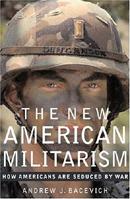
Well, not quite no one. Andrew J. Bacevich has written a book on militarism, American-style, of surpassing interest. Just published, The New American Militarism, How Americans Are Seduced by War would be critical reading no matter who wrote it. But coming from Bacevich, a West Point graduate, Vietnam veteran, former contributor to such magazines as the Weekly Standard and the National Review, and former Bush Fellow at the American Academy in Berlin, it has special resonance.
Bacevich, a self-professed conservative, has clearly been a man on a journey. He writes that he still situates himself “culturally on the Right. And I continue to view the remedies proffered by mainstream liberalism with skepticism. But my disenchantment with what passes for mainstream conservatism, embodied in the present Bush administration and its groupies, is just about absolute. Fiscal irresponsibility, a buccaneering foreign policy, a disregard for the Constitution, the barest lip service as a response to profound moral controversies: these do not qualify as authentically conservative values. On this score my views have come to coincide with the critique long offered by the radical Left: it is the mainstream itself, the professional liberals as well as the professional conservatives who define the problem.”
I’ve long recommended Chalmers Johnson’s book on American militarism and military-basing policy, The Sorrows of Empire. Bacevich’s The New American Militarism, which focuses on the ways Americans have become enthralled by, and found themselves in thrall to, military power and the idea of global military supremacy, should be placed right beside it in any library. Below, you’ll find the first of two long excerpts from the book, slightly adapted and posted with the kind permission of the author and of his publisher, Oxford University Press. This one introduces Bacevich’s thoughts on the ways in which, since the Vietnam War, our country has been militarized, a development to which, as he writes, the events of September 11 only added momentum. On Friday, I’ll post an excerpt on the second-generation neoconservatives and what they contributed to our new militarism.
Bacevich’s book carefully lays out and analyzes the various influences that have fed into the creation and sustenance of the new American militarism. It would have been easy enough to create a four-part or six-part TomDispatch series from the book. Bacevich is, for instance, fascinating on evangelical Christianity (and its less-than-warlike earlier history) as well as on the ways in which the military, after the Vietnam debacle, rebuilt itself as a genuine imperial force, separated from the American people and with an ethos “more akin to that of the French Foreign Legion”; a force prepared for war without end. But for that, and much else, you’ll have to turn to the book itself. Tom
The Normalization of War
by Andrew J. Bacevich
At the end of the Cold War, Americans said yes to military power. The skepticism about arms and armies that pervaded the American experiment from its founding, vanished. Political leaders, liberals and conservatives alike, became enamored with military might.
 The ensuing affair had and continues to have a heedless, Gatsby-like aspect, a passion pursued in utter disregard of any consequences that might ensue. Few in power have openly considered whether valuing military power for its own sake or cultivating permanent global military superiority might be at odds with American principles. Indeed, one striking aspect of America’s drift toward militarism has been the absence of dissent offered by any political figure of genuine stature.
For example, when Senator John Kerry, Democrat of Massachusetts, ran for the presidency in 2004, he framed his differences with George W. Bush’s national security policies in terms of tactics rather than first principles. Kerry did not question the wisdom of styling the U.S. response to the events of 9/11 as a generations-long “global war on terror.” It was not the prospect of open-ended war that drew Kerry’s ire. It was rather the fact that the war had been “extraordinarily mismanaged and ineptly prosecuted.” Kerry faulted Bush because, in his view, U.S. troops in Iraq lacked “the preparation and hardware they needed to fight as effectively as they could.” Bush was expecting too few soldiers to do too much with too little. Declaring that “keeping our military strong and keeping our troops as safe as they can be should be our highest priority,” Kerry promised if elected to fix these deficiencies. Americans could count on a President Kerry to expand the armed forces and to improve their ability to fight.
Yet on this score, Kerry’s circumspection was entirely predictable. It was the candidate’s way of signaling that he was sound on defense and had no intention of departing from the prevailing national security consensus.
Under the terms of that consensus, mainstream politicians today take as a given that American military supremacy is an unqualified good, evidence of a larger American superiority. They see this armed might as the key to creating an international order that accommodates American values. One result of that consensus over the past quarter century has been to militarize U.S. policy and to encourage tendencies suggesting that American society itself is increasingly enamored with its self-image as the military power nonpareil
How Much Is Enough?
This new American militarism manifests itself in several different ways. It does so, first of all, in the scope, cost, and configuration of America’s present-day military establishment.
Through the first two centuries of U.S. history, political leaders in Washington gauged the size and capabilities of America’s armed services according to the security tasks immediately at hand. A grave and proximate threat to the nation’s well-being might require a large and powerful military establishment. In the absence of such a threat, policymakers scaled down that establishment accordingly. With the passing of crisis, the army raised up for the crisis went immediately out of existence. This had been the case in 1865, in 1918, and in 1945.
Since the end of the Cold War, having come to value military power for its own sake, the United States has abandoned this principle and is committed as a matter of policy to maintaining military capabilities far in excess of those of any would-be adversary or combination of adversaries. This commitment finds both a qualitative and quantitative expression, with the U.S. military establishment dwarfing that of even America’s closest ally. Thus, whereas the U.S. Navy maintains and operates a total of 12 large attack aircraft carriers, the once-vaunted [British] Royal Navy has none – indeed, in all the battle fleets of the world there is no ship even remotely comparable to a Nimitz-class carrier, weighing in at some 97 thousand tons fully loaded, longer than three football fields, cruising at a speed above thirty knots, and powered by nuclear reactors that give it an essentially infinite radius of action. Today, the U.S. Marine Corps possesses more attack aircraft than does the entire Royal Air Force – and the United States has two other even larger “air forces,” one an integral part of the Navy and the other officially designated as the U.S. Air Force. Indeed, in terms of numbers of men and women in uniform, the U.S. Marine Corps is half again as large as the entire British Army – and the Pentagon has a second, even larger “army” actually called the U.S. Army – which in turn also operates its own “air force” of some 5,000 aircraft.
All of these massive and redundant capabilities cost money. Notably, the present-day Pentagon budget, adjusted for inflation, is 12 percent larger than the average defense budget of the Cold War era. In 2002, American defense spending exceeded by a factor of 25 the combined defense budgets of the seven “rogue states” then comprising the roster of U.S. enemies. Indeed, by some calculations, the United States spends more on defense than all other nations in the world together. This is a circumstance without historical precedent.
Furthermore, in all likelihood, the gap in military spending between the United States and all other nations will expand further still in the years to come. Projected increases in the defense budget will boost Pentagon spending in real terms to a level higher than it was during the Reagan era. According to the Pentagon’s announced long-range plans, by 2009 its budget will exceed the Cold War average by 23 percent – despite the absence of anything remotely resembling a so-called peer competitor. However astonishing this fact might seem, it elicits little comment, either from political leaders or the press. It is simply taken for granted. The truth is that there no longer exists any meaningful context within which Americans might consider the question “How much is enough?”
On a day-to-day basis, what do these expensive forces exist to do? Simply put, for the Department of Defense and all of its constituent parts, defense per se figures as little more than an afterthought. The primary mission of America’s far-flung military establishment is global power projection, a reality tacitly understood in all quarters of American society. To suggest that the U.S. military has become the world’s police force may slightly overstate the case, but only slightly.
That well over a decade after the collapse of the Soviet Union the United States continues to maintain bases and military forces in several dozens of countries – by some counts well over a hundred in all – rouses minimal controversy, despite the fact that many of these countries are perfectly capable of providing for their own security needs. That even apart from fighting wars and pursuing terrorists, U.S. forces are constantly prowling around the globe – training, exercising, planning, and posturing – elicits no more notice (and in some cases less) from the average American than the presence of a cop on a city street corner. Even before the Pentagon officially assigned itself the mission of “shaping” the international environment, members of the political elite, liberals and conservatives alike, had reached a common understanding that scattering U.S. troops around the globe to restrain, inspire, influence, persuade, or cajole paid dividends. Whether any correlation exists between this vast panoply of forward-deployed forces on the one hand and antipathy to the United States abroad on the other has remained for the most part a taboo subject.
The Quest for Military Dominion
The indisputable fact of global U.S. military preeminence also affects the collective mindset of the officer corps. For the armed services, dominance constitutes a baseline or a point of departure from which to scale the heights of ever greater military capabilities. Indeed, the services have come to view outright supremacy as merely adequate and any hesitation in efforts to increase the margin of supremacy as evidence of falling behind.
Thus, according to one typical study of the U.S. Navy’s future, “sea supremacy beginning at our shore lines and extending outward to distant theaters is a necessary condition for the defense of the U.S.” Of course, the U.S. Navy already possesses unquestioned global preeminence; the real point of the study is to argue for the urgency of radical enhancements to that preeminence. The officer-authors of this study express confidence that given sufficient money the Navy can achieve ever greater supremacy, enabling the Navy of the future to enjoy “overwhelming precision firepower,” “pervasive surveillance,” and “dominant control of a maneuvering area, whether sea, undersea, land, air, space, or cyberspace.” In this study and in virtually all others, political and strategic questions implicit in the proposition that supremacy in distant theaters forms a prerequisite of “defense” are left begging – indeed, are probably unrecognized. At times, this quest for military dominion takes on galactic proportions. Acknowledging that the United States enjoys “superiority in many aspects of space capability,” a senior defense official nonetheless complains that “we don’t have space dominance and we don’t have space supremacy.” Since outer space is “the ultimate high ground,” which the United States must control, he urges immediate action to correct this deficiency. When it comes to military power, mere superiority will not suffice.
The new American militarism also manifests itself through an increased propensity to use force, leading, in effect, to the normalization of war. There was a time in recent memory, most notably while the so-called Vietnam Syndrome infected the American body politic, when Republican and Democratic administrations alike viewed with real trepidation the prospect of sending U.S. troops into action abroad. Since the advent of the new Wilsonianism, however, self-restraint regarding the use of force has all but disappeared. During the entire Cold War era, from 1945 through 1988, large-scale U.S. military actions abroad totaled a scant six. Since the fall of the Berlin Wall, however, they have become almost annual events. The brief period extending from 1989’s Operation Just Cause (the overthrow of Manuel Noriega) to 2003’s Operation Iraqi Freedom (the overthrow of Saddam Hussein) featured nine major military interventions. And that count does not include innumerable lesser actions such as Bill Clinton’s signature cruise missile attacks against obscure targets in obscure places, the almost daily bombing of Iraq throughout the late 1990s, or the quasi-combat missions that have seen GIs dispatched to Rwanda, Colombia, East Timor, and the Philippines. Altogether, the tempo of U.S. military interventionism has become nothing short of frenetic.
As this roster of incidents lengthened, Americans grew accustomed to – perhaps even comfortable with – reading in their morning newspapers the latest reports of U.S. soldiers responding to some crisis somewhere on the other side of the globe. As crisis became a seemingly permanent condition, so too did war. The Bush administration has tacitly acknowledged as much in describing the global campaign against terror as a conflict likely to last decades and in promulgating – and in Iraq implementing – a doctrine of preventive war.
In former times, American policymakers treated (or at least pretended to treat) the use of force as evidence that diplomacy had failed. In our own time, they have concluded (in the words of Vice President Dick Cheney) that force “makes your diplomacy more effective going forward, dealing with other problems.” Policymakers have increasingly come to see coercion as a sort of all-purpose tool. Among American war planners, the assumption has now taken root that whenever and wherever U.S. forces next engage in hostilities, it will be the result of the United States consciously choosing to launch a war. As President Bush has remarked, the big lesson of 9/11 was that “this country must go on the offense and stay on the offense.” The American public’s ready acceptance of the prospect of war without foreseeable end and of a policy that abandons even the pretense of the United States fighting defensively or viewing war as a last resort shows clearly how far the process of militarization has advanced.
The New Aesthetic of War
Reinforcing this heightened predilection for arms has been the appearance in recent years of a new aesthetic of war. This is the third indication of advancing militarism.
The old 20th-century aesthetic of armed conflict as barbarism, brutality, ugliness, and sheer waste grew out of World War I, as depicted by writers such as Ernest Hemingway, Erich Maria Remarque, and Robert Graves. World War II, Korea, and Vietnam reaffirmed that aesthetic, in the latter case with films like Apocalypse Now, Platoon, and Full Metal Jacket.
The intersection of art and war gave birth to two large truths. The first was that the modern battlefield was a slaughterhouse, and modern war an orgy of destruction that devoured guilty and innocent alike. The second, stemming from the first, was that military service was an inherently degrading experience and military institutions by their very nature repressive and inhumane. After 1914, only fascists dared to challenge these truths. Only fascists celebrated war and depicted armies as forward-looking – expressions of national unity and collective purpose that paved the way for utopia. To be a genuine progressive, liberal in instinct, enlightened in sensibility, was to reject such notions as preposterous.
But by the turn of the 21st century, a new image of war had emerged, if not fully displacing the old one at least serving as a counterweight. To many observers, events of the 1990s suggested that war’s very nature was undergoing a profound change. The era of mass armies, going back to the time of Napoleon, and of mechanized warfare, an offshoot of industrialization, was coming to an end. A new era of high-tech warfare, waged by highly skilled professionals equipped with “smart” weapons, had commenced. Describing the result inspired the creation of a new lexicon of military terms: war was becoming surgical, frictionless, postmodern, even abstract or virtual. It was “coercive diplomacy” – the object of the exercise no longer to kill but to persuade. By the end of the 20th century, Michael Ignatieff of Harvard University concluded, war had become “a spectacle.” It had transformed itself into a kind of “spectator sport,” one offering “the added thrill that it is real for someone, but not, happily, for the spectator.” Even for the participants, fighting no longer implied the prospect of dying for some abstract cause, since the very notion of “sacrifice in battle had become implausible or ironic.”
Combat in the information age promised to overturn all of “the hoary dictums about the fog and friction” that had traditionally made warfare such a chancy proposition. American commanders, affirmed General Tommy Franks, could expect to enjoy “the kind of Olympian perspective that Homer had given his gods.”
In short, by the dawn of the 21st century, the reigning postulates of technology-as-panacea had knocked away much of the accumulated blood-rust sullying war’s reputation. Thus re-imagined – and amidst widespread assurances that the United States could be expected to retain a monopoly on this new way of war – armed conflict regained an aesthetic respectability, even palatability, that the literary and artistic interpreters of 20th-century military cataclysms were thought to have demolished once and for all. In the right circumstances, for the right cause, it now turned out, war could actually offer an attractive option – cost-effective, humane, even thrilling. Indeed, as the Anglo-American race to Baghdad conclusively demonstrated in the spring of 2003, in the eyes of many, war has once again become a grand pageant, performance art, or a perhaps temporary diversion from the ennui and boring routine of everyday life. As one observer noted with approval, “public enthusiasm for the whiz-bang technology of the U.S. military” had become “almost boyish.” Reinforcing this enthusiasm was the expectation that the great majority of Americans could count on being able to enjoy this new type of war from a safe distance.
The Moral Superiority of the Soldier
This new aesthetic has contributed, in turn, to an appreciable boost in the status of military institutions and soldiers themselves, a fourth manifestation of the new American militarism.
Since the end of the Cold War, opinion polls surveying public attitudes toward national institutions have regularly ranked the armed services first. While confidence in the executive branch, the Congress, the media, and even organized religion is diminishing, confidence in the military continues to climb. Otherwise acutely wary of having their pockets picked, Americans count on men and women in uniform to do the right thing in the right way for the right reasons. Americans fearful that the rest of society may be teetering on the brink of moral collapse console themselves with the thought that the armed services remain a repository of traditional values and old-fashioned virtue.
Confidence in the military has found further expression in a tendency to elevate the soldier to the status of national icon, the apotheosis of all that is great and good about contemporary America. The men and women of the armed services, gushed Newsweek in the aftermath of Operation Desert Storm, “looked like a Norman Rockwell painting come to life. They were young, confident, and hardworking, and they went about their business with poise and élan.” A writer for Rolling Stone reported after a more recent and extended immersion in military life that “the Army was not the awful thing that my [anti-military] father had imagined”; it was instead “the sort of America he always pictured when he explained … his best hopes for the country.”
According to the old post-Vietnam-era political correctness, the armed services had been a refuge for louts and mediocrities who probably couldn’t make it in the real world. By the turn of the 21st century, a different view had taken hold. Now the United States military was “a place where everyone tried their hardest. A place where everybody … looked out for each other. A place where people – intelligent, talented people – said honestly that money wasn’t what drove them. A place where people spoke openly about their feelings.” Soldiers, it turned out, were not only more virtuous than the rest of us, but also more sensitive and even happier. Contemplating the GIs advancing on Baghdad in March 2003, the classicist and military historian Victor Davis Hanson saw something more than soldiers in battle. He ascertained “transcendence at work.” According to Hanson, the armed services had “somehow distilled from the rest of us an elite cohort” in which virtues cherished by earlier generations of Americans continued to flourish.
Soldiers have tended to concur with this evaluation of their own moral superiority. In a 2003 survey of military personnel, “two-thirds [of those polled] said they think military members have higher moral standards than the nation they serve. … Once in the military, many said, members are wrapped in a culture that values honor and morality.” Such attitudes leave even some senior officers more than a little uncomfortable. Noting with regret that “the armed forces are no longer representative of the people they serve,” retired admiral Stanley Arthur has expressed concern that “more and more, enlisted as well as officers are beginning to feel that they are special, better than the society they serve.” Such tendencies, concluded Arthur, are “not healthy in an armed force serving a democracy.”
In public life today, paying homage to those in uniform has become obligatory and the one unforgivable sin is to be found guilty of failing to “support the troops.” In the realm of partisan politics, the political Right has shown considerable skill in exploiting this dynamic, shamelessly pandering to the military itself and by extension to those members of the public laboring under the misconception, a residue from Vietnam, that the armed services are under siege from a rabidly anti-military Left.
In fact, the Democratic mainstream – if only to save itself from extinction – has long since purged itself of any dovish inclinations. “What’s the point of having this superb military that you’re always talking about,” Madeleine Albright demanded of General Colin Powell, “if we can’t use it?” As Albright’s question famously attests, when it comes to advocating the use of force, Democrats can be positively gung ho. Moreover, in comparison to their Republican counterparts, they are at least as deferential to military leaders and probably more reluctant to question claims of military expertise.
Even among Left-liberal activists, the reflexive anti-militarism of the 1960s has given way to a more nuanced view. Although hard-pressed to match self-aggrandizing conservative claims of being one with the troops, progressives have come to appreciate the potential for using the armed services to advance their own agenda. Do-gooders want to harness military power to their efforts to do good. Thus, the most persistent calls for U.S. intervention abroad to relieve the plight of the abused and persecuted come from the militant Left. In the present moment, writes Michael Ignatieff, “empire has become a precondition for democracy.” Ignatieff, a prominent human rights advocate, summons the United States to “use imperial power to strengthen respect for self-determination [and] to give states back to abused, oppressed people who deserve to rule them for themselves.”
The President as Warlord
Occasionally, albeit infrequently, the prospect of an upcoming military adventure still elicits opposition, even from a public grown accustomed to war. For example, during the run-up to the U.S. invasion of Iraq in the spring of 2003, large-scale demonstrations against President Bush’s planned intervention filled the streets of many American cities. The prospect of the United States launching a preventive war without the sanction of the UN Security Council produced the largest outpouring of public protest that the country had seen since the Vietnam War. Yet the response of the political classes to this phenomenon was essentially to ignore it. No politician of national stature offered himself or herself as the movement’s champion. No would-be statesman nursing even the slightest prospects of winning high national office was willing to risk being tagged with not supporting those whom President Bush was ordering into harm’s way. When the Congress took up the matter, Democrats who denounced George W. Bush’s policies in every other respect dutifully authorized him to invade Iraq. For up-and-coming politicians, opposition to war had become something of a third rail: only the very brave or the very foolhardy dared to venture anywhere near it.
More recently still, this has culminated in George W. Bush styling himself as the nation’s first full-fledged warrior-president. The staging of Bush’s victory lap shortly after the conquest of Baghdad in the spring of 2003 – the dramatic landing on the carrier USS Abraham Lincoln, with the president decked out in the full regalia of a naval aviator emerging from the cockpit to bask in the adulation of the crew – was lifted directly from the triumphant final scenes of the movie Top Gun, with the boyish George Bush standing in for the boyish Tom Cruise. For this nationally televised moment, Bush was not simply mingling with the troops; he had merged his identity with their own and made himself one of them – the president as warlord. In short order, the marketplace ratified this effort; a toy manufacturer offered for $39.99 a Bush look-alike military action figure advertised as “Elite Force Aviator: George W. Bush – U.S. President and Naval Aviator.”
Thus has the condition that worried C. Wright Mills in 1956 come to pass in our own day. “For the first time in the nation’s history,” Mills wrote, “men in authority are talking about an ’emergency’ without a foreseeable end.” While in earlier times Americans had viewed history as “a peaceful continuum interrupted by war,” today planning, preparing, and waging war has become “the normal state and seemingly permanent condition of the United States.” And “the only accepted ‘plan’ for peace is the loaded pistol.”
Andrew J. Bacevich is Professor of International Relations and Director of the Center for International Relations at Boston University. A graduate of West Point and a Vietnam veteran, he has a doctorate in history from Princeton and was a Bush Fellow at the American Academy in Berlin. He is the author of several books, including the just published The New American Militarism, How Americans Are Seduced by War.
The New American Militarism: How Americans Are Seduced By War, copyright © 2005 by Andrew J. Bacevich. Used by permission of the author and Oxford University Press, Inc.
