



(Photos by Tam Turse)
George was out of town, of course, in the “battle cab” at the U.S. Northern Command’s headquarters in Colorado Springs, checking out the latest in homeland-security technology and picking up photo-ops; while White House aides, as the Washington Post wrote that morning, were attempting “to reestablish Bush’s swagger.” The Democrats had largely fled town as well, leaving hardly a trace behind. Another hurricane was blasting into Texas and the media was preoccupied, but nothing, it seemed, mattered. Americans turned out in poll-like numbers for the Saturday antiwar demonstration in Washington, and I was among them. So many of us were there, in fact, that my wife (with friends at the back of the march) spent over two hours as it officially “began,” moving next to nowhere at all.
This was, you might say, the “connection demonstration.” In the previous month, two hurricanes, one of them human, had blown through American life; and between them, they had, for many people, linked the previously unconnected – Bush administration policies and the war in Iraq – to their own lives. So, in a sense, this might be thought of as the demonstration created by Hurricanes Cindy Sheehan and Katrina. It was, finally, a protest that, not just in its staggering turnout but in its makeup, reflected the changing opinion-polling figures in this country. This was a majority demonstration, and the commonest statement I heard in the six hours I spent talking to as many protesters as I could was: “This is my first demonstration.”
In addition, there were sizable contingents of military veterans and of the families of soldiers in Iraq, or of those who were killed in Iraq. No less important, scattered through the crowd were many, as I would discover, whose lives had been affected deeply by George Bush’s wars.
This was an America on very determined parade. Even though the march, while loud and energetic, had an air of relaxed calmness to it, the words that seemed to come most quickly to people’s lips were: infuriated, enraged, outraged, had it, had enough, fed up. In every sense, in fact, this was a demonstration of words. I have never seen such a sea of words – of signs, almost invariably handmade along with individually printed posters, T-shirts, labels, stickers. It often seemed that, other than myself, there wasn’t an individual in the crowd without a sign, and that no two of them were quite the same.
The White House, which the massed protesters marched past, was in every sense the traffic accident of this event. The crowds gridlocked there; the noise rose to a roar; the signs waved, a veritable sea of them, and they all, essentially said, “No more, not me!”
Here’s just a modest sample of those that caught my eye, reflecting as they did humor, determination, and more than anything else, outrage: “Yeeha is not a foreign policy”; “Making a killing”; “Ex-Republican. Ask me why”; “Blind Faith in Bad Leadership is Not Patriotism”; “Bush is a disaster!” (with the president’s face in the eye of a hurricane); “He’s a sick nut my Grandma says” (with a photo of an old woman in blue with halo-like rays emanating from her); “Osama bin Forgotten”; “Cindy speaks for me”; “Make levees not war”; “W’s the Devil, One Degree of Separation”; “Dick Cheney Eats Kittens” (with a photo of five kittens); “Bush busy creating business for morticians worldwide”; “Liar, born liar, born-again liar”; “Dude – There’s a War Criminal in My White House!!!”; “Motivated moderates against Bush”; “Bored with Empire”; “Pro Whose Life?”; “War is Terrorism with a Bigger Budget.”
Because just about everybody had the urge to express him or herself, I largely followed the signs to my interviewees. People were unfailingly willing to talk (and no less unfailingly polite as I desperately tried to scribble down their words). The meetings were brief and, for me, remarkably moving, not least because Americans regularly turn out to be so articulate, even eloquent, and because so many people are thinking so hard about the complex political fix we find ourselves in today. I’ve done my level best to catch (sometimes in slightly telescoped form and hopefully without too many errors) just what people had to say and how open they were – the first-timers and the veterans of former demonstrations alike.
A day of walking and intensive talking still gave me only the smallest sampling of such a demonstration. To my amazement, on my way to the Metro heading back to New York at about 5:30 (almost seven hours after I first set out for the Mall), I was still passing people marching. So I can’t claim that what follows are the voices of the Washington demonstration, just that they’re the voices of my demonstration, some of the thirty-odd people to whom I managed to talk in the course of those hours. They are but a drop in the ocean of people who turned out in Washington, while the president was in absentia and the Democrats nowhere to be seen, to express in the most personal and yet collective way possible their upset over the path America has taken in the world. As far as I’m concerned, we seldom hear the voices of Americans in our media society very clearly. So I turn the rest of this dispatch over to those voices. Dip in wherever you want – as if you were at the march too.
Angry Graphic Designer: On the corner by the Metro, we meet Bill Cutter and a friend. Cutter is carrying a sign with a Bush image and enough words to drown a city. We stop to copy it down. It has a headline that asks, “What did you do on your summer vacation?” Inside a bubble is the president’s reply: “Well, I rode my bike, killed some troops, killed even more Iraqis, raised lots of money for my friends, ignored a grieving mom and, for extra credit, I destroyed an American city!” Cutter, a 45-year-old Washingtonian with a tiny goatee, says simply enough, “I’m just an angry graphic designer with a printer.” The previous day he made his sign and his friend’s (an image of Bush over the question, “Intelligent design?”– and, on the back, Dick Cheney with quiz-like, check-off boxes that say, “Evil, Crazy, or Just Plain Mean, Pick any three!” We’re all looking for the demonstration’s initial gathering place, and so we fall in step and begin to chat. A sign-maker will prove an omen for this day – the march will be a Katrina, a cacophony, of handmade signs, waves and waves of them, expressing every bit of upset and pent-up frustration that the polls tell us a majority of Americans feel.
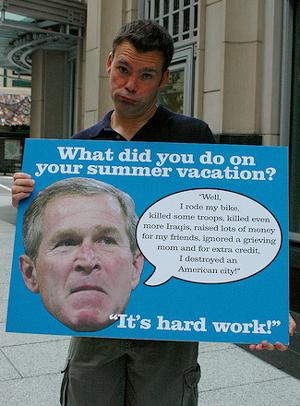
Cutter explains his presence this way: “I figure that if we live here and don’t do something, it’s ridiculous. Cindy Sheehan’s sacrifice is so much huger than anything anyone has done, so how could we not?”
On what is to be done in Iraq itself, he first says, “It’s a tough one” – a comment I will hear again and again, even from those intent on seeing American troops withdraw immediately. On this day, you would be hard-pressed not to come away with a sense of Americans in protest over Bush’s war and the mess he’s brought to our very doorstep, and yet deeply puzzled by what is now to be done and how exactly to do it. “We’ve gotten ourselves down a rat hole,” he continues. “I don’t know what to do. Ultimately, I think it’s going to end up as a civil war there and we’ll have caused it. I only wish the Democratic Party had the balls and would seize the moment. It’s like they’re practicing the politics of safety. Do what’s safe, not what’s right.” He pauses. “It’s the politics of expediency,” he adds with disgust just as we arrive at a plaza filled with a sea of pink balloons – a sign that the antiwar women’s group Code Pink is gathering here. We part at this point with him saying brightly, “I’m not sure ‘enjoy yourself’ is quite the right thing to say … but enjoy yourself!”
 Disabled (Peacetime) Vet: On the plaza we run into 48-year-old Steve Hausheer (“How-ser,” he says, “but if you look at the spelling, you’ll never pronounce it right”) – or rather he rolls past us at quite a clip in his wheelchair. He’s dressed severely in black, but has a kindly, open face. When I stop him, he swivels around, removes his black-leather wheeling globes (“my hands are a mess…”) and shakes firmly. “I’m disabled,” he says, “but I was in the peacetime military. I’m a peacetime vet. Seventy-six, seventy-seven. I just missed the Vietnam War.” He’s unsure about giving an interview. “I get really excited. I’m impassioned about this cause, but then everything just flies out of my head!” He’s from New York, he tells me, and adds, excitement in his voice, “I’ve looked forward to doing something more than just talk to my friends and donate. I’m just so tired of seeing this country head in the wrong direction. It’s time to get proactive!”
“We need to support the troops,” he insists with feeling and then, after a pause, “by bringing them home. We’re stuck now. We’ve torn Iraq apart, and there are going to be no easy answers. George Bush has taken us so far down the wrong road that it’s going to be very difficult to find our way back. My wish is that the people speak up until Congress and the other 40 percent of America that still thinks he’s doing a good job changes their mind.
“The men we’re trying to bring home are true heroes, and we need to treat them as such. It isn’t bad enough that he put them in harm’s way through a lie, now he’s working to treat them as anything but heroes. Can you believe it? He wants to cut their disability payments!”
I thank him, we shake hands, he begins to don his gloves and then, at the last second, he calls me back. “One more thing,” he says and begins to give me this final comment in a slow, measured way as you might dictate to a stenographer: “I want to put this country back into the hands of men and women who are dedicated to serving the American people instead of themselves and their cronies.” He stops, satisfied, and then adds, “This would be my quote, if you have to pick one.”
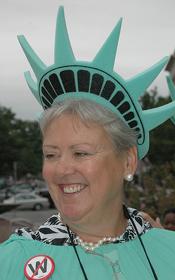 Ms. Statue of Liberty: Just down the plaza near a Montana Women for Peace sign, a group of women of all ages are scurrying to get their Styrofoam green Statue-of-Liberty crowns and green robes in place. A welcoming, white-haired Norma Buchanan is among them. “I am 56 years old. I have never been in a peace march in my life. I just snapped, and I had to be here. Enough is enough. This war, the leadership, is against the law. What I hope is that, at a grassroots level, we’re going to wake up the 40 percent of Americans who are still asleep at the wheel. I hope we’re going to stop worrying about what kind of dog Paris Hilton is carrying around or who’s divorcing whom, and pay some attention to what matters!”
Suddenly a cry goes up, “The march is starting!” It’s true. Hundreds of pink balloons, all attached to Code Pink women, are slowing beginning to bob out of the plaza heading for the gathering area near the Washington Monument where Cindy Sheehan is to speak and the official march is to begin. So Norma Buchanan excuses herself, picks up her placard, and a bevy of Montana-style Lady Liberties, hoisting aloft a cumulative painting of a Western mountain scene, head off to join what will soon be an ocean of protesting humanity, much of it, like Buchanan, at such an event for the first time.
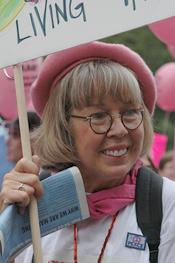 Vietnam Nurse: In a jaunty pink beret and a white “Stop the War” T-shirt (“My daughter made this for me!”), Peggy Akers is carrying a colorful hand-lettered sign that says, “Another Veteran for Peace.” She’s 58, cheery, has flown in from Portland, Maine, and is marching in the Code Pink contingent with her daughter and sister. She’s active in Veterans for Peace and promptly tells me, “I was a nurse in Vietnam.” If I want to get a sense of her sentiments about her Vietnam experience, she suggests, I should check out the CommonDreams Web site, which has posted a poem of hers on the subject, “Dear America.” (“I hear a helicopter coming in – I smell the burning of human flesh. It’s Thomas, America, the young Black kid from Atlanta, my patient, burned by an exploding gas tank… And Pham. He was only eight, America, and you sprayed him with napalm and his skin fell off in my hands and he screamed as I tried to comfort him… America, we have sent another generation of children to see life through an M-16 and death through the darkness of a body bag.”)
“I just feel it’s so important for people like myself to speak out about what I saw and did in Vietnam. I’m part of the conscience of this country. If people like myself don’t speak about what war does, it’ll never end. The images of war are not being shown to Americans. Not really. No one here knows what it’s like to see a young soldier, 18 or 19 years old, in a body bag, or an Iraqi mother who has lost her son. If Americans really saw that, this couldn’t go on.
“If it wasn’t for people marching like today, if they hadn’t done that during Vietnam, that Wall [the Vietnam Wall honoring America’s war dead] would be wrapped around this city 10 times over.
“You know,” she says with excitement, “we met so many people coming in who had never marched before. From Utah, from the Midwest, from everywhere. I think we should bring our troops home and instead send in a Peace Corps – plumbers, electricians, carpenters – to help rebuild that country; whatever the Iraqi people want from us, not what we want from them.”
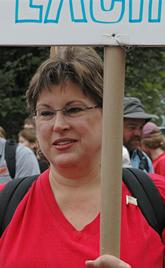 Republican for Impeachment: Approaching the rally, we notice Cathy Hickling, a financial consultant from Maryland, standing on the curb in a bright red T-shirt holding a “Republicans for impeachment” sign on a pole and can’t resist a stop. “My odyssey,” she says, “simply is: I’ve been a registered Republican for in excess of 30 years, and I think the Party’s been hijacked by the policies of George Bush! I think a president should be smarter than I am.
“This is my first demonstration. I felt strongly enough to come. What I hope will happen is that the Democrats and Republicans with a mindset similar to mine get people to change their minds about the direction this country is taking. Remember, Clinton was impeached for a lot less. I saw a sign that said, ‘Clinton lied, no one died,’ and that just about sums it up.
“This is an antiwar protest, but I’m not here to support the idea that we should be leaving Iraq immediately. Now that we’re there, we need to finish the job, but it’s folly to think that the people who got us there can get us out.”
 “Right on!” says a woman who happens to be standing next to her.
And after just a moment’s hesitation, she says it too: “Right on.”
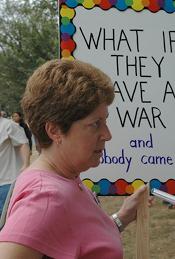
Sign of the Times: As we head into the rally, I run into Susan, a social worker from the New York area, and ask her to stop so I can copy down her sign. Its front says: “What if they gave a war and nobody came?” The back reads: “What if they had a hurricane and nobody came because… They were all at War!!” She insists I get front and back in the right order. “See, the front is that old Sixties slogan, and on the back it’s been adapted to the present. A teacher I work with made it. She’s more artistic than I am. I was absolutely infuriated after the hurricane. All our resources were at war. There was nothing to help our people here. I was infuriated and, after thinking about it, wanted to be here with this.”
The Man From Alabama: He’s white-haired, wears a striped oxford shirt, and carries an “Alabama has lost too many young people to this war” sign. He’s with a small group of fellow Alabamans. When I introduce myself and mention the TomDispatch Web site, he responds, “Do I know it! I send it to my lists, maybe 100 people. I can’t believe I’m actually meeting you here.” He introduces himself as Wythe (“Get Wythe it!”) Holt. I ask – as I do of many people – “What do you do in real life?”
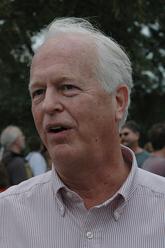 “Protest,” he says definitively. And then he chuckles. “But in the business world, I’m a retired professor of law at the University of Alabama. What I really do now is work for democracy, which means protesting, which is, of course, what democracy’s all about. Even those nitwits who are protesting on the other side are exercising their democratic rights.
“Alabama has lost a lot of children to this war. It’s making its mark on the state. The Tuscaloosa News is beginning to come out and question what’s going on. So the truth is filtering through to Alabama. There are, at this moment, big demonstrations in Birmingham, and in a little while we’re going to be in communication with our colleagues there. We belong to Tuscaloosa People for Peace. We meet two or three times a month for discussions. We read books together. We go to protests.
“I was against Vietnam in 1971. Then, we had two busloads of people driving up here. Now we have one SUV.
“I agree with Jefferson that unless you’re vigilant, you’re not going to have liberty. And this country is slowly losing its liberties. But we’re making liberty here today. Unfortunately, we don’t make enough of it in Alabama, but we try.
“As for Iraq, I say get out now. Leave Iraq to the Iraqis. Bring our young people home this minute. All that equipment that could have been used in New Orleans and Galveston and Houston. If we want democracy in Iraq, we should encourage it, not impose it. I saw a sign earlier that said, ‘Read between the pipelines,’ but it’s deeper than oil. Oil just happens to be the greedy object of the moment. The real struggle is between those of us who want to speak up for ourselves and want to have a government we have a part in, and those who have other goals, which are mostly selfish and greedy, and are interested in imposing their wills on others.”
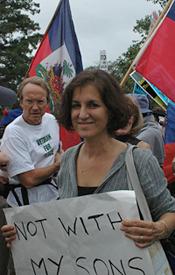 Mother Lion: She’s holding up a hand-scribbled sign that reads, “Not with my sons.” She’s Robbie from New York. “I’m a writer and a mom. I have three sons. One is almost 19, one’s almost 18. I wrote this sign. I mean it. You know, the mother lion. I feel so outraged. It’s the outrage of mothers – and fathers too – to see children sacrificed for these lies. We have to start getting angry and that’s why I’m here.
“I thought of this sign when I was home and identifying with those mothers who had lost their sons. Seeing all of these banners here representing each child who has been killed, that is just so graphic. You stop thinking of the war as being fought by another group of people. I feel this outrage, this energy. Like Cindy Sheehan said, we have to get back to our humanity, and so we mothers have to begin to be teachers. We’ve lost our way.”
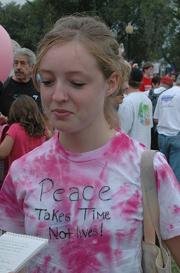 College Students: Samantha Combs and Andrea Solazzo are weaving happily through the crowd, wearing matching tie-dyed T-shirts, pink and blue. Samantha’s says, “Peace Takes Time, Not Lives!” They’re startled to be stopped, embarrassed at the thought of being interviewed. Extremely charming, a little giggly, they’re both 18, from Ecker College in St. Petersburg, Fla., and they’ve spent 19 hours on the Alliance for Concerned Individuals’ bus to get here. (“It’s a campus group that focuses on everything that deals with human rights,” Samantha tells me.)
Why are they at the demonstration? The responses are brief and to the point. Samantha: “So much money’s being spent in Iraq, when it should be spent here.”
Andrea: “My cousin went to Afghanistan and then Iraq. He’s been trying to go to college for years, and he keeps getting called up! I don’t think Iraq’s worth his life.”
 And then they exclaim in unison, “Our group’s leaving,” and with another round of embarrassed giggles they bound off.
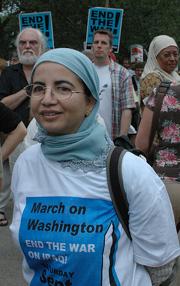
School Teacher: Sadida Athaullah is a social studies teacher in metropolitan Baltimore. She’s wearing a blue “March on Washington/End the Iraq War” T-shirt” and a light blue headscarf. She’s quiet-spoken and thoughtful. “This is my first time at such a demonstration. I’m a naturalized American of 25 years, originally from India. I gave up my heritage to be an American because I admired American values, and I don’t like what this country is turning into. When the war first began, I didn’t really take an active part against it. I thought it would be a quick action, over in weeks, not months, and not turning into this big, long disaster, which makes no sense to me. I don’t think the Iraqis are going to drink the oil in their country. They’re going to have to sell it on the open market, and we could buy it like anyone else.”
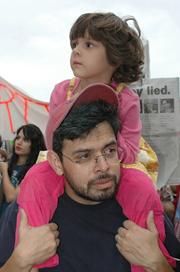 Father and Daughter: As we leave the rally grounds in a milling mass of humanity and pour out onto 15th Street, the sound level beginning to rise, I notice Frank Medina in a reddish baseball cap, and on his shoulders, his young daughter in a pink shirt and bright yellow dress. As I ask for his name, she leans over and shouts out with delight: “Claire Elizabeth Medina!” He’s a lawyer with the Securities and Exchange Commission. “I was at the demonstration before the war,” he tells me. “And now, this is just an appalling circumstance. That’s why I’m back. It’s an appalling war, and it needs to end immediately. There needs to be a coherent plan to turn the country back over to the Iraqis, with definite dates for the return of American troops. What can’t be done is to continue to justify the war there by the sacrifices that have already been made. It’s like saying that, when you’ve lost everything at the casino, you’re going to double-down. At some point, you need to cut your losses.
“However, it’s an administration that can’t admit its mistakes, that can’t admit the truth, and consequently that can’t change. So there is no hope.”
Why bother to come then, I ask.
“It’s important,” he says firmly, “to express your views, to protest.”
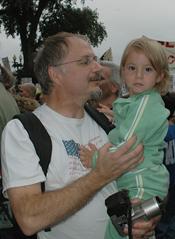 Grandfather and Daughter: Only moments later, another man with a little girl on his shoulders catches my eye. I approach him, introduce myself, and mention that he’s the second father I’ve seen this way in so many minutes. Joe Stone promptly corrects me: “I’m her grandfather. Her father’s in Iraq.” He lifts MacKenzie down from his shoulders, tired and ready for her nap, and puts her in a stroller pushed by his actual daughter Cindy. Then he turns back to me. “I haven’t done this in 30 years. I was here in 1970. I was tear-gassed at the University of Maryland. Same kind of war, different time.”
From Virginia, he’s the assistant controller at a dairy (“an accountant basically”). Like a lot of people at this demonstration, he speaks calmly, even quietly, but with a deep-seated disgust. “I’m just sick of it. I think Bush is immoral. You have to say something. We’re proud to be here. I’d slam the door in George Bush’s face if he came knocking.”
His daughter, like most of the demonstrators, is dressed casually – sweat shirt, blue jeans, sneakers. She tells me her husband, a combat engineer who joined the military in 2002, is back for his second tour of duty in Iraq. He was gone for his daughter’s birth, home for nine months, returned in the winter and now is stop-lossed. They’re not certain when he’ll be back.
I ask whether he knows she’s at the demonstration – her first, it turns out, other than a small “free Tibet” one.
“He wouldn’t say not to,” she replies in almost a whisper. “But I haven’t had a chance to tell him yet. I just feel the same as my dad, though. I’d had it. I can’t believe there are so many people in this country who still think the president’s so great, especially after his first term. I couldn’t get a single one of my friends to come. I work at a government contracting company, and my co-workers thought it was strange to do this because I might not have a job if the war ended. One of them even said, ‘You know, there’s video cameras down there.’ So what!”
Her father chimes in: “Defense contractors don’t need a war to keep going.”
She adds, “I don’t really know what to do about Iraq now. They can’t just leave, but I don’t see a plan of action for how we’re going to get out. I wish George Bush could get out of office. I just don’t see how, though.”
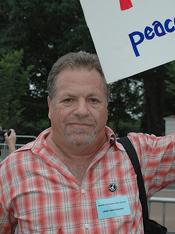 The Farmer: His sign reads “U.S. Farmers Say No to War,” and we bump into him just as we turn the corner and head for the White House, the march slowing into gridlock, the roaring of the crowd ahead rising to a din. But Michael O’Gorman’s voice carries well. “I’m a real farmer,” he says in response to my query. “I farm a thousand acres of organic vegetables for sale to the U.S. market in Baja California [Mexico]. I’ve been farming for 35 years. I’ve earned all these wrinkles.” And indeed his face is deeply creased.
“When I began in 1970, U.S. farmers were feeding the world. This is the first year, possibly in our history, when we’re importing more than we’re exporting, when we’re not feeding ourselves. China will feed itself. India will feed itself. We won’t. When I began farming, there were 2 million farmers in the U.S. Three hundred thousand of us remain; average age, 62. I’m almost there.” He laughs.
He tells me that he sits on the steering committee of United for Peace and Justice, which helped organize this demonstration. He flew in from Baja. “I was supposed to be in the lead contingent.” He shows me a badge that indicates exactly that. “But we were swamped by the crowd, and so I’m here. I remember joining protests back on July 4, 1987, in my community. We were supposed to speak about local issues, but I was protesting that the U.S. was arming Saddam Hussein’s Iraq and [Ronald Reagan aide] Oliver North was arming Iran in a war between those two countries where 2 million young men would die. I warned that it would come back to haunt us.
“On 9/11, my oldest daughter was at Ground Zero, right across the street, and she survived. My son volunteered after that because his sister had been there. Now, he’s at Guantánamo, so that war is haunting not just our society, but my own family.
“My son joined the Coast Guard Reserves. He thought it was a peaceable way to serve. Then they shipped him off to Cuba. I support him. We don’t argue about it too much. I’m waiting for him to make his peace with it. He had a week off recently and – can you believe it – they didn’t even fly him to Florida. We had to pay $750 to get him home.
“It’s a horrible situation. People say it’ll be a total mess if we pull out, but it’s a mess and we’re there. I don’t see any argument for the United States staying. If, in pulling out, we could create an alternative to the U.S. military, that would, of course, be best.”
He shakes hands and invites us to visit his farm in Baja. “I believe,” he says in parting, “that this is a very American movement. We’re reclaiming our country.”
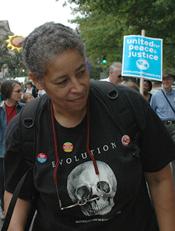 Protester With Cane: I approach Camille Hazeur, who works for George Mason University’s Office of Equity and Diversity, because of her cane (“arthritic hip”). I say that I thought, in a march like this, the cane indicated real commitment. “Darn right!” she replies. “I’m against this war. It’s indescribable that we’re even there. It’s my small way of saying, no, get out! And it’s for our kids over there. To bring them back. And for the Iraqis. You never even hear what’s happening to them. And I feel we’re just sitting here while atrocities are going on, and I’m afraid our kids will have to suffer the impact of what we’re doing there now. Those of us who are reading and thinking people… I’m not naïve about the Middle East or Saddam Hussein, but none of it justifies this.
“I was here in the ’70s. I went to college in this town. I remember the demonstrations. I remember them all. They had a distinctive smell, of tear gas and grass, and we haven’t smelled either of those today.”
Protester with Cane (2): We’re past the White House now, and Ann Galloway is walking with determination, cane well deployed (“I need a knee replacement”). The gridlock of the march has ended, and open space has appeared. She has a blue backpack strapped on. A little sign sticks out: “Support our troops, Bring them home alive.”
“I hosted a Cindy Sheehan vigil in Stanford, Conn., and have been a leader of one of the MoveOn teams there. This is the first big march I have been in since Dr. Martin Luther King, Dr. Benjamin Spock, and the Rev. William Sloan Coffin demonstrated in maybe 1967 against the Vietnam War. I actually became energized again because everything this administration does is so antithetical to what America is about and I intend to be part of a movement that takes back the Congress in 2006.
 “I’m a grandmother and, if anything, I am marching for my grandchild’s future. She’ll be two in December. I wrote to a friend that I’m going to show up with a cane and a floppy hat [which indeed she’s wearing] and become one of those little old ladies we used to joke about. But this – the abuses, there are just so many – has to stop. They won’t take the tax cuts off the table, but they’re willing to squander our precious dollars on the war in Iraq that could be used for a myriad of other things in this country, including” – she says it emphatically – “homeland security. These guys don’t care about any of it, just those tax cuts for their people who are not sending their children to fight this war.”
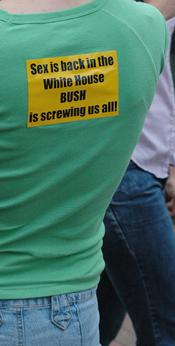
Flight Attendant: She’s standing at the curb in a green shirt with a sticker on the back that reads, “Sex is back in the White House. Bush is screwing us all!” She introduces herself as Liane. “I’m a flight attendant,” she says. “I got this sticker from a woman I met at a union rally by the Labor Department. I liked it, and she was so interesting. She had a history of coming to protests. She told me, if I gave her my address, she would send one my way. It was at least six months ago. I just haven’t had a chance to use it until now.”
This is her first antiwar protest. “I don’t know what to do,” she says. “I just think that the war in Iraq is a big mistake. Especially when I saw New Orleans and thought about the money for the levee system diverted to Iraq. That was upsetting. Even before that, though, I got the impression that the ones pushing the war were really planning for the best-case scenario, that they hadn’t planned for anything but the best outcome. I think what they’re doing is creating more terrorism.”
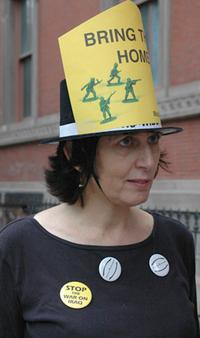 Toy Soldiers: As we turn the corner, heading up 17th away from the White House, I’m approached by a young man dressed all in black and wearing headgear that looks like a cross between a fedora and a top hat. It’s fronted by a yellow piece of cardboard with images of toy soldiers stamped on it. He hands me a little bag of green plastic soldiers of the sort I played with as a child and, strangely enough, in the midst of this antiwar demonstration, my heart takes a leap. I genuinely want them.
Each soldier, whether shooting or throwing a grenade, turns out to have a little piece of paper attached that says, “Bring me home” and includes the Mouths Wide Open Web site address. There’s even a small explanation in the bag that begins, “We’re spreading plastic Army men around the country and around the globe as small, everyday reminders of the ongoing horrors of the war in Iraq – using them as tools to foster dialogue, action, and resistance to the war.”
I ask if he’d mind being interviewed, which flusters him. He finally indicates Merry Conway, who is older. “She’s better to talk to,” he says. And it’s true. She’s happy to talk. In fact, she’s an enthusiast as well as an artist who “creates performance and installation shows with a very large community element.”
So I ask about Mouths Wide Open. “We’re a little group of friends in New York. Many are artists. We came together after 9/11 to see what we could do. We created the Four Horsemen of the Apocalypse Crusade. Maybe you’ve seen it at other demonstrations. It’s huge. But we were still thinking about how to create a dialogue, because so many people were acting as if the war wasn’t happening if they didn’t have a relative involved. It was business as usual. What, we thought, if we left a trace, started that dialogue with a poignant emotional effect. And these little toy soldiers that so many boys have played with are it.
“The other night in New York at a Cindy Sheehan event, we were handing these out and I gave a packet to one of the mothers there. She recoiled. She said, ‘My son’s in Iraq. I can’t take those. I used to hide them from him.’ But you know what she said then? She said, ‘Keep going. But keep going!‘
 “People get very excited about putting them in places and then other people find them. The other day we got an e-mail from a cop who had found one in the Federal Courthouse in New York, and he was so moved he wrote us.”
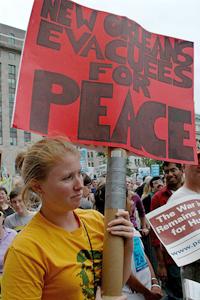
New Orleans Evacuee: She’s holding up a bright red sign that says, “New Orleans Evacuees for Peace.” Erica Smith is 25, a law student at Loyola in New Orleans. (“We’ve been relocated to the University of Houston law school.”)
“I’ve probably met about 10 people from New Orleans today, and I’ve had lots of people come up to give me a hug.
“I was planning to come to this anyway. But with what happened in New Orleans, well… I was lucky, I live uptown and my place is on the third floor and a friend had a key and checked. It’s okay. But all of our National Guard troops were off in Iraq instead of rescuing people here. Instead of being here to help out, they were off making problems in the rest of the world.”
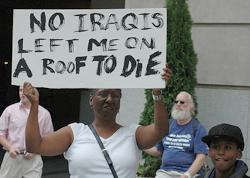 Mother and Son: As we circle back toward the Mall, we pass a mother and son standing on the sidewalk. She’s holding what, for me, is the most striking sign of the day: “No Iraqis left me on a roof to die.” Her 12-year-old son, Muata Hunter, holds a sign too. It’s simple and eloquent. “No war.” Just as I approach them, a young black woman comes up to ask (as I was about to do), “Is your home in New Orleans?”
“No,” the woman answers, “but my heart is. It’s my people.”
She’s Aziza Gibson-Hunter, a local artist. “I’ve been thinking and thinking,” she says, “trying to figure out how to make my people understand the direct correlation of this war and our well-being, and I just thought this put it succinctly.”
Her son shyly tells me that he made his sign that morning. “I just think war shouldn’t be done. War isn’t necessary. My uncle’s been in war, and my cousin Jimmy was in Iraq.”
His mother adds, “He made it back.”
Tom Engelhardt, who runs the Nation Institute’s TomDispatch.com (“a regular antidote to the mainstream media”), is the co-founder of the American Empire Project and the author of The End of Victory Culture, a history of American triumphalism in the Cold War.
Tam Turse is a photojournalist working in New York City.
