



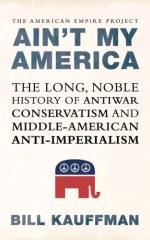
 Ain’t My America: The Long, Noble History of Antiwar Conservatism and Middle-American Anti-Imperialism
Bill Kauffman
Metropolitan Books, 2008
284 pp.
By Doug Bandow
American politicians routinely chatter about peace while inaugurating war. Indeed, despite the bitter partisan wrangling over Iraq, war has more often united than divided Washington’s establishment. Today, despite the ongoing debacle in Iraq, Republicans and Democrats compete to breathe more and hotter fire against Iran. It is Democrat Hillary Clinton who threatens to "obliterate" that nation if it attacks not America, but a far distant allied state, one already nuclear-armed and well able to defend itself. Both of the dominant political parties are war parties.
 The one constant of the wars so regularly and enthusiastically promoted is that they will be fought by Middle America. Members of today’s public warrior class are private pacifists. The Bill Clintons, Dick Cheneys, Paul Wolfowitzs, and conservative pundits and activists who fill the Neocon Greek Chorus never don a uniform. A few, like George W. Bush, carefully choose the right uniform to avoid actually ending up in combat. But all chirp their thanks for the sacrifices of those who do join and fight. Some, like President Bush, even prattle on wistfully about how they wish they could join today’s romantic struggles.
Worse, these faux patriots attack anyone who dares criticize the war – any war, whichever one it happens to be – as being a wimp, defeatist, or even traitor. This demonization has been made easier by the fact that opposition to war has in recent years has been concentrated on the Left. The same people who "lost" Vietnam are determined to "lose" Iraq, we are told.
Yet a different, or more complex, story comes from Bill Kauffman, onetime Senate staffer and think tank editor turned essayist and author, who lives in upstate New York – quintessential Middle America. He observes:
"[T]here is a long and honorable (if largely hidden) tradition of antiwar thought and action among the American Right. It stretches from ruffle-shirted Federalists who opposed the War of 1812 and civic-minded mugwump critics of the Spanish-American War on up through the Midwestern isolationists who formed the backbone of the pre-World War II America First Committee and the conservative Republicans who voted against U.S. involvement in NATO, the Korean conflict, and Vietnam. And although they are barely audible amid the belligerent clamor of today’s shock-and-awe Right, libertarians and old-fashioned traditionalist conservatives are among the sharpest critics of the Iraq War and the imperial project of the Bush Republicans."
Although the players and issues have varied dramatically over time, "In pre-imperial America, conservatives objected to war and empire out of jealous regard for personal liberties, a balanced budget, the free enterprise system, and federalism," explains Kauffman. To them, dissent was "a patriotic imperative." But another commonality was being vilified and worse. He adds: "As the American Firsters discovered, protesting war is a lousy career move. Dissenters are at best calumniated, at worst thrown in jail for standing against foreign wars and the drive thereto."
If today the Right seems a wholly-owned subsidiary of the War Party, the American people are less enthused. Naturally, this worries the elites who believe their role is to initiate wars for other Americans to fight. Observes Kauffman, "Bush Republicans and pro-war Democrats have fretted mightily over recent surveys from the Council on Foreign Relations showing that the American people are reverting to – horrors! – isolationism, which the CFR defines invidiously as a hostility toward foreigners but which I see as a wholesome, pacific, and very American reluctance to intervene in the political and military quarrels of other nations."
Indeed, the essence of nonintervention, however labeled, is that it is not the American purpose to engage in global social engineering. Whether the genesis of that belief is fear of or respect for foreigners really doesn’t matter. This reluctance to intervene is the highest form of internationalism. That is, noninterventionists respect other peoples enough to believe that Americans do not have the unilateral right to roam the world killing, maiming, and injuring whoever happens to be Washington’s declared enemy of the moment in pursuit of whatever happens to be Washington’s declared objective of the moment.
Kauffman highlights these conservatives for peace running back throughout U.S. history. What sets Ain’t My America apart from most foreign policy books is that it is less about foreign policy and more about America. Kauffman is a fine stylist, a literary composer whose editorial symphony appeals to the spirit as well as the mind. He discovers an eclectic mix of antiwar patriots as he joyously romps through the American tradition.
Kauffman appropriately begins with the nation’s founders, men whose views on war are dismissed as quaint by most politicians today. For instance, George Mason told the 1788 Virginia convention debating ratification of the U.S. Constitution: "I abominate and detest the idea of a government, where there is a standing army." Notes Kauffman, "His view was not anomalous; militarism was."
Imagine that, national politicians opposed to war. But a wariness of military entanglements was a constant of early America. There is, Kauffman observes, George Washington’s Farewell Address, which is "as close to an expression of early American political omnifariousness as one might find," a veritable "sacred text among conservative critics of empire." American children typically read it, or parts of it, but how many learn that, as Kauffman writes, "Washington’s valedictory amounts to a repudiation of U.S. foreign policy from 1917 to the present"?
Of course, America’s foreign policy rarely was purely republican. Kauffman points to the constitutionally-dubious Louisiana Purchase, pushed through by President Thomas Jefferson. The acerbic Kauffman notes: "Principles were as elastic as national boundaries."
But it was not just politicians who concerned themselves with great matters of state and principle. Kauffman presents poets who defended the republic, such as 13-year-old William Cullen Bryant. Marvels Kauffman: "The boy poet sings of ‘commerce’ and ‘agriculture’ as ‘the blessing of mankind’."
The ensuing War of 1812 yielded many opponents who fit Kauffman’s broad conception of conservative. One of the most fierce, even savage, was Rep. John Randolph of Roanoke. Perhaps the most grandiloquent was Daniel Webster, an antiwar Federalist. He inveighed against a proposal for conscription shortly before the conflict ended: "Who will show me any Constitutional injunction which makes it the duty of the American people to surrender everything valuable in life, and even life itself, not when the safety of their country and its liberties may demand the sacrifice, but whenever the purposes of an ambitious and mischievous government may require it?" Who indeed?
"Black Dan is still waiting for a reply," observes Kauffman.
Then there was the Mexican-American War, a shameless spasm of imperialist war-mongering growing out of a border incident created by the U.S. Explains Kauffman, "The war was driven by the ideology of manifest destiny – the notion, in its most naively appealing form, that so effervescent was the American spirit that it could not be contained in the constrictive old wineskins but needed a continent, perhaps even a continent and a half, over which to spill."
This was a profoundly unconservative notion, argues Kauffman, "the pipe dream of epicene East Coast intellectuals for whom America was not so much a country as it was an idea, a sort of viscous rolling blob capable of absorbing foreign peoples, sovereign republics, and anything else that got in its way." America, a "viscous rolling blob." It has the makings of a great patriotic song, don’t you think?
Kauffman’s lauds an obscure Whig politician by the name of Abraham Lincoln who exposed the lies that brought America into the Mexican-American War, as well as a Congregationalist minister, Samuel J. May, who denounced the war from his pulpit. There many others in what was a different America. Observes Kauffman: "Today [Ohio Senator] Thomas Corwin could kiss his career good-bye after delivering so blistering an assault on a war and a president. In antebellum America, he wound up in Millard Fillmore’s cabinet."
The Spanish-American War and, even worse, the brutal suppression of Filipino freedom fighters – who resisted American imperial rule just like they resisted Spanish imperial rule – moved a step beyond previous conflicts. An estimated 200,000 Filipinos, most of them civilians, died. Kauffman cites Felix Morley: "The deeper result was to make Washington for the first time classifiable as a world capital, governing millions of people overseas as subjects rather than as citizens. The private enslavement of Negroes was ended. The control of alien populations had begun."
Such unabashed imperialism drew sustained conservative fire. Kauffman paints a colorful opposition, with the famous, such as Grover Cleveland and William Jennings Bryan, leading a parade of lesser-known defenders – politicians and businessmen, lawyers and poets – of the American republic. Opponents lost this struggle to "the vascular young imperialists who rallied to the jingoistic calisthenics of Theodore Roosevelt," Kauffman observes sadly: "Empire was for the fit and vigorous who would not be chained to a place; peace was for the old, the anile, the invalided."
But the wars against Mexico, Spain, and Filipino insurgents were mere skirmishes compared to the massive slaughters of the 20th Century, which turned entire countries, even continents, into charnel houses. And these wars did something more, which offended the increasingly beleaguered band of war critics. Writes Kauffman: "The home front was militarized – Prussianized – to a degree almost unimaginable: conscription was imposed, taxation became burdensome, industries were effectively nationalized, and freedom of speech was drastically curtailed."
And opposition to war became unfashionable. Opposing America’s entry into World War I there were few stalwarts, such as publisher William Randolph Hearst, auto magnate Henry Ford, Progressive Sen. Robert La Follette, and House Majority Leader Claude Kitchin, who stood against the modern worship of Thor. But they were insulted, ridiculed, and denounced, while thousands of more common people were arrested, convicted, and imprisoned. If Woodrow Wilson was liberal, his liberalism was symbolized by the jackboot.
One of the odd heroes highlighted by Kauffman is Sen. James K. Vardaman (D-Miss.). A vile racist, like most leading southern politicians of the time, as well as the supposedly great liberal President Woodrow Wilson, Varadaman nevertheless exhibited genuine courage when he stood against America’s entry into World War I. He rejected the political counsel of friends to do the popular thing and lost his seat in 1918, Notes Kauffman: "Varadaman understood that standing athwart the empire would destroy his career. How easy it would have been to trim, to temporize, to dissemble, to quietly slip out of the peace camp and vote for Death. But to his eternal credit he did not."
Much the same scenario played out before World War II. There was a revulsion against militarism in the aftermath of the Great War, as WWI was called. Critics of imperial warmongering created the Veterans of Future Wars in 1936 and the America First Committee in 1940. The latter advocated a strong national defense, but "cooperated with pacifists and indeed featured such exponents of nonviolence as the novelist Kathleen Norris on its national committee," writes Kauffman. Shamelessly smeared by the enthusiastic advocates of war, the AFC disbanded after America’s entry into WWII. But "America First spoke for Middle America," notes Kauffman.
The organization was made up of patriots, not pro-fascists or anti-semites. Kauffman points out that "One passage in one speech by one orator is really the only stigma that the War Party could ever affix to America First." Charles Lindbergh’s attack on Jewish support for the coming war was rightly criticized, but was mimicked in behavior by President Franklin Delano Roosevelt, whose administration refused to admit Jewish refugees from Europe and target the death camps in occupied Europe.
Most important, Kauffman writes, Lindbergh’s foolish rhetoric did not represent "the last broad peace movement in American history, almost a million strong." While WWII was not the same sort of vain imperialist extravaganza like the Spanish-American War, Kauffman argues that "the America Firsters were heirs to the Anti-Imperialist League. They were Little Americans, fiercely loyal to their place and protective of their liberties."
This most horrific of horrible wars wrecked much of the known world. It also destroyed noninterventionism as a political movement. A beleaguered band of conservative peaceniks fought against the beginnings of the Cold War and much hotter Korean War, but with the death of Sen. Robert A. Taft (R-Ohio) in 1953, few skeptics of empire remained in high office. The conservative movement, under the leadership of William F. Buckley, largely embraced creation of the national security state to fight the Cold War.
But there was an ever so slight renaissance of the antiwar Right during the Vietnam War, with antiwar businessmen (who created Business Executives Move for Vietnam Peace), newly active libertarians, such as economist Murray Rothbard, and, after a fashion, Sen. George McGovern (D-SD). It’s a stretch to include the latter in the conservative pantheon, but Kauffman writes of the WWII B-24 bomber pilot: "This George McGovern, dyed deeply in the American grain, is a hell of a lot more interesting than the burlesque that was framed by his neoconservative critics."
Support for nation-building has come to dominate much of the Right. Even liberal Sen. Joe Lieberman (I-Conn.) receives right-wing accolades because he supports visiting death and destruction along the Euphrates. But Kauffman points to other conservatives – the traditionalist icon Russell Kirk, for instance, who denounced proponents of "American hegemony." And Patrick Buchanan, an uber-hawk when it came to prosecuting the Cold War, who returned to his small government roots once the Evil Empire dissolved.
Current political heroes include Rep. Ron Paul (R-Tex.), the sole antiwar voice in the Republican presidential race, and Rep. John "Jimmy" Duncan (R-Tenn.), an old line conservative who told Kauffman: "I’ve become convinced that most of these wars have been brought about because of a desire for money and power and prestige." Duncan, ever gracious to those around him, "is a throwback, a Taft Republican in search of a party of peace and frugality," as well as "a glorious anachronism as a representative of a place and a people," enthuses Kauffman.
Most disastrously, writes Kauffman, "the Republicans in the age of George W. Bush have become a War Party, nothing less and certainly nothing more. Dissident GOP voices are rare and unwelcome echoes." Even more tragic is the fact that the so-called Religious Right has joined the War Party. Notes the waggish Kauffman: "The Christian conservatives who have supplied Bush with an indispensable, almost blasphemously enthusiastic following might consider alternative Christian political traditions," such as that of William Jennings Bryan, "Or, if I am not being too much of an originalist, a biblical fundamentalist, that of Jesus Christ."
Conservatism once was an honorable term, associated with "decentralism, liberty, economy in government, religious faith, family-centeredness, parochialism, smallness," notes Kauffman. But he thunders: "The cockeyed militarism of the Bush administration, and the historical ignorance and cowardice of the subsidized Right that has cheered him on, have poisoned the word conservative. For years, if not wars, to come." Today, he complains, the word conservative "reeks of manslaughter and militarism."
Ain’t My America is deeply moving, with its eloquent retelling of the largely lost American tradition of conservatives against war. The loss of that tradition has cost Americans much blood and treasure. In closing this fine volume Kauffman echoes George McGovern, calling us all to rediscover our better nature,: "Come home, America. Reject the empire."
