



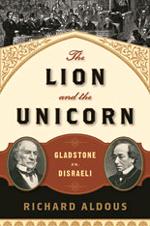
 The Lion and the Unicorn: Gladstone and Disraeli
Richard Aldous
W.W. Norton
368 pp.
Politics is a spectator sport, akin to baseball or football, but with far greater consequences for the rest of us. After all, no matter how much one despises the New York Yankees, it doesn’t really matter much if they win the “World” (too bad the rest of the world isn’t actually invited to play!) Series. In contrast, if the Republicans win the White House in November, we could be at war with a half dozen countries by next spring. If the Democrats triumph, we might be paying more in taxes and sitting in gas lines by the same time.
 But what American politics lacks is the compelling drama of two strong leaders battling over a period of years or decades. One reason is our presidential rather than parliamentary system. After eight years, max, you’re out. And as important as are the Senate and House leaderships, they don’t have the same kind of perch to compete with a president. Barack Obama represents a dramatically new Democratic figure at a time when there is no clear Republican champion: George W. Bush’s manifold failures have left him increasingly disliked and ignored, while John McCain is but a man for the moment. If he loses, he will quickly fade from public view. Whatever the outcome in 2008, no one really imagines Obama versus McCain as the political story-line in four, eight, and more years.
The British parliamentary system more often has turned politics into high theater. Parliament is a raucous affair, where the prime minister must appear and be questioned by the opposition. Although the Conservatives of late have had little patience for leaders who fail to win victory – they are on number four since Labor took power in 1997 – there were times when capable men long led the major parties, fighting multiple elections and swapping position and influence.
One of the greatest rivalries was between the Liberal Party’s William Gladstone and the Conservative Party’s Benjamin Disraeli, a story ably told by Richard Aldous in The Lion and the Unicorn. It is wonderful theater – or perhaps even more a riveting sports rivalry played out in multiple contests over the years, rather like we saw in tennis with Bjorn Borg and John McEnroe, Martina Navratilova and Chris Evert, and today Robert Nadal and Roger Federer.
Disraeli was a grand figure and successful party leader, helping reconstitute a Conservative Party divided over repeal of the protectionist “corn [grain] laws.” A favorite of Queen Victoria, he was later rewarded with a peerage, becoming the Earl of Beaconsfield. He also was a successful novelist and leading social figure. He served as prime minister twice, first for a short time in 1868 and second from 1874 to 1880.
Gladstone was the more successful politician though also perhaps the more tormented individual. He served as prime minister four times, and had the satisfaction of succeeding Disraeli after both of the latter’s premierships. For both his longevity and policy achievements, Gladstone is viewed as one of Britain’s greatest prime ministers, and was cited by Winston Churchill, among others, as his political inspiration.
The Disraeli-Gladstone rivalry was noted for its personal asperity, which Aldous covers in splendid detail. Gladstone outlived his rival, but even in death Disraeli discomfited his great rival, with Gladstone remarking to his diary: “I must not say much, in the presence as it were of his Urn.” Explained Aldous:
“Gladstone’s uncharacteristic reticence came because Disraeli’s death would ‘entail upon me one great difficulty: but God who sends all, sends this also’. Gladstone was understating the problem. The specific difficulty was the tribute to his great rival that, as prime minister, he would have to make in the House of Commons. His wider problem was that all society would be watching and waiting for him to slip up in the coming weeks. And nowhere would scrutiny be greater than from the very top. Queen Victoria had revered Disraeli. She reviled Gladstone. If he put so much as a foot wrong, she would make his life intolerable.”
Great Britain was by this time a constitutional monarchy, but the Queen still wielded enormous influence. When she received news of Gladstone’s victory in the 1880 election, reports Aldous, “Her reaction was one of predictable fury and hysteria. ‘Some of the language used,’ [private secretary Henry] Ponsonby said afterwards, was unrepeatable. Most of her anger was directed at Gladstone.”
But there also were great issues at stake, and the two leaders and their parties fought over electoral reform, disestablishment of the Anglican Church, intervention in the Balkans, tax policy, free trade, education, social reform, Irish home rule, colonial policy, and civil service reform. It was a time of enormous ferment highlighted by the maneuverings of two extraordinarily able antagonists battling for electoral power.
Aldous also brings alive the great parliamentary debates and votes. It is a spectacle Americans typically lack – there have been moments of high drama on the House and Senate floors, too, but most of them belong to the past, such as the pre-Civil War debates over slavery and related issues.
And there never has been anything in the U.S. quite like the Gladstone-Disraeli rivalry. Perhaps the angry struggles between Thomas Jefferson and Alexander Hamilton, John Quincy Adams and Andrew Jackson, and Theodore Roosevelt and Woodrow Wilson, but even those contests were more limited in breadth and time. Gladstone’s career as prime minister and leader of the opposition spanned 26 years, while that of Disraeli covered twelve. Franklin Delano Roosevelt served nearly as long as president as Gladstone did as prime minister, but Gladstone spent another 13 years as Chancellor of the Exchequer, the second most important Cabinet post. Disraeli spent nearly four years in the same position.
Politics matters because government has come to dominate society. The fight for power often is ruthless and ugly; the consequences often seem the same, irrespective of who wins. In America today, both major parties back expansive and expensive government and promiscuous foreign intervention, and view our nation’s heritage of individual liberty and limited government as an irrelevant relic.
British politics in the late 19th Century often was disreputable and ignoble. It would be a mistake to view the time of even such great figures as Disraeli and Gladstone as particularly enlightened.
Nevertheless, these two politicians transformed their country as the battled each other. And, ironically, given their enormous antagonism – suffused with hatred and contempt – their careers are forever linked in a fascinating and entertaining human drama. Concludes Aldous: “In the end these two Englishmen stand together not apart, memorialized as they lived: celebrated protagonists forever linked by history.”
