



 America Between the Wars: From 11/9 to 9/11
Derek Chollet and James Goldgeier
PublicAffairs
412 pp.
The end of the Cold War – the dissolution of the Soviet Union, crash of the Eastern European Soviet satellites, collapse of the Warsaw Pact, and fall of the Berlin Wall – was an extraordinary moment in human history. Hundreds of millions of people were liberated from tyranny. The threat of conventional war in Europe and especially a global nuclear exchange disappeared.
Yet good news for humankind was bad news for foreign policy practitioners. The Cold War was ugly but simple: contain the Soviets. Even minor geopolitical events mattered if Moscow was involved, forcing the US to range about the globe, micro-managing international events. But now, with no hegemonic peer competitor, no evil grand puppeteer to contain, what should America do in the world? Write Derek Chollet and James Goldgeier, “Remarkably, even after the West’s triumph took shape, Americans’ sense of unease deepened. They worried that Germany and Japan would be formidable economic competitors. And many elites feared that absent the Soviet threat, Americans would be unwilling to endure the costs of global leadership.”
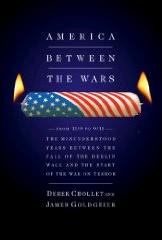 Chollet, with the Center for New American Security, and Goldgeier, a professor at George Washington University, review American foreign policy in the new, unsettled security environment post-11/9 in America Between the Wars. They prove a bit too ready to credit the Clinton administration with diplomatic successes – for instance, both the war against Serbia and denuclearization of Ukraine look more dubious in light of Russia’s war against Georgia and more aggressive stance against its neighbors. Nevertheless, the book offers a wealth of information about foreign policy developments which affect us still.
Perhaps their most interesting claim is that 9/11 settled nothing in terms of America’s role in the world. Rather than inaugurating a new foreign policy era, the terrorist assaults reinforced the uncertainty of the post-Cold War era.
They argue: “Although 9/11 created the illusion that America’s purpose was once again clear – this time combating Islamic extremism rather than fascism or Soviet communism – the questions America grappled with in the first decade after the Cold War remain unanswered. When should the United States use force to solve problems? When does it need to work through the United Nations to ensure legitimacy for its actions? Should it care that others perceive American goals as selfish? Will it promote free trade as more jobs go overseas? Should it make democracy promotion a central part of its foreign policy? How much should it care about what happens inside other states? Debates over these issues continue to rage.”
Which means these controversies and more will roll over to the next administration. Despite the notable difference between Barack Obama and John McCain over invading Iraq, both are committed to an activist internationalist role. Sen. McCain seems more likely to initiate war against countries big and small, but Sen. Obama has talked tough towards Iran, mimicked the McCain position on Russia vs. Georgia, and is surrounded by former Clinton administration officials who famously took America into a war against Serbia over issues that did not rise to an important let alone vital US interest. The presumption that America should, even must, act is going to dominate US policy irrespective of who wins.
As Chollet and Goldmeier detail, the first crisis of the post-Cold War era was Iraq. Evidence that the world had changed came from the solidarity of the Bush and reformist Gorbachev governments. Change also was evident in the US, where the Republican Party found itself torn by an unusual foreign policy debate. Explain the authors: “For GOP politicians and policy intellectuals, the end of the Cold War and the collapse of the Soviet empire brought to the surface tensions about the nature of the global order, the purpose and use of American power, and what, if anything, was required to ensure its legitimacy. These debates had been largely suppressed within the party by the forty-year struggle against communism.”
This debate has continued in succeeding years. Early on John McCain clearly associated himself with the neoconservative faction, attacking the supposed “isolationism” of those who did not share his fervor for war.
At least three broad factions developed – realists, associated with Brent Scowcroft, President George H.W. Bush’s National Security Adviser, neoconservatives, represented by Irving and Bill Kristol, and nationalists like Patrick Buchanan, who believed in returning to a more traditional foreign policy with the end of the Cold War.
It turns out that the public had little interest in foreign policy even after the first victory over Iraq. Bill Clinton won the presidency running on the slogan, “It’s the Economy Stupid.” Yet he embraced an expansive agenda, one that generated substantial neoconservative support in the election. Write Chollet and Goldmeier: “At the time, the differences between the neoconservatives and the Clinton team appeared slight, particularly compared to the ideas of Bush, Buchanan, and Perot.”
Clinton did not begin well. The debacle in Mogadishu, in which 18 Army Rangers were killed while attempting to seize the most important local warlord, wrecked President Clinton’s expansive internationalist plans. National Security Adviser Anthony Lake had laid out a new policy: “The successor to a doctrine of containment must be a strategy of enlargement – enlargement of the world’s free community of market democracies.” But as a successor to containment the Lake doctrine fizzled.
Part of the problem was Clinton. Disinterested in foreign policy and unfocused in personal temperament, he was ill-equipped to lead an effort to revolutionize the world. But Clinton was never one to accept responsibility: he complained that “Americans are basically isolationist,” thereby resorting to the usual smear launched against anyone who doubts the efficacy of global social engineering. Chollet and Goldmeier repeat the insult without comment, but isolationism has lost any real meaning. It now is used to attack anyone, no matter how interventionist, who doesn’t want to intervene as far and wide as the person denouncing isolationism. (After all, Al Gore attacked George W. Bush during the 2000 election as an “isolationist.”)
In early 1995 the Republicans took control of Congress, crippling President Clinton’s ability to dominate the domestic agenda. Clinton had become a more self-assured military commander-in-chief, even if his judgment never improved. Chollet and Goldmeier nicely detail how the Clinton administration conducted its foreign policy, but they are far too inclined to see action as the equivalent of success.
For instance, they write of the 1994 Haiti operation that put Jean-Bertrand Aristide back into power: “by upholding democracy without resorting to military force, the administration’s Haiti policy proved a success.” Yet the administration succeeded only by threatening to use military force, which would have violated the Constitution’s warpowers clause requiring a declaration of war, and by reinstalling a demagogue who advocated use of violence against his political opponents. This is a dubious example of promoting democracy. Especially since the US intervened a decade later to remove the same man from power.
The Clinton administration’s policy towards NATO was differently flawed. The alliance had been created to prevent Soviet domination of Eurasia. Why the US should continue to protect Western Europe, let alone the former Warsaw Pact countries, when the Soviet threat had disappeared was never obvious. Nor was the “North Atlantic” Treaty Organization a good vehicle to promote European integration – that role was best fulfilled by the European Union.
Moreover, now, years after Clinton left office, we clearly see the impact of NATO expansion on US-Russian relations. Moscow views Washington as having welshed on the post-Cold War deal and promoted a policy of encirclement. The attack on Georgia is one consequence, along with a general collapse in bilateral relations which is hampering US policy towards Iran, in particular.
Then there is the Balkans, which receives substantial attention in America Between the Wars. The authors contend: “Ending the Bosnian War was a turning point for US foreign policy.” By fall 1995, they contend, Clinton had earned his foreign policy spurs: “In less than six months, he took charge of the US-European relationship, spurred NATO to use overwhelming military force, risked America’s prestige on a bold diplomatic gamble, and put his political life on the line.”
Yet what is the outcome a decade plus later?
The artificial state of Bosnia staggers on; many, if not most, of its residents would prefer to be part of different countries. The US exhibited blatant hypocrisy during the Balkan wars, backing every minority group seeking to escape Serb rule, while rebuffing every Serb minority seeking to escape rule by another group – in Bosnia, Croatia, and Kosovo.
The US lowered the bar for war. Any nation state or coalition of nation states can claim to be following the American precedent by invading or bombing another nation in the name of preventing human rights abuses. More than four centuries ago the settlement of Westphalia established the inviolability of borders. It’s a flawed concept, but it does set a clear standard for aggression and may help reduce conflict in that way. Now anyone anywhere can claim to be engaging in humanitarian intervention.
Indeed, by dismembering Serbia and creating the independent state of Kosovo – in which America’s allies then engaged in systematic ethnic cleansing of the Serbs and other minorities – the US grandly set the legal precedent for Russian recognition of Abkhazia and South Ossetia in Georgia. Cynical Moscow’s move might be, but there is no juridical difference between the cases. Alas, Washington’s bleating about the outrage of violating the sovereignty and territorial integrity of other nations is correctly seen as hypocritical special pleading.
In short, the Clinton administration demonstrated competence in making things happen, but what it made happen was unprincipled and counterproductive. Thus, when Chollet and Goldmeier contend that “The most important lesson learned was that failure to lead during the early 1990s contributed to the international community’s inability to solve the Bosnia crisis,” they fail to consider whether Washington’s “solution” was a good one.
The Clinton years involved much more – NAFTA, the Mexico bail-out, eight years of quasi-war against Iraq, terrorism. Another problem which lives on is perception of US arrogance. Write Chollet and Goldmeier, “Still, Clinton and his top advisers wondered about how to defend against the backlash that bold US leadership could provoke.” Bombing and invading countries constitutes something more than “bold leadership.” And the responses can be deadly: North Korea, Iran, and even India likely have developed nuclear programs in part to deter the US from attempting to coerce them, as Washington has the Bosnian Serbs, Serbia, and Iraq.
But Clinton’s response to increased international wariness and even resistance to US dominance was to try to sharpen the sales job, as if he could persuade other governments to accept Washington’s right to decide everything for everyone else. Explain the authors, “Clinton wanted to do more than solve problems; he also sought to develop a convincing framework for America’s global leadership that could be embraced by those both abroad and at home. He set out to use his remaining days in the bully pulpit to articulate his case.”
But it proved to be a hard sell. After all, the American people understandably don’t want to pay to try to engineer the globe. And people around the globe don’t want America to remake them and their societies. “Washington knows best” is a hard enough sell in America, let alone in foreign lands.
America is affected by events overseas, as Clinton rightly pointed out, but that is not the same as being able to control those events, or at least to do so at an acceptable cost.
Texas Gov. George W. Bush seemed to have learned that lesson. In running for president he promised a more “humble” foreign policy and chose what appeared to be a foreign policy team of heavyweights. The new administration rejected some international entanglements in setting a more unilateral course. And then came 9/11.
The disastrous aftermath is well-known and is not the subject of America Between the Wars. The authors focus more on the impact on American foreign policy: “Bush initially led with a huge reservoir of support. Yet 9/11 created a false sense of unity, and the public became as polarized as ever.” The terrorist attacks affected policy, certainly, but have not provided the same unifying character as did the Cold War. Write Chollet and Goldmeier: “Despite Bush’s strident assertions, 9/11 has not provided the same clarity of purpose for US foreign policy that defined the Cold War.”
Indeed, the administration’s toxic mixture of partisanship, arrogance, ignorance, and incompetence made unity well-nigh impossible. Just as history has not ended, debate over foreign policy continues. But given the positions of the top two presidential contenders, this debate will occur only within very limited parameters. Washington must police the globe, routinely intervene in other nation’s controversies and affairs, and almost as routinely invade or bomb countries which refuse to kowtow when informed of America’s demands. There will be exceptions, at least for Obama – he did, after all, oppose war in Iraq, in contrast to McCain, who today cannot imagine a war anywhere anytime anyplace without US involvement.
Still, even a President McCain would not unify his own party on this issue. Chollet and Goldmeier see the conservative problem as a decreasing ability to use “a sense of threat” to win the policy debate. Thankfully, as they point out, “The 1990s fault lines on the right are reemerging. More conservatives find themselves questioning the wisdom of Bush’s aspiration to promote democracy and his pursuit of nation-building and are urging a return to a policy based more on interests than values.” If McCain is defeated, this reevaluation will gain speed, since nothing would more effectively focus the minds of Republican party apparatchiks on foreign policy than the realization that war-crazy neocon ideologues cost them both the White House and Congress.
America Between the Wars nicely explains how US foreign policy has ended up where it is at today. The authors provide no prescription for the future, though one senses that they identify with the Clinton prescription of multilateral meddling around the globe. Nevertheless, the book is an easy read and valuable resource. And its conclusion – that President George Bush and his neoconservative Greek Chorus have failed to permanently reorient American foreign policy – gives at least some hope for the future.
