



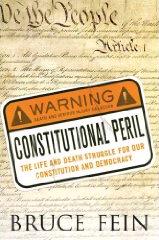
 Constitutional Peril: The Life and Death Struggle for Our Constitution and Democracy
Bruce Fein
Palgrave/Macmillan, 2008
238 pp.
The presidential election is almost upon us, and the candidates have been talking about all sorts of critical issues, such as who wears a flag pin, pays for travel for a candidate’s children, associates with bad people, and is friends with Joe the Plumber.
Actually, there are more important issues at stake. In Constitutional Peril, Bruce Fein, a former Reagan administration appointee, warns that the very future of constitutional governance is at stake. The problem is not a threatened attack from without, but the erosion of limits on government and safeguards for liberty from within. He reminds us that "Eternal vigilance is the minimum price of liberty," but the state of the presidential campaign is merely additional evidence that the American people, and most of those seeking to lead them, are anything but vigilant. He laments: "The probability that the current tides daily eroding the constitution can be reversed is slim."
 Fein starts with a bang. He advocates impeaching the president or risk "a degeneration of the US Constitution into executive despotism." Strong language, but the powers claimed by the Bush administration have been extraordinary.
Indeed, the president contended that the Authorization for Use of Military Force (AUMF), approved by Congress in the aftermath of the terrorist attacks of 9/11, also gave him essentially any power short of going to war, such as warrantless surveillance of American citizens and designation of American citizens as enemy combatants.
Fein takes his analysis a frightening step further. If the president’s argument is correct, what power does he not possess? Fein writes:
"This means that, among other things, the AUMF empowers President Bush to use the American military to kill any individuals in the United States whom he declares were complicit in the terrorist acts committed on 9/11 – on his say-so alone. In other words, the president is not required to supply evidence to a neutral or detached magistrate establishing reasonable cause for his belief that the target of the planned killing is a terrorist before employing lethal force. For example, if the president suspects that a dozen ‘high value’ al-Qaeda adherents are living in a suburban Los Angeles home, the AUMF authorizes him to order an aerial bombardment of the residence to kill its occupants. If the president’s suspicions are later proved wrong – as they were regarding the stockpiling of weapons of mass destruction in Iraq before the US invasion of March 2003; the numerous erroneous detentions at Guantanamo Bay, verified by the Defense Department’s voluntary release of hundreds of suspected unlawful enemy combatant detainees since September 11, 2001; and a June, 23, 2008, federal appeals court decision nullifying an unlawful enemy combatant finding – the homicides would still be considered legal."
This is America?
President Bush has not gone so far to level suburban neighborhoods across America, but it is the theory under which he has been governing. Thus, according to this administration, explains Fein, "if a power can be classified as ‘executive,’ then neither the legislative nor judicial branch may regulate, oversee, or check the president’s actions." It is, frankly, a preposterous argument, contradicting the intentions and actions of America’s Founders. They drafted the Constitution to disperse power to ensure that it was always checked, bounded, and constrained. How, asks Fein, "is President Bush’s unitary executive theory different from self-coronation?"
Even the war power, so closely associated with the president, is divided. Congress is to decide on whether there is a war for the president to manage. Congress establishes the military. Congress approves the rules of war. Congress provides the funding for war. In short, Congress is the dominant player even in this area. But not in the view of the Bush administration, and its legal acolytes within the conservative Greek Chorus.
Yet despite abuses so obvious and pervasive, Congress, under both Democratic and Republican control, has done little to restrain the executive branch. Rather, Fein notes, "Congress has augmented the Bush-Cheney embrace of despotic powers through the Military Commissions Act of 2006, the Protect America Act of 2007, the Foreign Intelligence Surveillance Act Amendment of 2008, and the John Warner National Defense Authorization Act of 2006."
This explains Fein’s extreme pessimism. Congress has the constitutional authority to check the executive, but it lacks the political will. Even worse, the American people seem disinterested in protecting their liberties. Notes Fein: "the American people are more culpable than Congress over the nation’s constitutional peril because they have declined to exercise their right to vote or their First Amendment right to petition Congress for a redress of grievances to demand corrective legislation or impeachment to end the Bush-Cheney transgressions."
An air of near desperation pervades Constitutional Peril. Fein details prior precedents of executive branch lawlessness. He parses the complicated controversy over the Foreign Intelligence Surveillance Act, originally approved by Congress to limit prior presidential misconduct but ignored by President Bush.
He spends a chapter on the critical topic of government secrecy, so important for the executive branch to hide illegal behavior. He notes: "President George W. Bush has reveled in secret government by invoking executive privilege or state secrets to frustrate congressional or private oversight of executive-branch actions – for example, the manipulation of US attorneys to skew law enforcement or secret spying programs that invade the privacy of Americans and, in the case of the Terrorist Surveillance Program (TSP), are flagrantly criminal."
He also discusses "extraordinary rendition," by which the US turns people over to allied states to be tortured, as well as military commissions, which have won few convictions despite being designed to ensure prosecution victories. The point is not that the government cannot defend America from people who mean the country ill, but that the steps taken must be consistent with American law and principles, and should be effective. Most foolish of all have been policies, such as torture, which have yielded little security gain while wrecking America’s reputation abroad.
Fein’s judgment of the Bush administration is harsh, but no other conclusion is possible. Who else – whether Abraham Lincoln, Woodrow Wilson, Franklin Delano Roosevelt, Lyndon Johnson, or Richard Nixon – has come close in executive misconduct? Writes Fein:
"President Bush has kidnapped, imprisoned, and tortured suspected terrorists abroad. He has created a climate of lawlessness in the executive branch, which emboldened CIA officials to destroy interrogation videotapes sought by the 9/11 Commission or Congress that probably provided ocular evidence of torture. He has signed bills passed by Congress while announcing his intent to disregard provisions that he maintains are unconstitutional – for example, a provision denying funds to establish permanent military bases in Iraq. He has asserted the power to break and enter homes, open mail, kidnap and torture to gather foreign intelligence without review by any other branch. He has tacitly declared that every square inch of the United States is a battlefield appropriate for military force and military law because al-Qaeda hopes to kill Americans anywhere, and terrorists can blend into civilian populations."
All the while the president’s policies actually have made Americans less safe. Quite an achievement for not yet eight years in office. Although Fein occasionally ranges over the top – for instance, he compares the philosophies of the bloody Grenadian dictator Maurice Bishop and President Bush – our republic truly is at risk. The danger comes not from the usual ruffians at the extremes of the political system, but seemingly respectable politicians, activists, and bureaucrats who insist that their powers must be enhanced and our freedoms must be sacrificed in order to protect us from dangers that only they recognize and understand. It is the same Siren call heard throughout history that has led to the destruction of so many liberal societies.
Ultimately, the American people can’t rely on anyone but themselves to preserve their liberty. Writes Fein: "Everyone in a democracy is thus burdened with a moral duty to act as a sentinel for the liberty of everyone else. At present, the majority of citizens are neglecting their duty."
If not us, who? If not now, when? The time to act is short. Fein presents an emergency manifesto that should be heeded by all patriots and lovers of liberty.
