



Meron Benvenisti in an excellent article mentions the “success of the propaganda campaign known as ‘negotiations with the Palestinians,’ which convinces many that the status quo is temporary." There’s indeed no better way to describe the ongoing talks between the two politicians living on borrowed time – Ehud Olmert and Mahmoud Abbas – than as a pastime orchestrated by the Bush administration. In the past, peace talks were supposed to lead to a peace agreement, which would in turn lead to peace; now, not even that little is assumed. What the negotiations are expected to yield is at best a “shelf agreement" to be implemented at some vague point in the future, or not. No one believes such an agreement can be reached, as agreed, by the end of this year, but even the shelf doesn’t really care.
But the show must go on. Last week the papers announced a great leap forward: Olmert’s Israel has submitted a detailed proposal for the final status. In true negotiations, one could have said: Now we know what Israel wants. This is not the case, since everybody knows Prime Minister Olmert is no longer relevant. So what’s the value of the proposal? We don’t really know what Israel wants, but at least we can see what Israel is willing to say.
This is an important issue in Israeli political discourse. During the last one-and-a-half decades, this has been a central point of controversy between the Zionist left and the radical left. Any honest person has to admit that nothing changed on the ground, at least not for the better: the occupation, supposed to be ending since 1993, has been worsening all the time, with the illegal Israeli settlements growing like a fatal tumor. The radical left sees this as evidence that Israel has no intention to end the occupation. The Zionist left, however, has another argument: “Listen to the way they talk." West Bank and Gaza realities are indeed worse than ever, but, claims the Zionist left, now even the Israeli mainstream openly talks about a Palestinian state, and words will inevitably become deeds – if we just support those good guys who keep entrenching the occupation while saying they want to end it (Rabin, Peres, Barak, etc. – even Sharon, who was wise enough to join the club).
The New, Generous Offer
So let’s see what official Israel is ready to say – not do – these days. The final-status proposal, according to Ha’aretz, includes the following points:
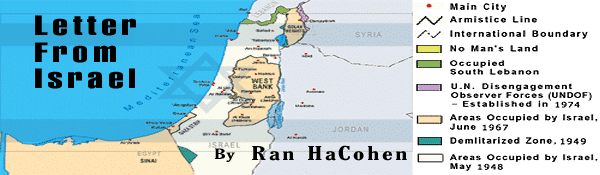
- Israeli withdrawal from some 93 percent of the West Bank, keeping Ma’aleh Adumim, Gush Etzion, the settlements surrounding Jerusalem, and some land in the northern West Bank adjacent to Israel, all in all about 7 percent of the West Bank.
- In return, the Palestinians would receive alternative land in the Negev, adjacent to the Gaza Strip, equivalent to 5.5 percent of West Bank.
- Free passage between Gaza and the West Bank without any security checks.
- The proposal rejects a “right of return” for Palestinian refugees, but includes a “detailed and complex formula” for solving the refugee problem. (No details given.)
- Olmert has agreed with Abbas that the negotiations over Jerusalem will be postponed.
Now this doesn’t sound all too attractive, not even as a “shelf agreement." Jerusalem is a core issue that hasn’t even been dealt with. Furthermore, as Ha’aretz explains, “Olmert’s proposal for a land swap introduces a new stage in the arrangement: Israel would immediately receive the settlement blocs, but the land to be transferred to the Palestinians and the free passage between Gaza and the West Bank would only be delivered after the PA retakes control of the Gaza Strip” (emphasis mine). The chances that the PA ever retakes control of the Gaza Strip are perhaps lower than that of Hamas taking control of the West Bank, but this only makes the proposal more attractive for Israel: we take the goods now, but we pay only after the Messiah comes.
Ha’aretz chooses to include an inevitable propaganda item in the otherwise informative report: “Over the past few months, Olmert has approved construction of thousands of housing units in these settlement blocs, mostly around Jerusalem, and some are intended for the voluntary evacuees." As always, Israel is breaching international law and is building more houses in the illegal settlements – but it is doing so with only one thing in mind: peace. For sure, the best way to end the occupation is to build thousands of new Israeli houses in occupied land. Their construction is (yet more) evidence of Israel’s deep commitment to peace.
Why This Eternal Pessimism?
But still, one may argue, still. Of course Olmert’s proposal will never be implemented. Of course it’s incomplete, dubious, and definitely not generous. But still: Israel is ready to pledge openly its commitment to the idea a Palestinian state on 93 percent of the West Bank, plus a 5.5 percent land swap. Doesn’t it mean that Israel finally admits the occupation’s days are numbered? Even one MK for the right-wing Likud Party consequently accused Kadima of advancing the worldview of the Zionist left: “Any [left-wing] Meretz faction member could have signed on to Olmert’s proposal." Is there any better evidence for a good proposal than the attacks from the right wing?
“Security Arrangements”
Not quite. As the report in Ha’aretz very briefly mentions, “Israel also presented the Palestinians with a detailed model of new security arrangements under the proposed agreement." At first, no details were given. Why spoil the peace party with small technical details? The initial report only mentioned a demand that the Palestinian state be demilitarized and without an army, a demand that the Palestinians accept, more or less. But obviously, the next day the Palestinians were reported to have rejected Olmert’s proposal as “unserious," in full accordance with the Israeli misconception about the alleged “Palestinian rejectionism” from 1947 to this day.
One had to wait a couple of weeks to find out what those unnamed “security arrangements” really meant. Tuesday, Ha’aretz reported that "the Palestinians oppose any Israeli military presence in the territory of a future Palestinian state." Once again, then, those unreasonable Palestinian demands: why must they insist on an independent state without an Israeli army presence?! Surely they know that Israeli soldiers are cute 18-year-old kids who never do any harm. But that’s not the end of it: the report also states that "For its part, Israel would like to supervise border crossings, maintain a limited deployment in the Jordan Valley, continue overflights of the Palestinian territory, maintain early warning stations on mountain ridges, and hold emergency response units in Palestinian areas."
Oh, so that’s what Israel means by a “two-state solution”: An “independent” “Palestinian” “state” with Israeli supervision on its borders crossings, full of Israeli soldiers, Israeli jets, Israeli military stations – and, of course, Israel’s right to send even more soldiers into it in “times of emergency." Shall we – to expose Israel’s true face – suggest mutuality? How about Palestinian control on Israel’s border crossings, a Palestinian military presence along Israel’s Mediterranean coast, Palestinian jets free to fly over Tel Aviv and Dimona, Palestinian military stations in Haifa and Ramat Yishay, and Palestinian emergency response units in Israeli areas? Obviously, such "security arrangements" are completely incompatible with a sovereign, independent state.
The Israeli proposal – as its “security arrangements” reveal – proves once again that Israel is no partner for peace. On the ground, all that Israel seeks is time to expand the settlements and strangle Palestinian society, hoping the “Palestinian problem” will eventually disappear. On the discourse level, however, things are just as bad. Despite the false contrary impression cultivated by the Israeli propaganda machine, Israel clearly rejects the notion of an independent Palestinian state, other than a Bantustan under total Israeli control. If you wonder why the Israeli-Palestinian conflict remains unresolved, this is the simple answer: the two-state solution, proposed by the UN 60 years ago and endorsed by the Palestinians 20 years ago, is still unacceptable to Israel’s military and political leadership.
