



“Where is the Palestinian Gandhi?” is a quite popular question, especially abroad. You won’t often hear it asked (with the inevitable self-righteous shrug) here in Israel: after all, the Israeli culture itself worships violence, with the semantic field of “war” being the richest in the modern Hebrew language, with militarism as the state religion, and with popular wisdom expressed in rules of thumb such as “where force won’t do, try more force.”
But Americans love the Gandhi riddle. While their governments give Israel gigantic military aid, private Americans with the best intentions – and Britons such as actor Ben Kingsley – translate the film Gandhi into Arabic and screen it all over the occupied territories as an example for the Palestinians to follow.
The intentions of “the Gandhi Project” must be noble. And though international law and conventions unambiguously acknowledge the right of occupied peoples to use violence against their oppressors – just like guerrilla fighters did under Nazi occupation – the question whether violence or nonviolence serves their cause better is for the Palestinians to decide. There are, of course, several convincing arguments in favor of abandoning the violent resistance, most notably the huge benefits that Israel draws from portraying the Palestinians as “terrorists” to legitimate the use of its overwhelming military superiority against them.
If “the Gandhi Project” wants to be truly helpful, however, I have a better idea for it. Instead of screening Gandhi in the occupied territories, let it screen throughout America the footage of the recent demonstration in the Palestinian village of Bil’in (to be found on Gush Shalom’s Web site). This footage can help inform Americans about the realities of the occupation largely equipped and financed by their taxes – a much more urgent task than teaching Palestinians about the late Indian leader. It also suggests an unusual solution to the puzzle of the “Palestinian Gandhi.”
The Bil’in Demo
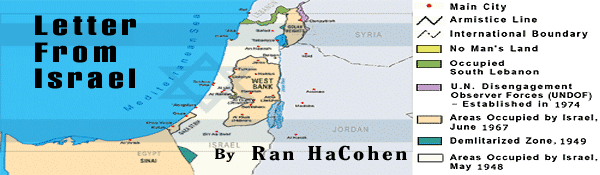
Bil’in is a small village in the occupied West Bank. The apartheid wall, advancing full speed ahead behind the effective smokescreen of the “disengagement plan,” is now being built there, almost touching the houses of the village and separating it from most of its lands. These lands will be given to the illegal settlement of Kiryat Sefer, which is built on lands taken from the Palestinian villages all around it and inhabited by ultra-orthodox Jews (the Zionist state managed to mobilize even parts of this traditionally non-Zionist Jewish sector for its colonialist project).
On Thursday, April 28, about 1,000 Palestinians and some 200 Israeli guests, invited by the people of Bil’in, participated in a demonstration against the wall. All the participants undertook in advance to avoid all violence, no matter whether they had seen the Gandhi film or not. But even before the demo could reach the site of the fence, it was savagely attacked by the Israeli security forces, which bombarded it with tear-gas bombs without the slightest provocation. Among the demonstrators were the Palestinian minister Fares Kadduri, presidential candidate Mustafa Barghouti, Uri Avnery, and Israeli Knesset member Muhammad Barakeh, who was wounded during the attack. The peaceful demonstration was a welcome occasion for Israeli special units to wound several demonstrators with the latest innovation, introduced here for the first time: especially painful plastic bullets covered with salt. Indeed, the so-called Jewish Genius is never exhausted.
Israeli Army Incriminates Itself
So far, you may say, there’s nothing new. Gandhi never promised the British wouldn’t use violence: he propagated nonviolent uprising in spite of British violence. Indeed, the army’s provocation did not work and the demonstration remained nonviolent. So here is what happened next, as reported in Ha’aretz, April 29, 2005:
“During the clashes, undercover security forces mingled with the demonstrators and began to throw stones at the soldiers and police, demonstrators said. The undercover security forces had provoked the police and soldiers into opening fire with rubber bullets and tear gas. The demonstrators said they had not thrown stones at the soldiers and police.”
The “undercover forces” mentioned are Israeli soldiers dressed as Palestinians who mingle in the crowd. Such forces – well-trained in Arabic language and customs – have been employed by Israel since the First Intifada in the late 1980s, often used also as death squads for the summary killing of “wanted” – i.e., unwanted – Palestinians. Now we hear that these undercover Israeli soldiers threw stones.
Well, you may argue, “demonstrators said.” Demonstrators always say such things. Who said such undercover soldiers were present in Bil’in at all? After all, they were dressed as Arabs, so how can you tell? Even if the undercover soldiers were present, why should I trust the demonstrators’ accusations?
Okay, good points. But listen to what the officer in charge had to say to Ha’aretz about the event:
“Military sources … added that the undercover forces had only started throwing stones after Palestinian youths had adopted such tactics. ‘Stone-throwing by the undercover forces is part of the way in which they operate in such instances,’ the sources said.”
Oh, so undercover units definitely were present in Bil’in – the army itself admits that (in fact, it’s very easy to spot undercover soldiers when they start making arrests). And not only did they throw stones on this occasion: stone-throwing is part of their job as a rule – again, the army itself says that! The only disputed point is whether they started throwing stones before or after demonstrators did so. Now think for yourself: why on earth should an undercover agent provocateur throw stones after some demonstrators do so? Give me one reason. Obviously, the Israeli officer (identified in Ha’aretz’s Hebrew edition as “Lieutenant Colonel Tzahi”) is lying on this point.
We’ve now got a clear confirmation of what Palestinian and Israeli peace activists have been saying all along: the Israeli army would not tolerate a Gandhi-style resistance. Someone up there in the occupation echelons must have studied Ben Kingsley’s film long before “the Gandhi Project” got started and reached the conclusion that nonviolent resistance is not in Israel’s interest. To thwart this threat, Israel employs soldiers whose task is to turn a peaceful demonstration into a violent one, by infiltrating it undercover and throwing stones at Israeli soldiers. During the demonstration, the army uses these stones as a pretext to break the demonstration by force, using tear gas, salt, or rubber-coated bullets and live ammunition. In the aftermath, this stone-throwing – pictured by army photographers who surely don’t miss the stones thrown by their own comrades – enters the world media as propaganda, depicting the peaceful demonstrators as dangerous stone-throwers.
*
So the problem is the perpetrators, not the victims: it’s Israel, not the Palestinians. The Palestinians don’t have to watch the Gandhi film. They fought the First Intifada with stones (1987-1993) and were answered with Israeli bullets. They fought the Second Intifada (00-2004) with weapons and were answered with Israeli tanks, Caterpillar bulldozers, and airplanes. And they now start a Third Intifada, a popular, unarmed, nonviolent struggle against the strangulating fence, which is answered with Israeli undercover soldiers who throw stones and want us to believe the Palestinians have done it.
There are thousands of Palestinian Gandhis out there, then: whole villages that demonstrate daily and peacefully against the robbery of their land and livelihood. Alas, their voices are unheard – because of the Israeli undercover soldiers who throw stones from within these peaceful demonstrations, and because of commentators and movie stars who then wonder, “Where is the Palestinian Gandhi?”
