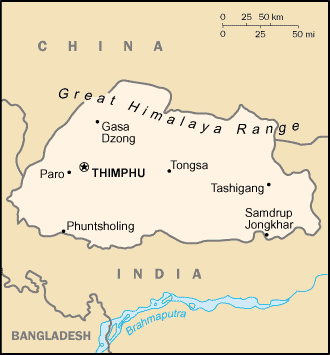
GENEVA – More than 100,000 refugees from the small Himalayan nation of Bhutan continue to languish in camps in Nepal, while neither talks between the governments of the two South Asian kingdoms nor the international community have come up with any plan to put an end to their forced exile, which has dragged on for 13 years.
The long wait to return to their homes and their land has undermined the refugees’ hopes and left them extremely frustrated, especially the younger generations, said Bhutanese Professor Ratan Gazmere, who was forced into exile in 1992.
Since late 1990, tens of thousands of ethnic Nepalis from southern Bhutan, who are mainly Hindus, have been expelled from the country and stripped of their Bhutanese nationality, said Gazmere.
Gazmere was among the Nepali-speaking Bhutanese arrested for protesting the "One Nation One Culture" policy introduced by King Jigme Singye Wangchuk in 1990, which modified citizenship requirements and forced all Bhutanese to wear the dress of and practice the Drukpa culture of the dominant Buddhist ethnic groups that make up roughly three-quarters of the population.
Demonstrations held by ethnic Nepalis to protest that policy triggered what human rights organizations describe as an "ethnic cleansing" campaign by the government, which began to arrest activists for participating in "anti-national" activities.
The resulting police and army repression, which according to human rights groups included gang rapes, prompted the mass exodus of southern Bhutanese, who fled westwards to Nepal, through India. (Bhutan is wedged between India and China.)
Meanwhile, the ethnic Nepalis who remain in the southern lowlands of Bhutan, where their ancestors have lived for centuries, are treated like second-class citizens, say organizations like the New York-based Human Rights Watch.
The latest census among the refugees in southeastern Nepal, carried out last June, found that 104,235 people – roughly one-sixth of the population of Bhutan – are living in the seven camps there under the protection of the United Nations Office of the High Commissioner for Refugees (UNHCR).
UN High Commissioner for Refugees Ruud Lubbers said two weeks ago during the sessions of the UNHCR executive committee in Geneva that the situation of the Bhutanese refugees was far from encouraging.
Developments over the past year in Nepal "have only made it more urgent to find solutions for the group," said Lubbers, referring to the stepped-up activity of Maoist guerrillas in Nepal and the rise in government repression.
Gazmere, a former political prisoner, told IPS that "for now we haven’t seen very clear evidence of [the guerrillas] affecting our stay in Nepal. But we are very worried . . . and we want the international community to intervene urgently" so that the internal tension in Nepal does not make the refugees’ situation even more difficult.
Since 1993, the negotiations seeking a solution to the refugee problem have been limited to the bilateral level, between the governments of Nepal and Bhutan.
Authorities in Bhutan have refused to allow the UNHCR to take part in the talks. Nor have they accepted the presence of representatives of that UN agency in Bhutan.
But the Nepali government immediately requested assistance from the UNHCR, as soon as the southern Bhutanese began to flow into the country in the early 1990s.
The refugees want to return to their original homes and properties with safety guarantees and full citizenship rights. But since 1998, the government has been resettling Buddhist Bhutanese from other regions on the land that once belonged to the refugees.
The only tangible result from the talks was an agreement by the two countries that the people living in the camps should be classified in four different groups, to determine eligibility to return to Bhutan.
The categories are: (1) "bona fide" Bhutanese who have been forcibly evicted; (2) Bhutanese who supposedly voluntarily left their country; (3) non-Bhutanese; and (4) Bhutanese who have purportedly committed criminal acts (including those who participated in "anti-national" pro-democracy activities in Bhutan).
Under that agreement, the government of Bhutan pledged to "accept full responsibility for [any] bona fide Bhutanese national who has been forcibly evicted from Bhutan."
So far, the 12,500 refugees living in Khudunabari camp have been screened as part of the verification process.
But UNHCR representative in Nepal Abraham Abraham said his agency was "concerned over the results, as only 293 individuals [74 families] were found to be bona fide Bhutanese, whereas over 70 percent of the Khudunabari refugees were categorized as persons who had voluntarily left Bhutan and thus lost their citizenship in accordance with the Bhutanese Nationality Act."
"Furthermore," he added, "some 85 families were categorized as criminals, including babies and young children born in the camps," while other families were split up into different categories.
A full 94 percent of the Khudunabari refugees have appealed the findings of the screening process. But the UNHCR has expressed concern that "the bilaterally agreed appeals process does not comply with international legal standards that call for an independent body" to review the appeals.
Human Rights Watch and other non-governmental organizations (NGOs) have expressed concern that flaws in the verification process "risk leaving tens of thousands of refugees stateless."
The leaders of the refugees, meanwhile, say they have no faith in the talks between Nepal and Bhutan. The "bilateral process is not going to resolve this problem and provide a durable solution to the Bhutanese problem," said Gazmere.
Concerned NGOs "are asking the international community to convene an international conference" as soon as possible, he added.
The activist said Nepal, Bhutan, the UNHCR, the UN Office of the High Commissioner for Human Rights, the refugees themselves, and the donor countries that are helping support the refugee camps should take part in that international conference.
Invitations should also be extended to NGOs like the London-based Amnesty International, Human Rights Watch, and the Lutheran World Federation, which have taken an interest in the situation of the Bhutanese refugees, he added.
Gazmere said that as the refugees continue to wait for a solution, conditions in the camps have deteriorated, particularly health and education services, which he said have been "drastically reduced."
"Many people are dying now because they don’t get medical assistance in time, especially old people because [the assistance] seems to focus on young people," he complained.
And while the UNHCR provided education up through the university level at the start, that was eliminated after just two or three years, and since then young refugees have only had access to primary and secondary level education, said Gazmere.
Until this year, that is, when only primary school classes began to be offered, he added.
However, Jennifer Pagonis, UNHCR deputy head of Media Relations and Public Information Service, said it is not true that health care coverage for the elderly has declined.
The UNHCR, through NGOs, "has been consistent in providing an acceptable level of health care to refugees of all ages," she told IPS.
"Actually, the quality of health care provided to the refugees exceeds that of the local population," she added. "In fact, we’re including the local population in our programs to raise their standards to equal ours."
And with regards to education, "Under UNHCR’s mandate we must provide primary education to refugees throughout the world. In the case of the Bhutanese refugees they have also been receiving secondary level education."
"Unfortunately, the NGO which provides education in the camps, Caritas, has been unable to get the necessary funding for secondary education this year. We are hoping, for the refugees’ sake, that [the group’s] funding situation improves," said Pagonis.