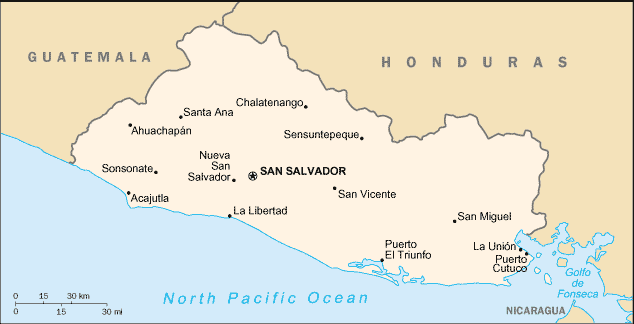
MEXICO CITY – As of Oct. 22, an eternal flame will burn continuously outside the Metropolitan Cathedral in the capital of El Salvador, as an everlasting tribute to Catholic Archbishop Oscar Arnulfo Romero, a leading light in the struggle to bring peace to his country, whose murder remains unpunished after almost 25 years.
As the archbishop of San Salvador, Romero regularly spoke out against the growing violence and violations of human rights perpetrated by the armed forces and paramilitary death squads in his country.
On March 23, 1980, he directly addressed the country’s soldiers in his weekly homily, pleading, “In the name of God, in the name of these suffering people whose cries rise to heaven more loudly each day, I implore you, I beg you, I order you: Stop the repression.”
The next day, he was shot dead by a sniper while celebrating Mass.
Romero almost instantly became a martyr and icon for progressive Catholics throughout Latin America, and was officially recommended by the Catholic Church of El Salvador for canonization as a saint in 1994. Yet today, as the 25th anniversary of his assassination draws near, those responsible continue to enjoy full impunity.
His followers and relatives have not ceased in their demands for justice to be served. But the current Salvadoran government led by President Antonio Saca refuses to investigate the case, which has been conveniently buried beneath an amnesty law.
Saca is from the Nationalist Republican Alliance (ARENA), the party founded in 1981 by Roberto D’Aubuisson, who was previously the founder and leader of El Salvador’s notorious death squads, and is widely considered to have ordered Romero’s murder.
According to the report issued in 1993 by the UN Truth Commission on El Salvador, “There is full evidence that former major Roberto D’Aubuisson gave the order to assassinate the Archbishop and gave precise instructions to members of his security service, acting as a death squad, to organize and supervise the assassination.”
The amnesty law was also passed by an ARENA-controlled legislative assembly, the very same year the report was released.
Since March of this year, numerous religious and cultural activities have been organized to commemorate the slain archbishop. The next major event will be the lighting of the eternal flame outside the cathedral, to be followed by other activities culminating in April 2005.
Despite the obstacles they face, religious and human rights groups have not given up the pursuit of justice.
Their hopes were raised in September when a U.S. federal court judge in the state of California ruled that former Salvadoran Air Force Captain Alvaro Saravia was guilty of planning Romero’s murder together with other former military officials. Saravia was ordered to pay $10 million in damages.
Saravia had emigrated to the United States when an investigation into his role in the assassination began.
In 1987 he was detained by U.S. authorities when Salvadoran prosecutors sought his extradition. But the Salvadoran government and judicial system moved quickly to have the request withdrawn, under the pretext that there was not enough evidence to lay charges, and Saravia was set free in 1988.
Archbishop Romero’s surviving family – his two brothers, now in their 70s – eventually turned to the U.S. courts, filing a civil suit against Saravia in the state of California under the Alien Tort Claims Act and the Torture Victim Protection Act, which allow foreign nationals to be tried in the United States for crimes committed abroad.
Saravia did not appear in court, and was tried and sentenced in absentia. Although his exact whereabouts are unknown, it is assumed he is still in the United States.
“What happened in California is encouraging, but the people who planned and carried out the murder of Archbishop Romero remain unpunished, and are protected by [Salvadoran] state structures,” Adelaida de Estrada, spokesperson for the non-governmental Oscar Romero Foundation, told IPS over the phone from San Salvador.
“And that is because the ruling party, ARENA, has blood on its hands from this crime,” she added.
D’Aubuisson, the army major who founded ARENA, is identified in numerous reports, including the one issued by the UN, as the creator of the notorious death squads that assassinated Romero and murdered countless Salvadorans during the civil war that escalated throughout the 1980s and continued into the early 1990s.
Throughout the years of armed conflict against the leftist guerrilla forces of the Farabundo Martí National Liberation Front (FMLN), the Salvadoran security forces and paramilitary death squads were responsible for massacres, killings, torture and “disappearances” on a massive scale.
The war left 75,000 dead and another 7,000 “disappeared,” while an estimated one million Salvadorans fled the violence by seeking refuge in other countries. Among those murdered by the army and death squads were 18 Catholic priests and five nuns, four of whom were from the United States.
“Political power is in the hands of the armed forces,” Romero declared in a homily just a month before his death. “They use their power unscrupulously. They only know how to repress the people and defend the interests of the Salvadoran oligarchy.”
In his weekly homilies, Romero relentlessly spoke out against the violations of human rights and repression exercised by the soldiers and death squads. He harshly criticized the far right, and promoted pastoral work in rural communities and slum neighborhoods.
Romero also denounced the involvement of the U.S. government, which sent billions of dollars in military aid to the Salvadoran government during the civil war, as well as providing training for the country’s armed forces. The late D’Aubuisson himself was a graduate of the School of the Americas, a U.S. military college specializing in counter-insurgency.
Just weeks before his death, the archbishop sent a letter to then U.S. President Jimmy Carter, in which he wrote, “You say that you are Christian. If you are really Christian, please stop sending military aid to the military here, because they use it only to kill my people.” The letter was never answered.
Born in 1917 in the Salvadoran city of Ciudad Barrios, Romero studied theology at the Gregorian University in Rome and was ordained as a Catholic priest in 1942. He returned to El Salvador where he served as a parish priest and later the rector of a seminary in the capital. He was ordained a bishop by the Vatican in 1967, and then designated archbishop of San Salvador on Feb. 22, 1977.
Romero was specifically chosen because he was viewed as a “conservative.” He had publicly criticized the progressive stances adopted by followers of Liberation Theology, or option for the poor, which was becoming a growing force in the Catholic Church in Latin America.
Much to the dismay of the church and government establishments, however, he was soon to become an outspoken champion of the poor and oppressed, and a critic of the very sectors that had originally applauded his designation.
In recognition of his tireless efforts to defend human rights and promote a negotiated settlement to the violence in El Salvador, Britain nominated him for the Nobel Peace Prize in 1978.
But Romero’s denunciations of the human rights abuses committed by the army and death squads and his defense of the poor and marginalized sectors of society earned him the enmity of the wealthy elites and the U.S.-backed military forces, who viewed him as a “communist.”
The hatred toward him continued even beyond his death: during the archbishop’s funeral services, a bomb exploded outside the cathedral in San Salvador, and government troops then opened fire on the crowd of 50,000 who had gathered there to pay their last respects. An estimated 40 people died and another 200 were wounded as a result.
The armed conflict in El Salvador finally ended in 1992 when the government and the FMLN signed a peace accord in Mexico City.
But according to Romero Foundation spokeswoman de Estrada, “We Salvadorans continue to state loudly and clearly that there can be no real peace while murders like Archbishop Romero’s remain unpunished.”
The Saca administration refuses to even consider reopening the Romero case, despite continuing demands that it do so and the findings of a 2000 report from the Inter-American Commission on Human Rights.
As part of the efforts to seek justice for the Archbishop’s assassination, a case was brought before the Commission, which ruled that “a state cannot rely on the existence of provisions of internal law to elude carrying out its obligation to investigate human rights violations, place on trial the persons responsible, and prevent impunity.”
The Commission’s report noted that with regard to the Romero case, the Salvadoran government had violated numerous international agreements on due justice.
The report further recommended “that the State carry out a complete, impartial, and effective judicial investigation, expeditiously, so as to identify, try, and punish all the perpetrators, both the direct perpetrators and the planners of the violations established, notwithstanding the amnesty decreed.”
Nevertheless, when the legal department of the San Salvador Archbishop’s Office requested that certain articles of the amnesty law be repealed in order to resolve the question of Romero’s murder, Saca said that “Reopening old wounds from the past would not be in the best interests of a country looking towards the future.”
“The Salvadoran people elected me to manage the future, and for that reason, reopening old wounds is something I do not agree with,” he added.
But while the ARENA-led government continues to hide behind the amnesty law to avoid reopening the case, the Romero Foundation and other humanitarian groups will not cease in their fight for justice.
“The murder of Archbishop Romero was a crime against humanity, and it cannot be sheltered by any law,” said de Estrada.
“There are people who were behind D’Aubuisson in Romero’s assassination, and they are still walking around with impunity. They have to pay,” she said.
Both the archbishop’s office and the Romero Foundation are working with lawyers to determine the best course to follow in order to pursue further legal action, either in El Salvador or in foreign courts.