PARIS – Beneath the apparent calm after the last round of clashes, the diplomatic battle in Cote d’Ivoire is getting hotter.
This time the clash is building up not between government and rebel leaders but between the government of President Laurent Gbagbo and the French, who had protected and supported Gbagbo until recently.
French President Jacques Chirac now calls the Gbagbo government a "questionable regime." He has declared his government will maintain its military presence in Cote d’Ivoire "because we are fulfilling an international mandate supported by the whole of the African community."
France has had a presence of about 1,000 troops in Cote d’Ivoire under a military cooperation agreement signed in 1960 that allows French military intervention "in the event of foreign aggression." Following the outbreak of the civil war in late 2002 between government forces and northern rebels, France expanded that force to about 5,000.
After the civil war, the French forced Gbagbo to abandon the controversial concept of the ‘Ivoirite’ built into the constitution, under which about 4 million northerners in a population of 15 million were denied political participation or land ownership. This was on the ground that they were descendants of migrants from neighboring countries, mostly Burkina Faso and Mali.
A peace agreement signed in Marcoussis in France in January last year imposed upon the government the end of the concept of Ivoirité. This was the main demand of rebels trying to oust Gbagbo.
"By building the end of the Ivoirite into the peace agreement the French government bestowed a degree of legitimacy on Gbagbo rivals," Claudine Vidal, expert on West African politics at the French National Research Center told IPS.
The agreement also obliged Gbagbo to carry out radical reforms and to designate several political opponents as ministers. But while French diplomatic intervention went one way, its military intervention had gone another. In the civil war, the French helped Gbagbo resist the rebel offensive.
"Gbagbo never really accepted the Marcoussis agreement," Vidal said. "He publicly said that he had to accept it because at the time he did not have the military capacity to crush the rebellion."
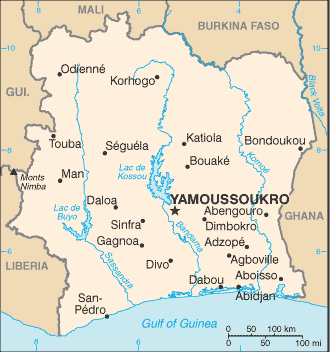
Earlier this month, he evidently thought he did. He launched an offensive against northern rebels across the so-called "confidence zone," a demilitarized stretch that runs from the border with Liberia in the west to the border with Ghana in the south. During that offensive, Gbagbo’s forces attacked a French post killing nine French soldiers and injuring 23.
Gbagbo said later that the attack did not take place, and that if it did, it was an accident.
The diplomatic battle followed. "We just do not want that a fascist regime takes hold of the country," Chirac said. Gbagbo, on the other hand, accused the French of "supporting for 40 years a one-party regime in Cote d’Ivoire," a reference to French support for the regime of Felix Houphouet-Boigny from 1960 to 1993.
In the present scenario, Gbagbo said, "by destroying our air force, Chirac has taken sides with the rebels."
Gbagbo accuses French military forces of summary executions of his supporters, and other human rights violations. The French refute such charges.
The diplomatic war is being fed by economic pressures. The economy of Cote d’Ivoire has been in crisis since the devaluation of the French African franc in 1994 and the fall of the price of cocoa.
France now says it will use military power if necessary to defend French interests in Cote d’Ivoire. French companies control most of the economy, particularly public services such as water, electricity, telephones, and transport.
About 500 small and medium enterprises at the heart of the private economy are also in French hands. "All this has created the impression that the Ivoirians are suffering from a neo-colonial economy," Africa expert Stephen Smith wrote in the Le Monde daily.
Gbagbo’s supporters, the "young patriots" as they are called, have been demonstrating in the commercial port city Abidjan to demand an end to "colonial occupation." They have attacked French schools and settler homes, shouting slogans like "One French for every one of us."
The French are again trying to persuade government leaders and rebels to hold talks, but this time no one seems to be listening. Gbagbo says that honoring the Marcoussis agreement is now out of the question. Rebel leaders say it is not good enough for them either.
The French government has won stronger international support for its intervention in Cote d’Ivoire through the Organization of African Unity and the United Nations.