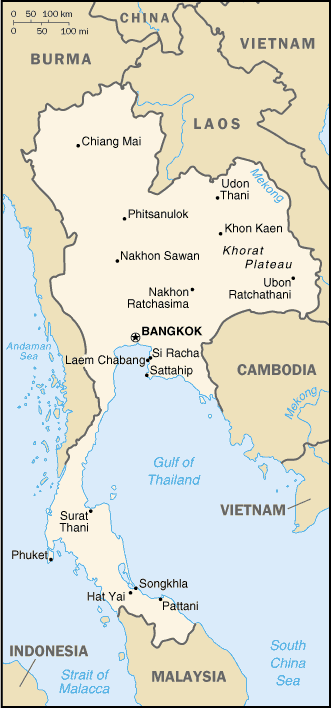
BANGKOK – By permitting judges to arm themselves in the southern provinces, Thailand has conceded that it faces a daunting task in trying to control violence in the region, which now seems to have taken a turn for the worse.
This week’s decision by the Office of the Judiciary for court officers to be armed comes in the wake of a provincial judge being killed by insurgents in the predominantly Muslim province of Pattanti on Friday.
The 37-year-old Rapin Ruangkeow became the highest-ranking official to have been murdered since violence erupted in Thailand’s south in January this year. Rapin, say newspaper reports, was shot seven times in the head and body by three gunmen on a motorcycle while he was in his car. His wife and daughter witnessed the killing.
Provincial judges with guns will become the latest in a growing number of civilians who are being encouraged to bear weapons to defend themselves – an indication that, at least in southern Thailand, the state cannot fulfill its role of protecting its citizens.
In June, teachers in high schools were given the nod to arm themselves in the wake of attacks by insurgents on the halls of learning. And since then, the army has helped train civilians in villages that are vulnerable to attacks.
Such measures towards self-defense arise from the high civilian death toll, a number that could increase with the targeting of high-profile civilians like provincial judges, say analysts.
"The shooting of the judge this month marks the beginning of a new trend," Panitan Wattanayagorn, a national security expert at Bangkok’s Chulalongkorn University, said in an interview.
"The armed groups have been forced to switch tactics with the police and the army is better protected and going after them," he added. "They will turn to high-value targets, now that time is running out for them."
According to Panitan, there has been over 500 attacks against the security forces, government officials, civilians and symbols of the state in the south over the past eight months.
The death toll has reached 210, he added.
Of that, civilians have been the worst hit – with 114 deaths – followed by the police, with 38 killed. Thirty-five local officials have also been killed and the army, so far, has suffered 23 deaths.
And a spate of recent arrests has helped the government point a finger at some of the people behind these attacks – men belonging to Thailand’s Malay-Muslim minority in the volatile region.
But Bangkok’s attempt to bring the Muslims’ under its wing through a show of force is provoking rage. The regular assaults mounted by security forces on an import symbol of the Malay-Muslim culture – the Islamic schools – are a case in point.
On Tuesday, the Bangkok Post accused the army of being heavy-handed in its raids on the pondoks, as the religious schools are known. "The raids were violent and insensitive," it argued in an editorial, adding further that since these crackdowns began, "authorities have yet to report the capture of any terrorist mastermind or weapons."
Further, human rights groups have already expressed concern about the deaths and disappearances of Muslim civilians since martial law was imposed at the beginning of this year.
The rage among sections of the Muslim youth towards the political climate in the South was witnessed on April 28, when scores of them, armed with mostly knives, machetes and some guns, attacked 10 police stations and security check points in the provinces of Yala, Songkhla and Pattani.
One hundred and seven of them were killed, including 32 Muslim militants who had taken refuge in a mosque of historic significance.
Some Muslim academics doubt that the government can curtail the bloodletting due to the increasingly heavy-handed military approach that Bangkok is embracing as a strategy.
"When you respond with violence towards culturally sensitive symbols like the pondoks, you risk pulling the phenomenon of violence to another level," Chaiwat Sath-Anand, director of the Peace Information Center at Bangkok’s Thammasat University, told IPS.
Yet at the same time Chaiwat, a member of Thailand’s Muslim minority, is disturbed by the way the assailants have targeted civilians. "It is quite different from the attacks against the state, which we have witnessed before."
Some of the victims who have been targeted, such as Buddhist monks, reveal a new form of hostility in the South, he asserted. "It is unprecedented in several ways. I have not seen it in all my years as an academic."
The Malay-Muslims accounts for 2.3 million people of Thailand’s 63 million population, the vast majority of whom are Buddhists. The Muslim minority lives in five southern provinces, four of which share a border with Malaysia.
In the early 1970s, Muslim rebels launched a separatist struggle to restore a once independent Muslim kingdom of Pattani, which was annexed by Bangkok in 1902.
Such a struggle was a reaction to the attempts by military dictators who ruled Thailand, at the time, – when they tried to force Malay-Muslims to assimilate into the Thai nation. And although the rebellion was quelled by the early 1980s, the region has witnessed outbursts of violence since the early 1990s, with average attacks since 1993 being between 40 to 70 a year.
That Bangkok is far from immediate success in the current spate of violence was brought home over the weekend, when it announced that it would be sending nine more battalions to strengthen the 10 military battalions stationed in the south.
"Sending more troops to the area is good if it helps to crackdown on those who are breaking the law," Nimu Makaje, vice president of the Islamic Council in the southern province of Yala, told IPS. "Anything illegal has to be stopped."
But just as important, he cautioned, is the way the new troops will perform. "They have to have an understanding about what is going on in the South. They have to know who the people are."
"If not," he added, "they can make the situation worse."