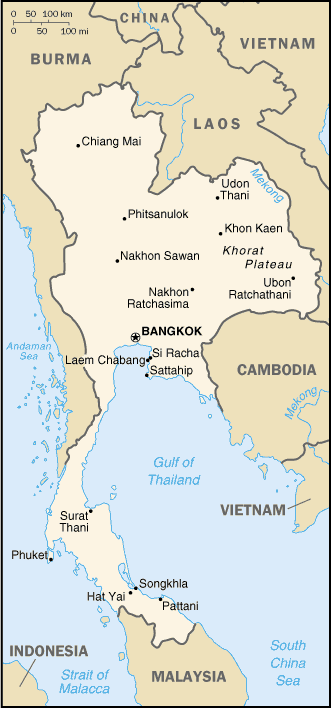
BANGKOK – A clash at the start of this week between hundreds of Muslim protesters and heavily armed Thai troops in the country’s south – which left over 80 dead – has delivered a blow to Bangkok’s view that it has the local communities on its side.
The showdown on Monday that initially resulted in six Muslim demonstrators killed and an estimated 20 soldiers, police, and protesters wounded marked an ominous sign in a region gripped by spiraling violence since early January this year.
That climate worsened by Tuesday evening, when a senior Thai army commander confirmed that 78 Muslim protesters had died of suffocation while being taken in packed military trucks to army camps in the southern province of Pattani – five hours by road from where the demonstrators were arrested.
Reporters who attended the press conference in Pattani quoted Maj. Gen. Sinchai Nutsathit, deputy commander of the Fourth Army Region, which handles security in Thailand’s south, as affirming that "over 80 percent of the deaths were due to suffocation."
This is the second highest number of people killed in a day in the troubled southern provinces, three of which have a predominant number of Malay-Muslims.
The bloodiest day was on April 28. It happened after a showdown between heavily armed Thai troops and Muslim assailants with machetes and knives. Over 110 people died, the vast majority of whom were Muslims who had attacked police and army posts in three southern provinces – Yala, Songkhla, and Pattani.
The killing of 32 militants among that number who had taken refuge in a historic mosque in Pattani prompted cries of "massacre" for the military’s excessive use of force.
Already, the fallout from Monday’s clash is being cast in dismal tones by politicians and human rights advocates.
"This display of public anger was never the case before. What we have is a collective outcry by Thai Muslims against the government for the methods used in the south," Kraisak Choonhavan, chairman of the committee on foreign affairs in the Thai Senate, told IPS.
"It is a response to the violent and tough methods used by the government to quell any form of protests there," he added. "Thai-Muslim communities are fed up with the government."
The government imposed martial law after violence erupted in January. That has resulted in alleged human rights violations by the police and government troops, such as arbitrary arrests, tortures, killings, and disappearances, say groups like Amnesty International.
Soon after Monday’s bloody clashes, the administration of Prime Minister Thaksin Shinawatra announced plans to seek out the masterminds of the protest. First in line for this inquiry will be the estimated 1,300 protesters who were arrested and taken to military barracks in Pattani.
Local newspapers carried large photos of some of these men – forced to lie on the road, face down, with their hands tied behind their backs.
On Monday night, television stations provided graphic footage of the clashes that had erupted in the southern province of Narathiwat.
The protest began at six in the morning, when about 200 people gathered outside a police station to demand the release of six men suspected of stealing firearms given to civilians to protect their community, say Thai newspapers.
By afternoon, the numbers had swelled to an estimated 2,000 agitated people, and the police station’s security had been reinforced by close to 1,000 armed soldiers.
Fire engines were brought in to spray water at the protesters, but they were unable to contain the crowd. When security forces fired tear gas at the protesters, pandemonium ensued.
The Thai troops are also being accused of firing live ammunition into the crowds.
A Thai human rights advocate finds this week’s outburst "alarming" and concurs with Kraisak, the senator, about the possible sparks that triggered the over six hour-long stand off between the booing and jeering demonstrators and the security forces.
"It is understandable, because of the maltreatment of the people. The public in the south doesn’t trust the government and officials anymore," Boonthan Verawongse, secretary of the Bangkok-based Peace and Human Rights Resource Center, told IPS.
Increasing signs of such visible collective anger by the Malay-Muslim minority toward symbols of the state in the south have surfaced in recent months. In late September, for instance, paramilitary rangers were forced to flee a checkpoint in Narathiwat after being confronted by hundreds of villagers, who converged on the soldiers with sticks and rocks.
That animosity grew out of a charge made by the villagers that the soldiers had allegedly shot a 37-year-old Muslim woman with birdshot.
In mid-September, a Muslim cleric threatened to bring over 50,000 people onto the streets to protest against the manner in which Thai troops were raiding Islamic boarding schools in search of suspected Malay-Muslim separatists.
Violence in southern Thailand erupted on Jan. 4, when assailants stormed an army camp in the south and escaped with military hardware, including 380 M-16 rifles. That day also saw 21 public schools torched.
The attacks have escalated since then, and Bangkok is accusing Muslim separatists for killing over 200 people, including policemen, soldiers, civil servants, teachers, Buddhist monks, and students.
According to official figures, over 350 people have died since Jan. 4.
The Malay-Muslims account for 2.3 million people of Thailand’s 63 million population, the majority of which is Buddhist.
Militants among this Muslim minority waged separatist struggles in the 1970s to reclaim five southern provinces that are home to Muslims. Over a century ago, these provinces belonged to the kingdom of Pattani, which was annexed in 1902 by Siam, as Thailand was then known.
Besides religion, the Malay-Muslims have a history, culture, and language that are different from the one shared by the majority of Thailand.
According to Boonthan, the human rights advocate, this division is bound to grow, given the message Bangkok is sending out in its policy toward the south.
"The government seems to think that only using violence can solve problems," he said.