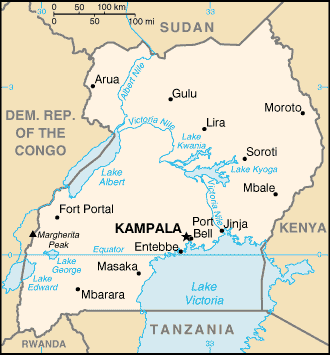
NAIROBI – The conflict in northern Uganda, which has claimed thousands of lives and displaced about a million people, is losing momentum and slowly grinding to a halt, religious leaders and human rights groups say.
"The situation [in northern Uganda] is quiet. There is a climate of optimism that the war is in its final stages," Catholic priest Fr. Carlos Rodriguez told IPS in a telephone interview from the main northern Ugandan town of Gulu on Sept. 21.
Rodriguez, a top official of the Justice and Peace Commission of Gulu Archdiocese, lives in Gulu where the region’s main ethnic group, the Acholi, has borne the brunt of attacks by rebels of the Lord’s Resistance Army (LRA) since 1986.
More than 850,000 Acholis, out of a population of about 1.2 million, have been displaced by the fighting between the army and the rebels.
"Of the displaced, 80 percent are women and children. The number of children displaced by the war is 300,000," Anne Sekandi, the UN Children’s Fund’s assistant communications officer, told IPS from Kampala, Uganda’s capital on Sept. 21.
Led by a former Roman Catholic catechist, Joseph Kony, himself an Acholi, the LRA is seeking to topple the government of President Yoweri Museveni and install a system of rule based on the Biblical Ten Commandments.
To the dismay of human rights groups, the rebels have been attacking civilians and abducting children whom they recruit as fighters, laborers and sex slaves.
More than 50 percent of the LRA soldiers are children aged six to 17 years, according to human rights groups.
"The rebels kidnapped 10,000 children between June 2002 and October 2003, up from 101 in 2002. This brought the total number abducted by the LRA since the start of the conflict to more than 20,000," the UN Office for the Coordination of Humanitarian Affairs (OCHA) said in a publication, "When the Sun Sets, We Begin to Worry," released in January.
Fearing abduction, thousands of civilians caught in the conflict walk up to 10 km (6.2 mi.) from the countryside into more secure towns or camps every evening, sleeping in the open in school compounds, hospitals and churches. These people have earned the name "night commuters."
"There were 44,000 child ‘night commuters’ at the end of August 2004 in the conflict-ridden districts [of Gulu, Pader and Kitgum]," Sekandi said.
Rodriguez said the figures of children abducted have reduced drastically. "Two weeks ago there were 20 abductions in Kitgum, as opposed to previous ones when there would be five or 10 kidnappings a day," he noted.
Perhaps, the refusal by Sudan government to allow the LRA to operate from its territory might have weakened the rebel movement.
"The LRA have been militarily weakened by the government," the Rt.-Rev. Macleord Baker Ocholla, vice chairman of the Acholi Religious Leaders Peace Initiative (ARLPI), told IPS in an interview from Gulu. His group brings together religious leaders in the north to work for peace.
As the religious leaders push for talks, the army said it attacked a rebel hide-out in southern Sudan last week, killing at least 25 rebels and capturing seven others, among them Kony’s personal doctor, according to local media reports. The reports claimed the army did not suffer any casualties in the attacks mounted on LRA’s den, some 150 km (93 mi.) north of the Ugandan border.
Efforts to get comment from the presidential press secretary on the government’s attempts to contain the rebels were futile, as his cell phone was constantly on answering machine.
Unwilling to give up, the religious leaders say they have held a series of meetings with the LRA. The government has also invited the rebels to discuss a peace formula. But the insurgents have scoffed at both overtures.
Their refusal has prompted the religious leaders to demand for a third party to push the peace process forward. "We have made a proposal to each side to choose a third party to mediate between them. We have come up with a list of mediators including Graca Machel, the wife of former South African President Nelson Mandela, and Betty Bigombe, whom the rebels have been speaking to. The government [says it] has no objection," Ocholla said. Bigombe is a former minister for peace in Uganda.
Nonetheless, the pressure by the religious leaders seems to have paid off. According to the Justice and Peace Commission of the Gulu Archdiocese, the rebels sent a letter Sept. 20 asking to surrender to the United Nations.
Four years ago, the government granted amnesty to LRA combatants to surrender. Since then, the amnesty has been extended, the last one on Aug. 17, for the twelfth time for a further three months.
The result of the amnesty, say religious leaders, has been the return of rebels, mostly children, from the bush. "More than 400 children have returned home in the last two months," Ocholla said.