|
|||||||||


Posted August 22, 2001
FlowerPower.com
Your article, "No Proof of Soaring Costs to Maintain Aging Equipment," is nothing more than simple leftist fart-gas.
As a former
tanker in the US Army, and currently in the ANG, I have seen first hand
what happens when we don't upgrade. At our last TLF, (training, live fire)
each tank unit (M1-IP) had 3 (!) rounds to fire. Three. In other
words, our tank fired 6 live practice rounds for the entire year.
Why? Because the subcontractors saw their costs continually rise by having
to make M1 ammunition that was used in a limited number of tanks. The
IP model is an interim (read holdover) model. Additionally, your
love-child, Bill Clinton, reduced our funding to the point where we were
buying our own parts for GI issue guns. I personally had to buy mags for
my M-16, because there weren't any serviceable ones left.
We have the lowest military preparedness since 1933. Any of you flower power types remember what happened in 1936? Don't worry about NMD or the Red Chinese nuking us, because they will be ready in about 5 short years to simply invade us conventionally, and we will not be able to stop them without nukes, nukes that you hand-wringers sing disarmament songs about at your little rallies. By the way, when you go to those rallies, where do you park the BMW's? Is it valet'd?
...Weakness invites aggression.
~ 2nd Lt. M.A., 1st div, 3rd Amrd Batl'n
The Backtalk editor replies:
"Simple leftist fartgas"? The Congressional Budget Office reported that there's no proof to support the Pentagon's claim of rising costs due to aging equipment. Bloomberg.com, a website for American investors, wrote about this report. The Bloomberg story was re-posted on FreeRepublic.com, a site which describes itself as "a conservative news forum." Antiwar.com, a site founded by libertarians, linked to FreeRepublic's page. It seems that by "leftist" you must mean something like, "ideas Marc Atkinson doesn't like." Merriam-Webster defines the Left as "those professing views usually characterized by desire to reform or overthrow the established order especially in politics and usually advocating change in the name of the greater freedom or well-being of the common man."
Political orientation aside, reforming the established military order does seem like a good idea, considering that fact that the Pentagon has been receiving over $200,000,000,000 per year, yet, apparently, isn't providing gun parts to soldiers.
A Chinese invasion of the United States seems unlikely, since the Chinese haven't invaded a non-Asian nation at any time during their thousands of years of civilization, while the US military bombed Chinese territory two years ago (their embassy) and has killed Chinese (and others) in Asia, a number of times.
Gifu
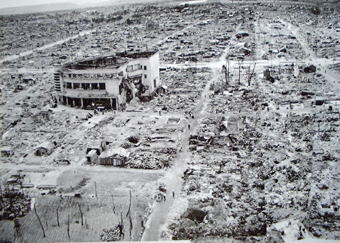
I've been reading Antiwar.com for nearly a year now, and am quite impressed with the level of discussion your site provides. I especially keep up on Justin Raimondo's ... column; his articles concerning US actions during the Pacific side of World War II constantly strike what is, to me, a very personal chord.
Born near Washington DC ([I] grew up watching presidential helicopters flying over my house), I emigrated to Japan in 1992. I have lived in a small town called Gifu for most of the past decade, and in the course of fomenting a stable, happy life here, I have become very familiar with my adopted hometown's history. It is a history of fiery pain that is not unlike many other small, forgotten towns across the country. Forgotten, that is, by the Americans who once bombed them to smithereens.
On July 9, 1945, a little less than one month before the destruction of Hiroshima, total pulverization of the rest of the country was already being carried out with conventional bombs. In a classic case of overkill, one hundred and thirteen B-29 bombers flew over Gifu just before sunset, their "official" orders being to knock out the Kakamigahara Air Base just east of town.
They did not stop there. They unloaded their entire bomb bays over the Gifu city center, wiping two-thirds of the town off the face of the earth in forty-five minutes. Nine hundred people – common citizens whom, I must mention, were in no way even remotely connected to the Japanese military – met a fiery death. According to a local Japanese web site devoted to the Gifu Air Raid, the purpose of the attack was stated by US authorities as being "to erode the Japanese will to fight." The site's maintainer, as well as myself, tend to believe that this is one of the most stupid reasons to completely raze a city to the ground, war or no war. Following the old, grand stereotype of the Japanese as moving in formation with their government (as opposed to their spiritual leader, the Emperor) like a school of trout, the Americans assumed that every Japanese citizen was enlisted and had a rifle strapped to their backs. Or at least it seems so to me, judging by the USAF's reasoning.
I am enclosing a photo of Gifu the day after the attack. For all the press the atomic bomb gets, one must remember that A-bombs were only two incidents of the US military going much, much too far.
Although I plan to visit Hiroshima someday and pay my respects to the hundreds of thousands my former country felt the need (or want) to destroy, I ... prefer to reflect on my new place of residence here in Gifu, in which I have been able to speak with eyewitnesses (who, I must note, harbor no ill feelings toward me personally despite the consequences, which is more than I can say for old Yanks who live in Hawaii).
Cannot Have It Both Ways
In regard to Mr. Raimondo's August 17th column on Japan and its "bashers," ["Yasukuni Brouhaha"] a few comments:
First, in regard to Iris Chang, I doubt she would claim to "parrot" the Chinese communist party line regarding Japan since her family moved to the United States from Taiwan. Whether or not her family fled to Taiwan with the Nationalists, I cannot say; however, your column suggests that she herself was/is somehow a spokesman for the Red Chinese, which is not the case.
Secondly, to suggest that the Chinese are some how morally compromised in all of this since they too killed many of their own, is to knock the stuffing out of the straw man himself. The Nationalists, unfortunately, made a poor showing of things while engaged in its war with both the Japanese and the communists. (In fact, historically, China has not been terribly unified as a country. Throughout the centuries, warlords from different provinces have fought with each other making the rise and fall of dynasties inevitable.) As such, a large number of poor peasants were all too willing to embrace the communists since initially, treatment at their hands was in many cases better than it was at the hands of the Nationalists. (We will ignore the role played by communists in the American government.) Consequently, the vast majority of Chinese people did not embrace the communists knowing or thinking that they would soon set about destroying the Old Order, instituting a nihilistic totalitarian government the envy of Stalin. Rather, they believed that things would or might be better than they were under the stern hand of the Nationalists and their often disorderly ragtag troops.
The Japanese did, however, invade China with the intent of beating her into submission and subjecting her people to the whims of the Japanese empire. In fact, despite its admiration for Chinese culture and philosophy, Japan itself has quite a history of "China bashing." In this sense, it is a strange scale of values that sees in the brutality of Mao a moral "out" for the brutality of the Japanese army. The Chinese people did not want the Japanese in China and had no reason to think their presence or rule would be a good thing for them. In this sense, isn't a civil war different from an invasion? If you beat your wife does that mean that your neighbor can as well?
Of course this does not mean that Japan should forever be required to genuflect at the feet of the international global socialists who want national sovereignty to die a quick and silent death. However, if one sometimes flirts with the Hobbesian view that nation-states do exist in a state of nature and therefore ought to be entitled to their unique traditions, etc., one may end up with the unpleasant Hobbesian principle that a consequence of said condition is "might makes right." If so, there may be little the Japanese can do.
If, however, one accepts a more deontological view, then rights and duties are internal to the universal principles of reason – in which case, the behaviour of the Japanese is to be condemned in and of itself.
One cannot have it both ways.
Justin Raimondo replies:
Chang’s parentage has nothing to do with it. Plenty of Taiwanese (or, rather, mainlanders living on Taiwan) parrot the Communist Party line, regarding Japan and every other issue. Aside from that, I never said she was a "spokesman for the Red Chinese," only that her views are similar to theirs on this issue.
I think the author of this letter has misunderstood the meaning and motive of my alleged "defense" of Japanese imperialism: indeed, I am not defending it at all, but merely seeking to explain it in economic and geopolitical terms. As an American anti-interventionist, my concern is with the foolhardy, dangerous, and unconstitutional foreign policy of global interventionism practiced by my own government. I will leave it to the Japanese anti-war movement to oppose the expansionism of their rulers – and I will support them so long as they oppose, in the same breath, the military occupation of Japan.
It is important to remember that, prior to the attack on Pearl Harbor, the left-wing ostensibly "anti-war" movement at the time vehemently campaigned for American intervention in China – in the name of "humanitarianism," of course. Never mind that supporting our Chinese "allies" meant turning the whole country over to the Communists. The letter-writer doesn’t want to talk about the role played by Communists and their sympathizers inside the US government, but this was a key factor in driving us toward war in the Pacific.
If Antiwar.com had been around to oppose FDR’s drive to war, we would have said this: America cannot and must not take sides in a three-way war between Chinese Communists, Chinese authoritarian Nationalists, and Imperial Japan. We had no dog in that fight – and the dog we picked turned out to be the wrong one, anyway. Secretary of defense Donald Rumsfeld recently announced that China is now the main danger to US interests and we must shift our focus to Asia: would this alleged "threat" be even half-credible if we had stayed out of the Far East to begin with? The answer, clearly, is no.
To expose FDR’s lies, and the deliberate policy of provocation leading up to Pearl Harbor, is not to excuse or condone Japanese militarism. We did not condone Milosevic’s rule, or his crimes against his own and other peoples, yet still we opposed the Kosovo war. We are no friends of Saddam Hussein, and take no position on whether Kuwait is or is not Iraq’s long-lost "nineteenth province" – yet we oppose the continued bombing and pitiless sanctions that has brought bitter suffering on a whole generation of Iraqis. The point is that we are not trying to save the world from injustice, or from itself: we are merely advocating a foreign policy consistent with the ideals and advice of the Founding Fathers of this country, who warned of the dangers of entangling alliances – and saw that war is the mortal enemy of liberty.
Reply to Besqa
[Regarding Besqa's letter of August 17, "Bored with the Balkans":]
...Besqa says in "Backtalk" [that] he [or she] is tired of the Balkans issue, in reaction to Malic's recent article re the Macedonia conflict ["Macedonia's Futile Surrender," August 16]. ...Besqa says the issue is ... the EU – essentially German – control of the Balkans. [Besqa] goes on to say [that] we Americans were lied to and deceived to get us into the mess.
I generally agree but ... Besqa should also consider: EU-NATO members are on record as stating that they would probably not have gone along with the NATO vote to bomb Kosovo if they had known details of the Rambouillet process.
At Rambouillet, supposedly negotiations between Kosovo Albanians and Yugoslavia, "refereed" by the USA, the secretary of state of the USA, Madeleine Albright, presented Yugoslavia with terms [that] no leader of a sovereign nation could accept. The ultimatum was: sign my terms of occupation of your country or be bombed. When Yugoslavia did not sign, Albright arranged for the bombing. Such diplomacy was commonplace in the Third Reich. ...Besqa should consider how Albright's role is consistent with his own correct analysis. Perhaps he will be more concerned. After all it was the USA's secretary of state who was doing the lying and deceiving.
Interestingly, the present conflict in Macedonia seems to be a NATO exercise designed to show what a wonderful world we would have had, if only Slobo had given up sovereignty of Serbia at Rambouillet. Bush is getting the establishment off the hook and hoping for a political payoff. Antiwar's story on money we are spending on a media blitz in Macedonia is most telling.
Personally, I never thought Macedonia was viable as a nation state right from the beginning. I naively believed that there was some error involved, even as American troops moved into Macedonia a decade ago.
~ Steffen Blendheim