Let’s be clear about the nature and meaning of the mandate we’re going to be hearing so much about: President-elect Barack Obama has a clear mandate to end the Iraq war as expeditiously as possible. His campaign was energized by and differentiated from Hillary Clinton’s by his emphasis on correcting that horrific mistake. Hillary equivocated, refused to recant her vote for war, and coyly suggested that we might withdraw only as far as Kurdistan. Obama, on the other hand, pledged to get us out in a year, albeit adding weasel words about "residual" forces guarding our bigger-than-the-Vatican ambassadorial compound. He gained his initial momentum by grabbing on to this issue and holding on for dear life, as the Clintons self-destructed and the economy did, too. Obama arrived at this moment not only on the strength of his pledge to end the present war, but also the implicit promise to refrain from involving us in any further hostilities.
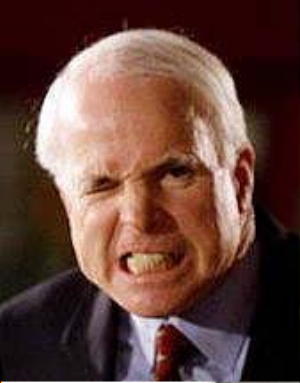
The defeat of the GOP was easily predicted: I’ve been doing it for years, here, for example, and here. This election was a referendum on John McCain’s brand of enthusiastic interventionism and his volcanically warlike temperament,and it was a stunning repudiation of both. Iraq, Iran, the wilds of the Caucasus – what was distinctive about the McCainiac foreign policy was the wide range of his potential targets. Al-Qaeda often seemed to take second or even third place on his enemies list, with the Iranians and the Russians taking first and second respectively.
Here was a campaign run by the hardest of the hardcore neocons, and the weight of this bone-crushing defeat will settle heavily on their shoulders. Saddled with the neocons’ war and the central theme of the McCain campaign – "victory" in Iraq and intervention around the world – Republicans all across the nation have been dragged down to defeat: the neocons have proven a heavier albatross than the party can bear. What we may be witnessing is the end of the GOP as an effective political force, at least on a national level.
We know what the American people voted against: they voted to end not only this war but the grim prospect of perpetual war, the "generational" conflict that served as a cover for the politics of fear and an unprecedented assault on our constitutional rights. They voted to punish the hubris of that top White House official who told journalist Ron Suskind:
"The aide said that guys like me were ‘in what we call the reality-based community,’ which he defined as people who ‘believe that solutions emerge from your judicious study of discernible reality.’ … ‘That’s not the way the world really works anymore,’ he continued. ‘We’re an empire now, and when we act, we create our own reality. And while you’re studying that reality – judiciously, as you will – we’ll act again, creating other new realities, which you can study too, and that’s how things will sort out. We’re history’s actors… and you, all of you, will be left to just study what we do.’"
It’s possible to evade reality, to believe it is self-created, and to persist in this delusion for quite some time. In the end, however, reality has a nasty habit of catching up with us. The day of reckoning for "history’s actors" has arrived, and not a moment too soon. The nation breathes a sigh of relief, as a long-festering carbuncle is sloughed off and falls away.
The scar it leaves, however, will long remain. Certainly it will disfigure the face of the GOP for decades to come. Ron Paul warned them, and they didn’t listen. Now they are paying for their arrogance, and in spades.
Paul, the leader of the party’s anti-interventionist wing, predicted that the burden of empire would cause the economy to fail – and, with it, the GOP’s electoral prospects. His reward was to be refused entry to the national convention, where they didn’t even do him the courtesy of counting his votes. The party rejected a million enthusiastic Republican and independent voters, and did their best to shrink rather than grow their pool of voter support. As ye sow, so shall ye reap.
This election will make many of our supporters and contributors very happy. At last, the War Party, which they see as synonymous with the Republican Party, has been driven out of the White House, and peace is about to break out all over. A word to the wise: don’t bet on it. The War Party, as I’ve explained often and at length, is hardly limited to the GOP. Its Democratic proxies are influential and often have a decisive influence; witness the legions of Democrats who voted "aye" on the Iraq war resolution.
As I pointed out yesterday, the War Party has already launched its campaign to capture the Obama administration – and, given his pledge to escalate the Afghan war, they haven’t got far to go. Now is the time when the antiwar movement must rely on its own institutions and exert maximum leverage. We must put pressure on the administration to keep its promise to get us out of Iraq – and guard against a possible confrontation with Iran.
Joe Biden predicted Obama would soon be "tested" in the foreign policy realm, and when the time comes, one has to wonder: will he take the opportunity to prove his "toughness" and overreact, or will he fulfill the promise of his campaign – the promise of a meaningful change in our foreign policy of relentless aggression?
Obama has promised to talk to our alleged enemies, but one has to question whether this will merely amount to an elaborate series of ultimatums delivered to Tehran’s doorstep or left at the gates of the Kremlin. If so, these extended "negotiations" are likely to culminate in conflict, giving us more of a pretext to lure our European "partners" into going along with the program.
From the perspective of the antiwar activist, there are many dangers that lurk just around the corner, and the most insidious and least obvious is the consolidation of economic power in the state. This centralization will make it easier for the federal government to mobilize all the resources of the country for military purposes: indeed, the economic crisis will give the government cover to further consolidate and rationalize its growing power and increase its ability to punish "anti-government" critics. From what we have seen so far, the Obama administration is almost certain to abuse its power in this way.
Another danger that looms large on the horizon of Obama World is the prospect of a lovesick media corps, one so enamored of their Messiah-in-the-White-House that, while failing to examine his policies overseas, they swallow his explanations too readily. It is all too easy to imagine our besotted press corps capitulating to a new era of political correctness in Washington, where all criticism of the Dear Leader is deemed "reactionary" and implicitly racist. When the Obama administration assures us Iran is building "weapons of mass destruction," how many in the mainstream media will be inclined to question them? I’m very much afraid of the answer to that question.
The Obama campaign was supposedly born as a grassroots movement, an online phenomenon that went viral and created a new majority. This myth is belied, of course, by the huge amount of corporate dollars that went into the campaign. McCain was outspent by an incredible margin. The Money Power is heavily invested in Obama, and they fully expect their generosity to be repaid – with interest.
In the international arena, this means the protection of corporate interests abroad, with the U.S. military being used as a private police force to protect American business interests – you know, the sort of enterprises that are "too big to fail" and have to be succored by the U.S. Treasury. Obama, like McCain, signed onto the Wall Street bailout, and he’ll be just as willing to send in the Marines to secure their interests abroad.
The more years I accumulate observing American policymakers in action, the more I’m struck by the essential continuity of U.S. foreign policy. Since the end of World War II, our course has been set: straight for the same mausoleum that houses the remains of the British, the Soviet, the Roman, and all other would-be global empires of the past. It will take more than mere "change" to turn this around. It will take a Herculean effort, one that is now possible – but only if we remain vigilant, and relentless in our exertions.