



Thirteen colonies fought off one of the most powerful, expansive and brutal empires in the history of the world in the late 18th century, creating a new nation based on anti-imperial principles and the notion that people have a right to self-determination. For about a hundred years, the United States, whatever its faults and unwise excursions, stuck fairly closely to the tenets of its founders – most importantly, the principles of peace and nonintervention.
In the late 19th century, the philosophy of imperialism began to take root, but it was kept at bay by a rich American tradition and pervasive ideology of nonintervention, largely embraced by both political parties and most national politicians.
Many scholars believe that the Spanish-American War was the first step on the road to empire. A little over a century later, we see that the sacrifice of nonintervention as a policy has brought the United States into a state of perpetual war, including its engagement in the two World Wars, the Cold War, Korea and Vietnam, as well as smaller disastrous and bloody interventions throughout Latin America, Europe, Africa, Asia, and the Middle East, culminating in the global war on terror that we now see, which the War Party assures us will last our entire lives and never fully succeed in destroying the vague metaphorical enemy “terror.” The Bush administration has been arrogantly aggressive and frighteningly reckless in its engagement of the War on Terror, and, unfortunately, Bush’s most likely replacement appears to be equally hawkish, notwithstanding any insincere and superficially moderate rhetoric he might spout about “leading alliances” and planning to “win the peace.”
Some hawks refer to ours as a benevolent empire; others deny that it is an empire at all. To understand the issue, we need some sort of analysis of whether or not the United States has in fact become an empire; whether or not, if it has become an empire, this is a good thing; and whether or not the U.S. government has so far succeeded or failed in the ostensibly laudable foreign policy goals of which the American interventionists speak so highly. It would also be good to know how U.S. foreign policy has unfolded into its current form, what costs America has incurred in its wars, and what history might teach us about the present and future state of global affairs.
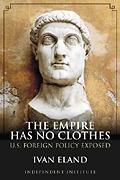 Ivan Eland’s new book, The Empire Has No Clothes: U.S. Foreign Policy Exposed (Oakland, Calif..: The Independent Institute, 2004), addresses all these questions well in its nonpartisan critique and history of failed U.S. interventions over the last century. Perhaps most importantly, it addresses the question: Is the U.S. an empire?
Well, not to split hairs, but it depends on what your definition of “empire” is. Eland explains the distinctions between different empires and different definitions of the term, drawing upon the competing definitions offered by various scholars. Perhaps formally, America is not technically an empire in the narrowest sense of the word. It doesn’t resemble all modern empires in every manner: “The American empire – with its alliances and military bases spanning the entire globe – most closely resembles Sparta in the 400s BCE, before and during the Peloponnesian War.” (29)
In other words, the United States is definitely a warfare state with hegemonic designs and tendencies. All that remains of the controversy is whether this is good or not. If the goal is to impose democracy throughout the world, Eland shows that the United States has more often than not been unsuccessful, and has, in fact, frequently intervened in ways quite contrary to this supposed goal. Surely, the two World Wars didn’t make the world as safe for democracy as advertised. And since then, we have seen “the Eisenhower administration’s CIA-sponsored coup against the more independent Mohammed Mossadegh to restore the more U.S.-friendly Pahlevi dynasty in Iran; … the Nixon administration’s CIA-sponsored coup against the newly elected socialist Allende government in Chile” and other foreign policy adventures that, whatever else one can say about them, undermined democratically elected governments. (31) Moreover, imposing self-rule from the top down is self-contradictory.
Interventionists often counter that, in spite of its missteps, the U.S. government must maintain a permanent war footing for its own security. Eland discredits these assertions, showing clearly how it is U.S. intervention that has incited terrorist attacks on Americans in and out of America. He also does an impressive job blowing holes in the “democratic peace theory” espoused by so many intellectual hawks, showing that, on top of the U.S. government’s counterproductive and failed attempts to institute democracy by force, the theory itself is deeply flawed: “Sometimes democracies behave more aggressively than oligarchies and dictatorships. … In fact, democratic Athens was more aggressive than oligarchic Sparta. … As the Athenians assembled a powerful force to conquer Melos, the Melians attempted to make a moral case for peace. The Athenians slaughtered all the men, sold the women and children into slavery, and colonized the island.” Eland goes on to give other, more recent, examples – from the War of 1812 to the American Civil War, from the “British atrocities during the Boer War in South Africa” to “the Israeli invasions of Lebanon in 1947 and 1981” – to show that democracies, few and new as they are, have often been aggressive both toward each other and toward non-democratic states. (40-41)
The U.S. government has also largely failed to impose free markets, in the real sense of the term, and to establish order, stability, and humanitarian aid in nearly all of its foreign military endeavors. Even taking as a given the disparate goals of interventionists from across the political spectrum – whether they are encouraging free trade with Europe or bringing aid and stability to Somalia and Haiti – U.S. imperialism has had very few successes.
“Conservatives should be against Empire,” writes Eland, because unnecessary foreign entanglements and interventions lead to a poorer economy. Seeing as how “the United States accounts for nearly 40 percent of the world’s military spending but only about 30 percent of global GDP,” the U.S. government is milking taxpayers dry for a destructive foreign policy that transfers wealth from Americans to defend foreigners, and yet has done this altruistic act incompetently, to say the least. (105) The U.S. warfare state has frequently fostered nationalization of the economy, attacks on economic liberty, and confiscatory levels of taxation. Inevitably, war equals big government, which conservatives claim to oppose.
“Liberals should be against Empire” because leftist humanitarian missions are almost always total failures, they make matters worse, and, indeed, they usually involve ulterior motives. “For example, the Spanish-American War was justified on the grounds of freeing Cubans from Spanish aggression. Yet Cuba, the Philippines, and Puerto Rico did not achieve genuine independence after the war. In fact, in Puerto Rico, the United States replaced an autonomous, elected government with press censorship and military rule.” (132-133) More recently, we have seen Clinton’s intervention in Kosovo yield disastrous results: “[I]n the year before the NATO bombing campaign, the number of Kosovar Albanians killed by Serbs was only about 2,500. In contrast, during the eleven weeks of Allied bombing, with no longer anything to lose, the Serbs slaughtered 10,000 Kosovar Albanians.” (140) Eland also shows how, in addition to their failures abroad, foreign interventions lead to erosions of civil liberties at home, which liberals claim to oppose.
Indeed, as Eland points out, “all Americans should be against Empire.” As a result of a century of aggressive foreign interventions, America has an imperial presidency, a seriously injured constitutional structure with Congress no longer serving to curb the Executive power, blowback terrorism, and more war and clumsy interventions, bound to fail, all to reverse the problems of past interventions.
Eland touches on numerous important and subtle points in The Empire Has No Clothes. He exposes how, in spite of rhetorical differences, Republican and Democratic administrations have had nearly identical foreign policies of failure and aggression throughout the years. He explains how U.S. intervention in World War I paved the way for global despotism in the 20th century and the horrendous bloodshed of World War II. He punctures the ludicrous myth that Americans are attacked because of their freedoms, laying out “the fact that other Western nations have free societies – both politically and economically – but are much less threatened … than the United States,” mainly because of differences in foreign policy. (196) Americans must realize that “empires have always been hated. This was as true of the Spaniards in the sixteenth and seventeenth centuries as it was of the Americans and Soviets in the twentieth century.” (9)
Eland also takes on the military industrial complex, widespread mythologies surrounding the Cold War, and the very concept of nation building. Most importantly, Eland outlines a sane, reasonable American foreign policy of peace and nonintervention, rather than the bullying and global policing that has made America poorer and more vulnerable, with very little to show for it in terms of international successes.
Of course, the author discusses the War on Terror and the Iraq war as well. Eland documents how, “having created a monster” in Iran, “the United States, in an attempt to cage it … create[d] another one” in the form of Saddam Hussein. “To contain Iran, the United States, although ostensibly neutral in the war, secretly helped Saddam win” by providing “Iraq with key intelligence, military planning, and billions of dollars in loans.” As an even more chilling modern example of a “cure being worse than the original problem”: “[In] a U.S. attempt to entrap the Soviet Union in an unimportant backwater … the Carter administration aided the radical Mujahadeen opponents of the Soviet-supported Afghan government. … Unintentionally, the United States helped train and fund those who attacked the USS Cole, the U.S. embassies in Kenya and Tanzania, and, of course, the World Trade Center and Pentagon on September 11, 2001.” (89-90)
But Eland’s book goes beyond our most immediate foreign policy debacles and threats, and far beyond the fleeting trivial non-controversy represented in the “choice” offered to American voters this year. Transcending partisan biases and trivialities and modern misconceptions, Eland puts current international crises in historical, economic, and philosophical context. The Empire Has No Clothes is a must read, accessible and useful to readers across the ideological spectrum, and its lasting importance will be equally compelling regardless of which interventionist candidate of whichever faction of the War Party wins the election this Nov. 2.
