



In 2005, Col. Lawrence Franklin was indicted alongside two executives of the American Israel Public Affairs Committee (AIPAC) for allegedly violating the 1917 Espionage Act. Franklin later pled guilty to passing AIPAC a classified presidential directive and other secrets concerning America’s Iran policy. AIPAC then allegedly forwarded the highly sensitive information to Israeli government officials and selected members of Washington’s media establishment. This covert leaking appears to be just one of many AIPAC programs designed to encourage tougher U.S. policies toward Iran, from financial boycotts to naval blockades and possibly even military strikes.
It hasn’t worked out very well for Franklin. He was sentenced to 12 years in prison. Curiously, Franklin remains free pending the outcome of the repeatedly postponed criminal trial against AIPAC’s Steven Rosen and Keith Weissman. On Oct. 28, 2008, the prosecution is scheduled to appeal the ruling judge’s order that it prove the alleged leaks harmed the United States. This is a far tougher standard of proof than the Espionage Act actually requires. Nevertheless, observers and critics hope the trial will provide insight into Middle East policy formulation – but there is diminished reason for this hope. A passel of musty documents from an earlier, long-secret Department of Justice attempt to hold the Israel lobby accountable was declassified on June 10, 2008. The files reveal that stalling tactics – and most critically, regime change in Washington – provide ample opportunity for the Israel lobby to subvert due process.
 In 1962, the Senate Foreign Relations Committee investigated foreign lobbyists active in the United States. The committee hired tough investigators, including Walter Haskell Pincus, now the Washington Post‘s national security journalist. These investigators played hardball with the American Zionist Council (AZC) by going after its hidden financial flows. The Senate investigators rifled through the filing cabinets of the Israeli government’s colonization and charitable fundraising partner, the Jewish Agency, American Section, based in New York. This raised howls of protest from Isaiah L. Kenen, then editor of a lobbying newsletter, the Near East Report.
The Senate investigation forced the Jewish Agency, American Section, regulated since 1938 under the Foreign Agents Registration Act (FARA), to file more detailed biannual activity declarations.[i] FARA is a disclosure law requiring all agents of foreign principals to detail their activities in reports filed at a public office within the U.S. Department of Justice. The Jewish Agency functioned as a quasi-governmental organization whose executive board was composed of Israelis (including government officials) and Americans. It not only received government funding, but had influence over internal policy and legal matters before they went to the Knesset under a 1953 "covenant" agreement with the Israeli government.
Sen. Fulbright, who led the investigation, was outraged at the idea that U.S. foreign aid and tax-preferential charitable funds were being funneled back into the U.S. to multiply foreign aid through lobbying and a massive stealth public relations campaign. At the time, Israel was far from the only violator. The Senate committee also caught the Philippines playing the same game through Washington lobbyists doling out campaign contributions in exchange for enormous WWII reparations payments funded by U.S. taxpayers. But Israel’s covert lobbying and public relations venture was truly massive. By the time Fulbright’s public Senate hearings ended in 1963, it had been established that the Jewish Agency laundered over $5 million (around $35 million today) into U.S. public relations and lobbying initiatives over a two-year period. The true scope of the campaign was never revealed, in spite of diligent attempts at law enforcement.
As in the Rosen and Weissman espionage incident, the FBI and Justice Department initially pressed the case forward. Their law enforcement efforts and internal deliberations work were largely invisible to the American public, but many sent letters urging that the American Zionist Council be registered as a foreign agent. On Nov. 21, 1962, before the full extent of the stealth PR and lobbying campaign was publicly exposed in Senate hearings, the head of the DOJ’s Internal Security Section, J. Walter Yeagley sent a two-page letter and foreign agent registration forms [.pdf] to the American Zionist Council by certified mail.[ii] The DOJ formally demanded that the Israel lobby’s top umbrella organization openly register and disclose all of its U.S. activities as an agent of influence.
The AZC at the time – as the nonprofit umbrella corporation for the Zionist Organization of America, Hadassah, and other elite Zionist organizations in the United States – was the Israel lobby. It was almost completely dependent upon Jewish Agency-directed funds, some with special earmarks from the executive in Jerusalem to AIPAC founder Isaiah L. Kenen. Other recipients of the funding included New York Times media personalities, exiles from the shah’s regime in Iran living in the U.S., tenured professors at Harvard, and authors active in churning out hundreds of "scholarly" books about Arab terrorism and Israel’s special role as an ally to the U.S. in the Cold War.[iii]
The Justice Department, directed by Attorney General Robert F. Kennedy (RFK), insisted that the AZC register as the Jewish Agency’s American foreign agent. RFK and his top advisers felt the documented funding flows had "compromised" the lobby so much that they would quietly agree to file registration statements and disclosures. They did not count on the lobby’s response. The lobby saw the registration demand as an “extinction-level event,” like one of Hollywood’s massive asteroids cinematically falling toward Earth. The lobby’s outside lead counsel, Simon Rifkind of the firm Paul, Weiss, Rifkind, Wharton & Garrison, was apoplectic: FARA registration would be a "noose around the neck of his client" and "choke the very life out of it."[iv] The lobby’s response was quiet, asymmetrical, and successful. The parallels with the 2005-2008 AIPAC espionage saga are uncanny.
In 2005, the Department of Justice’s chief prosecutor on the espionage case, Paul McNulty, was suddenly and inexplicably promoted within the DOJ after he backed off on criminally indicting AIPAC as a corporation. That would have led to AIPAC’s immediate demise as a going concern, just as earlier indictments doomed Enron and Arthur Andersen. A February 16, 2005 defense team communication between Rosen’s lawyer, Abbe Lowell, and Nathan Lewin, AIPAC’s legal counsel, revealed that U.S. Attorney Paul McNulty "would like to end it with minimal damage to AIPAC." Lewin further told Lowell that McNulty was now on AIPAC’s side "fighting with the FBI to limit the investigation to Steve Rosen and Keith Weissman and to avoid expanding it."[v] After discussing restricting the scope of the prosecution with AIPAC’s lawyer and shortly after handing down only individual indictments (Aug. 4, 2005), McNulty was nominated to the position of deputy attorney general on Oct. 20, 2005. He was sworn into office on March 17, 2006. Why McNulty fought so hard to restrict the scope of the FBI’s investigation is now less of a mystery. He was simply following the successful career path first blazed by Deputy Attorney General Nicholas Katzenbach 40 years earlier.
Back in the 1960s, Katzenbach had also suddenly risen within the DOJ, becoming attorney general on Jan. 26, 1965, after he helped unwind the Israel lobby FARA registration demand within the DOJ. During the calamitous period after the Cuban missile crisis and John F. Kennedy’s assassination, Katzenbach brokered an unprecedented deal. The American Zionist Council could register a "sample" Foreign Agent Registration Act declaration for a "representative" time period of its own choosing. Unlike every other filing open for public inspection at the FARA section, the AZC’s would be kept in a special folder, with a secret name key linking the individuals and entities receiving Jewish Agency funding kept separate from the disbursement filing.[vi] This deal was derisively referred to as "the caveat" within the FARA section. It was the DOJ’s and America’s first and only "nonpublic" FARA disclosure. Many dedicated members of the FARA section, such as Nathan Lenvin and Irene Bowman, fought hard against this corruption of their transparency mandate. They lost. The Israel lobby’s meager disclosure and internal files about the incident were classified and kept secret, only released under the Freedom of Information Act on June 10, 2008.
This subversion of the very essence of FARA heralded its subsequent demise as a serious buffer between Congress, the executive, and the American people and Israel’s stealth lobbying campaigns. Analysis of the core documents related to the case reveals how seriously the Israel lobby managed to compromise the U.S. Department of Justice’s enforcement efforts while it was vulnerable – during the Johnson administration’s 1964 reelection campaign. FARA now serves only to pick off the most tangential of foreign schemers out of favor with the administration, such as those laundering Venezuelan "campaign contributions" through the U.S. to Argentina. The showdown with the Israel lobby and subsequent lobby-driven amendments gutted serious FARA enforcement in the early 1970s.
This calamity also produced an unprecedented career opportunity for Isaiah L. Kenen. Until the FARA battle, he was a long-term public relations operator for the nascent Israel lobby. The investigation traumatized Hadassah and the ZOA and exposed them to serious legal risks; it necessitated a corporate reshuffling because the need for an elite organization to spearhead Israel lobbying was still acute. Folding the AZC would leave a power vacuum in Washington. The AZC’s stealth lobbying programs and public relations activities were subsequently transferred to a fledgling organization originally established as a unit within the AZC that was internally referred to as "the Kenen Committee."[vii] This became the American Israel Public Affairs Committee. Its prerogatives have expanded such that in light of history, trade secrets theft [viii] and eventual run-ins with election law [ix], not to mention the Espionage Act, now seem all but inevitable. The Justice Department’s reticence to prosecute AIPAC, given its painful but secret FARA experience, seems understandable, though not necessarily forgivable.
The approaching criminal prosecution of Rosen and Weissman is no doubt again considered an extinction-level event by AIPAC and the rest of the Israel lobby, even in its highly robust present configuration. The lobby will have little time in 2009 for another cumbersome reorganization to rebuild credibility, not with soaring military aid demands, concerns over Iran, and its need to secure a semi-permanent U.S. military presence in the heart of the Middle East . But there is one problem. As years pass, it has become more difficult to score any viable legal strategy for dismissing the criminal case against Rosen and Weissman that would appear legitimate to the American public. The case docket [.pdf] reveals many defense team attempts to throw the case out on technical quibbling and how much classified U.S. national security information Rosen and Weissman may expose in their defense. Time also reveals that presiding Judge T.S. Ellis has been neither cowed by the potential graymail that typically plagues cases involving classified information nor intimidated by the lobby’s allies in the news media.
Both the Republican and Democratic parties desperately need this case to go away long before the next president is sworn in. From their standpoint, it would be unseemly to have U.S. officials subpoenaed and actually put on the witness stand to reveal how Middle East policy is really crafted in the height of an election season dominated by narratives of hope, change, and restoring integrity. But hiring away the U.S. attorneys prosecuting the case, always a viable strategy, is now pretty much exhausted. One key member of the government’s prosecution team has already left for the private sector.[x] The Jewish Telegraphic Agency, formerly a wholly owned subsidiary of the Jewish Agency, recently called out for a popular uprising in Rosen and Weissman’s defense. But like the Wall Street Journal‘s own earlier editorial page clemency plea directly to Attorney General Michael Mukasey, it has produced no tangible results. It is now up to the president himself to pardon Rosen and Weissman and end the trial before it can begin.
If President George W. Bush waits to pardon Weissman and Rosen until shortly before leaving office, it would be too late for AIPAC’s most precious asset: its reputation as an entity engaged in lawful activities. The administration also has an overriding self-preservation interest in seeing this case vanish: it is the singular judicial process for determining whether AIPAC goes too far in agitating for wars – whether in Iraq, Lebanon, or Iran. For Americans a trial would be a very healthy process for determining whether powerful Washington think tanks and corporate news personalities blithely trafficking in our most sensitive national defense information for their own profit should ever be held accountable. But in the waning days of the Bush administration, short-circuiting public accountability for war decisions and the system that produces them is now the overriding doctrine. The pressure is on. Judge Ellis approved subpoenas for Douglas Feith and Paul Wolfowitz as well as National Security Adviser Stephen Hadley, Secretary of State Condoleezza Rice, and Richard Armitage to appear as witnesses for the defense. Pardoning AIPAC would mean that Col. Lawrence Franklin, a member of Douglas Feith’s infamous Pentagon policy shop and a crucial witness for the prosecution, walks free.
The decision to let the Israel lobby walk in 1965 was three years in the making. The initiative quietly gained momentum through similar appeals, stalling, and law enforcement delays. It was finalized during regime change in Washington. The calendar’s pages are now inevitably turning toward a brief, singular moment for another special Israel lobby deal from a sitting U.S. president, a president who has little to gain by such public exercises in justice, and much to lose. However, unlike the secret Foreign Agents Registration Act deal of the 1960s, a presidential pardon will be impossible to keep secret. The possibility that a pardon could at last mass-mobilize the American people out of their unknowing tolerance for the lobby’s dangerous foreign subversions may even be reason to welcome it.
[i] Senate Foreign Relations Committee Investigation into the Activities of Agents of Foreign Principals in the United States, Washington, U.S. Government Printing Office, Aug. 1, 1963, pp. 1,704-1,709.
[ii] Certified letter from Assistant Attorney General Internal Security Division G. Walter Yeagley to the American Zionist Council Nov. 21, 1962 [.pdf], released under Freedom of Information Act on June 10, 2008.
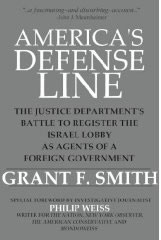
[iii] Smith, Grant F., America’s Defense Line: The Justice Department’s Battle to Register the Israel Lobby as Agents of a Foreign Government, p. 173.
[iv] Memo from Thomas K. Hall, executive assistant, Internal Security Division to Files, p. 2, Jan. 24, 1962, released under Freedom of Information Act on June 10, 2008.
[v] Judge T.S. Ellis III, U.S. vs. Steven J. Rosen and Keith Weissman, memorandum opinion, Aug. 9, 2006.
[vi] Smith, Grant F., America’s Defense Line: The Justice Department’s Battle to Register the Israel Lobby as Agents of a Foreign Government, pp. 177-178.
[vii] Senate Foreign Relations Committee Investigation into the Activities of Agents of Foreign Principals in the United States, 88th Congress, 1st session, Washington, U.S. Government Printing Office, May 23, 1963, p. 1,343.
[viii] “FBI Investigates Leak on Trade to Israel Lobby,” Washington Post, Aug. 3, 1984.
[ix] “Papers Link Pro-Israel Lobby to Political Funding Efforts,” Washington Post, Nov. 14, 1988.
[x] “Top Prosecutor in AIPAC Case Quits,” Jewish Telegraphic Agency, Feb. 28, 2008.
