|
Antiwar
Protestors Aren't Fanatics
|
|
Antiwar
Protestors Aren't Fanatics
|
|
|
||
|
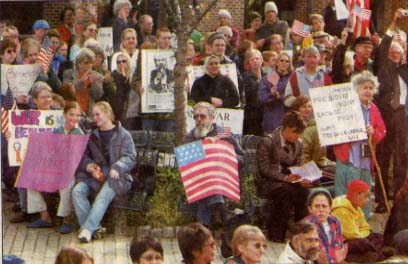
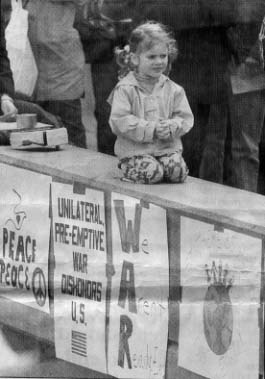
An analysis by Marc Cooper in the Herald Leader on Sunday, November 17, claims that peace movements opposing a war in Iraq have been hijacked by fanatics. Two pictures from the Lexington anti-war rally on October 20th accompany the article. A caption next to one of the pictures states that the peace movement "has been stalled by left-wing radicals." The implication is clear: the organizers of the local protest espouse extremist views not worthy of consideration and not representative of Americans.
This portrayal is absolutely false. The organizers of the rally do not even remotely resemble the fanatics whom Cooper portrays in his article. According to Cooper, the current peace movement supports Saddam Hussein and Slobodan Milosevic, and believes that America got what it deserved on September 11. Everyone on the committee that organized the Lexington rally holds a deep respect for all human life, and believes that Saddam Hussein, Slobodan Milosevic, and the gang that perpetrated the barbarity of September 11 are mass murderers. Our same respect for life compels us to give up our free time to meet in order to prevent another war in the Middle East. Such a war could kill tens of thousands of people on both sides, and so enrage people in the region as to fuel terrorism, taking more lives in the future. We also oppose the war because the US administration has lied about the threat posed by Saddam Hussein, and has fabricated evidence (such as a non-existent report from the International Atomic Energy Agency) to make its case. Since these anti-war criticisms have been voiced by the head of the C.I.A., as well as military brass such as former Marine Scott Ritter, they are hardly radical. Average Americans who have never been involved with the left are expressing similar concerns about a possible Iraqi war. One of the most moving speakers at our rally, University of Kentucky political science professor Stuart Kaufman, had never attended an anti-war protest, but he felt so strongly that an Iraqi war was immoral and dangerous, that he contacted our group to ask us to speak. Some of our other participants included Nancy Kemper of the Kentucky Council of Churches, Charles Holmes representing the Bluegrass United Nations Associations, poet Nikki Finney, and two professional classical musicians. We also had letters of support from nationally known-writers Wendell Berry and George Ella Lyons.
The Herald Leader fails to see the diversity of the protest, and dismisses the number of important voices opposing the war. In the article that covered our protest on October 21, it characterizes the participants as "old hippies recharged for a new anti-war cause," as if we were knee-jerk left-overs who didn’t have a clue. Is this why the newspaper buried the protest in the City section, even though a war with Iraq is one of the biggest events of our time, and a protest, right or wrong, is a front-page issue? Is this why the newspaper estimated the crowd at two hundred, when different participants counted between four and five hundred? The captions next to a picture from our rally states that the members in the peace movement seek to "demonize the United States." This suggests that criticizing the decisions of our leaders amounts to criticizing our entire country, including its people. It suggests that protest is un-American. We on the committee feel that protest against our government is as old as our founding fathers, as courageous as Samuel Adams, as intellectual as Henry David Thoreau, and as American as the fourth of July. Paul Tremblay was an organizer of the Lexington anti-war rally on October 20.
|