|
 |
|||||
|
|
|
|
|||
 |
|
|||||
|
|
|
|
|||
|
|
|||||
|
|
|
|
|||
|
|
|||||
|
|
|
|
|||
|
|
|||||
|
|
|
|
|||
|
|
|||||
|
|
|
|
|||
|
|
|||||
|
|
|
|
|||
|
|
|||||
|
|
|
|
|||
|
|
|||||
|
|
|
|
|||
|
|
|||||
|
|
|
|
|||
|
|
|||||
|
|
|
|
|||
|
|
|||||
|
|
|
|
|
|
|
|
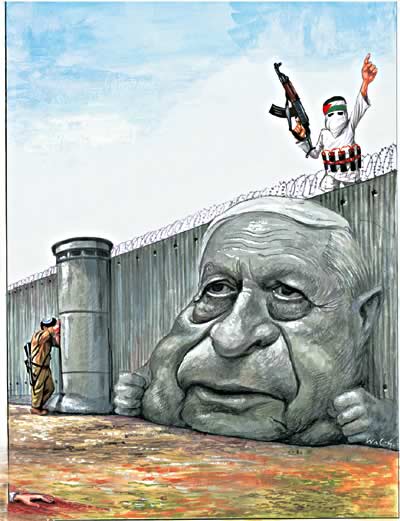
Last week yet more children were slaughtered in the Holy Land. Four little Israeli girls and their pregnant mother were gunned down by Palestinian terrorists on a settlement road in Gaza. Eleven Palestinian children were killed by the IDF, also in Gaza. ‘Nothing changes,’ said my Israeli host in Jerusalem as we left his home on our way to a restaurant. ‘We need something — God, do we need something — to pull us out of this madness.’ Some Palestinian children ran off into the bushes, scared. ‘That’s “starvation crime”; kids trying to steal car radios for a few shekels. We have economic despair on both sides, as well as terror. We’re still living in dread of their retaliation to us assassinating Sheikh Yassin and Rantisi. And the government thinks the wall will help.’ The wall is, of course, Israel’s security barrier in the West Bank. The following day I was on a tour bus with two Israelis and a party of North American priests. We got out and looked up at the wall’s vastness, eight metres high, and then along the length of it, running limitless into the distance, dividing the Palestinian suburb of Jerusalem into two parts, one side of the street permanently divorced from the other. Life stilled around it. ‘I thought the barrier was supposed to divide Israelis from Palestinians,’ said the priest next to me, mystified. Our Israeli guide explained the political nature of the barrier, pointing across the valley to the sites of two brand-new settlements. ‘This section of the barrier puts paid to the claim that it is a defensive measure. It is not about security,’ he said. ‘It’s about Israel holding on to occupied Palestinian land, including all of Jerusalem.’ ‘But how do families on that side get to the hospital, how do they get supplies, food, fuel? How do they get to see their relatives? How does anyone ...what do the kids ...where do...? This is,’ the priest said, ‘an obscenity.’ An Israeli on the tour shot back, ‘You don’t understand terror, not unless you live here. The Palestinians want to kill us. They are terrorists, it’s as simple as that.’ ‘What, all three million of them?’ asked another priest. The Israeli was offended. ‘Like I said, you don’t understand. Nothing will stop the terror because it’s in their nature, but the Israeli Left will never admit it. If I had my way there would be no gates in this wall.’ Fortunately there are some gates in the wall, and the Palestinian population can use a limited number of them to get out of the enclosures and reach schools, fields or hospitals — though they will need permits to get through. ‘You know, it’s easier for us to get to heaven than down the street these days.’ Like many Palestinians, the artist’s mood was grim. The allusion to suicide bombs and their allure for the desperate was clear. ‘Forget the road map, the Geneva Accord, Bush’s statements,’ she said. ‘Forget diplomacy. And forget international law. Even Sharon’s Gaza pull-out plan. They’re all bullshit. For what’s really going on, just look at Israeli construction in the West Bank.’ The reality on the ground is a series of walled-in detention camps: the territory that the Prime Minister Ariel Sharon is willing to concede as a Palestinian ‘state’. Blind to the demands even of US diplomacy, the construction projects that now lock the West Bank into Israel have forged ahead, leaving fenced-off pockets for the three million Palestinian inhabitants living between the settler domains. Instead of a ‘freeze’ on settlement building, existing ones are extended and new ones started, and mile after mile of four-lane settler-only highways are laid out, turning the land into an apartheid warren peppered with industrial parks to keep the incarcerated Palestinians busy — to give them, as a settler from Efrat assured me, ‘the only things they want: dignity and a job’. The network of Israeli infrastructure is laid down over Palestinian lands and lives as though they were not there. With a foreign passport — roadblocks, trenches, checkpoints and Israeli Defence Forces (IDF) soldiers permitting — you can still move about the West Bank where there are gaps in the barriers. These are closing quickly, leaving tens of thousands of Palestinians on the Israeli side, sometimes entirely ringed in by fence or wall. Major General Amos Gilad, head of the political-military bureau at Israel’s ministry of defence, is pleased with the security barrier. ‘I don’t like roadblocks,’ he told me in Tel Aviv last week. ‘The fence will decrease the need for internal closure.’ Palestinians point out that it hardly matters whether or not there are roadblocks inside the giant holding pens. As the barrier cuts them off and closes them in, more and more Palestinian families and communities are being swept westwards into the designated pens, their only chance of getting the services the rest of us take for granted. Those who mete out the international aid that keeps them alive, as well as many Palestinians and Israelis, ask what will happen when the prisoners can’t stand being captive any longer. ‘I’m not sure I have the answer to that,’ says General Gilad. ‘What I can say is that by this barrier we are saving lives, Palestinian and Israeli. When Palestinians kill Israelis, we have to take measures in retaliation; they get killed. So we save their lives this way.’ This justification of the wall — to save Palestinian lives — is a new one. Palestinians see the wall as destroying Palestinian livelihoods. ‘If only the barrier had run along the border. We’re all trapped now, Israelis and Palestinians both,’ was the sorrowful verdict of an Israeli academic at a conference on human rights in the occupied territories. Many observers concede that the occupation is probably irreversible. Although some Israelis still insist that ‘the settlements will go, just wait and see’, 193,000 Likud voters decided otherwise on 2 May, when 60 per cent of them voted against Ariel Sharon’s plan to make a stab at removing a handful of settlements. ‘Sharon,’ said the Palestinian health minister, Jawad al Tibi, over coffee in Gaza, ‘is weak in the face of the settlers.’ In a referendum that left many Israelis gasping — ‘And we call ourselves a democracy?’ — a tiny fraction of the population was given, and took, the chance to throw out the Prime Minister’s plan to ‘disengage’ from Gaza. The plan would remove most of the 7,500 settlers living among 1.2 million Palestinians, but hold on to the borders, the air space, water, and the right to re-invade at any time, while preventing the Palestinians from having their own seaport, airport or using the border with Egypt. As Israel’s most influential columnist, Nahum Barnea, put it, Sharon’s assumption was that ‘the world would be grateful to Israel for quitting Gaza and for a few years at least lessen its pressure for solutions to other territorial demands. Gaza would save the West Bank.’ Another Israeli was more explicit: ‘All this backfired when Sharon lost his vote to the fanatics. And it leaves Bush — who threw away America’s mediator role and publicly gave Sharon the right to redraw Israel’s borders, but got nothing in return — looking particularly foolish.’ The sense of despair on both sides is overwhelming. ‘There are no initiatives, no hope,’ said al Tibi. ‘What is left?’ people ask: a workable two-state solution is virtually out of the question now, given the facts on the ground. A continuation of the Bantustan status quo will eventually end because, moderate Israelis claim (perhaps optimistically), the international community at some point will object to Israel’s tightening system of control. ‘Voluntary’ transfer, whereby conditions are made so unbearable that yet more Palestinians leave, is unlikely to happen because, the Palestinians say, ‘we have nowhere to go’. That leaves the ‘one state for two peoples’ solution. On a day that saw major demonstrations of support in Gaza for Arafat, Dr Haider Abdel Shafi, the Madrid negotiator and revered Palestinian leader, told me that the one-state solution is ‘the only logical thing’. ‘Of course Israelis don’t want a single bi-national state,’ said Ziad Abu Amr, a former minister under Abu Mazen. ‘In fact, they would abort it more aggressively than the two-state solution because it means the end of the Jewish state [one day the Palestinians will be the majority]. We have to take into account the realities, that we are weak and this is a situation in which power determines everything. Israel and the US have all the power, and for that we are paying a heavy price; we are made to live like animals — every village and town a zoo because of the closures.’ Palestinians, he said, had no choice but to leave things to historical process, not politics. ‘Israel knows that it can do what it likes, even more so with what’s going on in Iraq — how can the Americans or British criticise Israel’s tactics now?’ General Gilad, too, said he was shocked by the US abuses in Iraq. ‘We don’t do atrocities,’ he said. Watching the scenes of abuse by the occupying powers in Iraq, Israeli and Palestinian alike were stunned. That day a group of Palestinian ambulance drivers had described to me their humiliations at the hands of the IDF: among other things, soldiers at checkpoints frequently make them strip naked. And there on the dispatch station’s screen above our heads were US forces doing the same, and worse, to Iraqi prisoners. ‘At least the Israelis don’t pretend they’re on a mission to liberate us,’ laughed one paramedic. As the barrier closes and the West Bank construction project locks in the Palestinians, the international community continues to demand that Palestinians ‘democratise’ their Bantustans. In Ramallah, a campaigner for democratisation said, exasperated, ‘It’s like a sick joke. Very democratic, these prisons. And ask Mr Blair why the British are pulling investment out of civil society, to pour it into military training instead. Isn’t the international community supposed to be backing democratisation among Palestinians? Isn’t encouraging democracy what it’s all about?’ Since Mr Bush authorised Sharon to keep six settlement blocs on the basis of ‘demographic reality’ and ruled out at a stroke the refugees’ right of return, he has reined in a little, giving Jordan’s King Abdullah assurances that ‘all final status issues must be negotiated between the parties in accordance with UN Security Council Resolutions 242 and 338. And the United States will not prejudice the outcome of those negotiations.’ But a genie left its bottle that day. The chessboard, as the New York Times columnist Thomas Friedman said, was thrown up into the air. One Palestinian-American stressed that for many people the rules are now rewritten: ‘Let’s talk demographic realities, Mr Bush. On the basis of your “demographic reality” you want to trash international law, write off UN resolutions and sign away 15 per cent of the West Bank for 200,000 Israeli settlers. Fine. By your logic we Palestinians — 40 per cent of the people living in these “disputed” lands — are entitled to at least 40 per cent of the Holy Land. You want to rewrite the rules of negotiation? Great, that suits us.’ ‘Look,’ he said intently. ‘All those, from your country and mine, who said they opposed settlements but did nothing serious to discourage each successive Israeli government from building them — they are responsible. They have given victory to the settlers. But this victory could have a cost. The settlers have succeeded in making a two-state solution impossible. What choice is there now? It’s either full-scale expulsion of all of us, or a single state for both peoples.’ |