The Pentagon’s new pin-up boy
Toby Harnden
Mukhtara, Lebanon
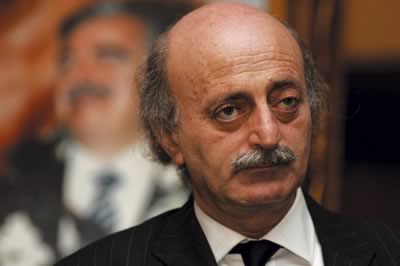
With his bald pate, droopy moustache and sad, bleary eyes, Walid
Jumblatt looks more circus clown than Pentagon pin-up. And if the
warlord’s eccentric appearance were not enough to dismay White House
officials, then his penchant for virulent leftist anti-Americanism
would seem to place him firmly in their ‘against us’ category.
As Lebanon’s Soviet-backed chieftain of the Druze, a secretive
sect which broke away from Shia Islam in the 11th century and
believes in reincarnation, Jumblatt, now 55, played an active role
in the country’s blood-soaked civil war. In 1983 he announced a
campaign of ethnic cleansing of Maronites. ‘With the help of our
Syrian allies we have removed the Christians and only the Druze
villages will remain.... Such is our objective.’ History records
that he tried to be true to his word.
Over the years Jumblatt’s colourful pronouncements kept him well
away from the Oval Office guest list. In 2003 he not so much as
stepped but cartwheeled over the mark. Reflecting on the news that
Paul Wolfowitz, the deputy Pentagon chief and top Washington
neoconservative, had emerged unscathed from a rocket attack in
Baghdad, he said, ‘We hope that next time the rockets will be more
accurate and effective in getting rid of this virus and his like,
who wreak corruption in the Arab lands.’
In case anyone was unsure where he was coming from, Jumblatt
noted that the true axis of evil was one of ‘oil and Jews’.
President George W. Bush was a ‘mad emperor’ while Tony Blair’s
‘idiot laugh’, ‘peacock appearance’ and preened hair were signs of a
deep moral corruption. ‘People who pay that much attention to their
appearance are fascists by nature. Or they have psychological or
sexual complexes.’
Jumblatt was refused a US visa on the grounds that entry could
not be permitted to an alien who had used his ‘position and
prominence within any country to endorse or espouse terrorist
activity’. But that was then. When what the Bush administration
swiftly dubbed ‘the cedar revolution’ broke out in Beirut, Jumblatt,
by now a born-again anti-Syrian and de facto leader of the Lebanese
opposition, told the Washington Post that he had changed his spots.
The neoconservatives had a collective orgasm.
‘This process of change has started because of the American
invasion of Iraq,’ Jumblatt ventured. ‘I was cynical about Iraq. But
when I saw the Iraqi people voting three weeks ago, eight million of
them, it was the start of a new Arab world.’ Google hits on the
comments so far: 9,620. Jumblatt’s stock in the White House:
priceless.
Perched on a window seat in his magnificent ancestral home, which
takes its name from the nearby village of Mukhtara in the Chouf
mountains, Jumblatt rolled those sad eyes and made a pretty good
fist of looking sheepish.
‘I heard a nice remark about me by Paul Wolfowitz on TV the other
day,’ he said. Wolfowitz had commented, ‘Even a man like Walid
Jumblatt who has said some not so nice things in the past has had a
lot of courage in standing up to the Syrians. We admire that.’
Jumblatt, sipping Arabic coffee in a cavernous anteroom decorated
with his collections of 19th-century French rifles and Roman glass,
appeared genuinely chastened. ‘I do appreciate his dismissing my
awful remarks wishing him to be dead,’ he said. ‘I was in this old,
closed mindset of denouncing the imperialist.’
Looking around the Arab world, not least in Beirut’s Martyrs’ Square,
where thousands had gathered to demand an end to a Syrian occupation
that began in 1976, Jumblatt concluded that Bush’s brand of freedom
and democracy was the wave of the future. ‘Slowly but surely the
Berlin Wall of Arab regimes is crumbling,’ he said, pausing as one
of his parrots screeched. ‘There was voting in Iraq, voting in Palestine.
When Arafat died, Abu Mazen was elected according to the constitution.
The Saud family decided it was time for municipal elections. President
Mubarak has decided that he’s not going to be the sole candidate
in September. Things are really moving.’
But despite the Karl Rove talking points, Jumblatt is not exactly
a sunny optimist. There were dark forces, he intimated, that would
be difficult to defeat. ‘[President Bashar] Assad [of Syria] is
trying to buy time. If he gets out of Beirut and the foreign policy
of Lebanon, he’s going to lose a lot of prestige. And there’s another
aspect — money. You have a joint Syrian–Lebanese mafia that is strangling
the country.’
The Jumblatt family history has left him with a tendency towards
fatalism. In 1977, when Walid was a 27-year-old playboy known for
speeding along the mountain roads on his Harley in denims and a
leather jacket, he heard the rattle of a machine-gun. He ran down
from the Mukhtara to find his father slumped in the back of his
car, his brains oozing on to the newspaper he had been reading.
Jumblatt’s father, Kamal, leader of the Progressive Socialist party,
had been murdered by two men wearing Syrian special brigades uniforms.
His grandfather Fouad was assassinated in 1921, his aunt was shot
dead in 1976 and his ex-wife committed suicide. ‘My father once
said, “No one in this family dies in his bed”,’ said Jumblatt. ‘I’m
living on borrowed time.’
Did he expect to expire peacefully? ‘Let’s leave it to destiny.
It’s the risks of the business. If you are obsessed by security
you are paralysed psychologically.’ Nevertheless, the tall, rail-thin
Druze is not venturing out of the Mukhtara, where the Jumblatts
have lived since about 1650, for fear of meeting death on the road
to Beirut just like his father.
The Mukhtara still bears bullet and shrapnel marks from the civil
war. ‘We were bombed by our own army at one point,’ said his glamorous
Syrian wife, Nora. The complex also survived a broadside from the
USS New Jersey in 1982. ‘They can’t blow up all these buildings,’
Jumblatt said proudly as he peered through a Soviet artillery range-finder
in his sitting-room. ‘They’d need B52s.’
Long seen as a weathervane of Lebanese politics, Jumblatt has cleverly
used shifting alliances to keep the Druze, under 10 per cent of
the population, aligned with those on top. His rejection of Syria
is a recognition that, on balance, Bush rather than Assad is calling
the shots. He chuckled at the notion that he is now the darling
of the neocons, though he fits almost to a tee the classic definition
of the term — socially liberal, formerly left-wing, a believer in
the efficacy of military power and the universal application of
democracy. He even confessed to reading the works of Robert Kaplan.
‘After the compliments of Mr Wolfowitz, perhaps I should join the
club.’
‘What he said showed that he was a civilised, rational person.
The difference between the Western and the Eastern mind is that
in the West they reason like Descartes, in the Eastern, totalitarian
world they don’t use reason — in the morning you are a traitor and
in the afternoon a patriot.’
Toby Harnden is chief foreign correspondent of the Sunday Telegraph.
|