January
11, 2004
India-Pakistan
Peace Process Fragile, but Real
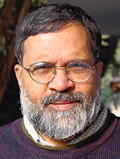
by Praful Bidwai
Efforts
at achieving normal relations and peace between South Asian rivals
India and Pakistan have collapsed or run into a dead-end so many
times in the past.
Thus,
it is only rational to ask if their latest attempt at a breakthrough
is for real and likely to succeed. Doubts persist on this even after
Indian Prime Minister Atal Bihari Vajpayee and Pakistan President
Gen Pervez Musharraf issued their joint statement – hailed as ''historic''
at a South Asian summit on Tuesday.
And
yet, a simple answer to this complex and nagging question is possible:
the peace process is real and authentic, but it is fragile and can
be derailed. India and Pakistan will have to make special efforts
to consolidate it in the next few months.
The
momentum in favour of reconciliation is much stronger today than
it was in Lahore, Pakistan in 1999 or Agra, India in 2001, when
the heads of the two governments met. Lahore took place barely nine
months after the India-Pakistan nuclear tests, which raised grave
fears of a possible Atomic Armageddon.
The
summit process did launch a bus service between Delhi and Lahore
and it half-attempted nuclear confidence-building and transparency.
But
the Pakistan army was deeply suspicious of the civilian government
of Nawaz Sharif and tried to undermine the peace process by instigating
a border intrusion at Kargil in Kashmir along the Line of Control
(LoC) that runs through it.
That
precipitated history's greatest conventional war between any two
nuclear weapons-states. The peace momentum was lost.
The
Agra summit meeting of July 2001 between Vajpayee and Musharraf
failed to resolve differences over the ''core issue'' -- for Pakistan,
Kashmir; and for India, an end to ''cross-border terrorism''.
Indian
leaders did not feel reassured that Pakistan had really called off
its infiltration in Kashmir. India's hawkish interior minister,
Lal Krishna Advani, vetoed a draft declaration after it was agreed
by Vajpayee.
This
week's meetings between Vajpayee and Musharraf and between Vajpayee
and Prime Minister Mir Zafarullah Khan Jamali in Islamabad, on the
sidelines of the summit of the South Asian Association for Regional
Cooperation (SAARC), took place against a qualitatively different
backdrop.
This
backdrop was one against a post-Sep. 11 climate that underscored
the issue of terrorism to India's advantage, the United States'
continuing war against the Taliban in Afghanistan, which transformed
Washington's relations with Islamabad, and a series of modest confidence-building
measures (CBMs) between India and Pakistan from October onwards.
The CBMs sustained the positive tempo generated by Vajpayee's Apr.
18 offer of the ''hand of friendship'' to Pakistan from Srinagar,
capital of Indian-controlled Kashmir.
However,
far more important were ''back channel'' interactions, in particular,
between India's National Security Adviser Brajesh Mishra and his
counterpart Tariq Aziz and Musharraf's aide Hamid Javed.
These
prepared the ground for top-level interactions on the sidelines
of the summit of the seven-member SAARC on Jan. 4 to 6 in Islamabad.
A
critical ingredient of the process was the Indian insistence on
a visible reduction in Pakistan's support to militants' infiltration
into Indian Kashmir.
On
the ground, there has been a perceptible change in this. Pakistan
announced a ceasefire across the border in Kashmir effective Nov.
26. India reciprocated. This has held remarkably well.
Not
to be discounted are the roles played by external powers, especially
the United States and Britain. The U.S. government offered a 3 billion
U.S. dollar aid package to Musharraf in June, making it conditional
upon ''cooperation'' in the ''war on terrorism'', improved relations
with India, and greater internal democratisation.
U.S.
pressure mounted in recent weeks with new disclosures about Pakistani
scientists' role in transferring sensitive nuclear technology and
components to North Korea, Iran and most recently, to Libya.
Washington
insists that Musharraf show greater moderation in nuclear policy
and in relations with India while cracking down on Islamist hardliners.
Neither
the Lahore nor the Agra summits was preceded by preparations. By
contrast, elaborate preparations and favourable circumstances preceded
the Islamabad meeting.
Underlying
the preparations is a major change in Pakistani ''mindsets''. Much
of the Establishment there has realised that the costs of running
a militant operation from Afghanistan to Kashmir have been extremely
onerous for Pakistan. Extremists have penetrated key institutions
of the Pakistani state.
The
most lethal indications of their power were assassination attempts
on Musharraf on Dec. 14 and 25, 2003. These highlighted the grave
internal danger from extremist Islam.
Here
lies the most important key to the success of the dialogue, which
both India and Pakistan have agreed to resume in February. The Musharraf
leadership will have to go to the logical end in isolating militant
Islamists and cleansing state agencies of their influence.
This
will not be easy. Musharraf stands accused by Pakistan's right-wingers
and conservative nationalists of having ''betrayed'' the cause of
Kashmir.
Some
believe that he has ''sold out'' and conceded too much to India
(and the United States) without getting much in return. Yet others
find fault with his tactics and language, although not with his
overall strategy.
To
sustain the peace process, Musharraf must convince or silence some
of his domestic critics by citing concrete gains from a dialogue
with India. The critical issue here is Kashmir, which has got entangled
with the very definition of nationhood and national identity in
the two countries.
No
one can reasonably expect a workable, durable solution to Kashmir
to emerge in a short period. But if the process of discussing one
continues, it can itself become the product.
Indian
leaders must appreciate Musharraf's difficulty and help him. The
best way to do so is to propose and negotiate more and more CBMs,
including visa relaxation, greater people-to-people contacts, tourism
promotion, and scientific and technological cooperation. They must,
above all, combine these with positive moves on Kashmir.
Among
these could be a unilateral, phased reduction of Indian troops stationed
in the Kashmir Valley by, say, 50,000 or so. Their total strength
is claimed by Islamabad to be 700,000. A more realistic estimate
may be 400,000 or so.
Of
great significance will be a gradual ''softening'' of the Kashmir
Line of Control. A good beginning has been made with the proposed
bus service between Srinagar and Muzaffarabad in Pakistani Kashmir.
This needs to be followed with the opening of more entry points
and border-trade posts.
A
precondition for the success of these moves is that India must appear
to be generous and large-hearted. As the bigger of the two countries,
and with greater resources, it can take unilateral measures without
waiting for Pakistan's reciprocal gestures.
This
needs a major decision -- to make a clean break with the sordid
past of mutual recrimination, bloody-minded rivalry and spiralling
hostility.
One
can only hope that Vajpayee does not subordinate this decision process
to the compulsions stemming from the next parliamentary elections,
expected to be advanced to April-May. The litmus test of leadership
lies right here.
 –
Praful Bidwai –
Praful Bidwai
Copyright
Inter Press Service
|
comments
on this article?
|
|
|
Please
Support Antiwar.com
Antiwar.com
1017 El Camino Real #306
Redwood City, CA 94063
or
Contribute Via our Secure Server Credit Card Donation Form

Your
contributions are tax-deductible
|