

Sat Nov 15, 2003
US Death Toll Tops 400 (now 418)
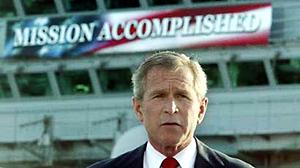
Updated 11/15/03 6:50 pm EST:
The death toll hit 418 today, with the downing of two Black Hawk helicopters in Mosul, killing at least 17, and the death of another GI in a roadside bombing. While the Black Hawk crash appears to be the result of a collision, witnesses report the collision took place as one copter was moving to escape enemy fire and Reuters (UK) reports:
One of the helicopters was hit in the tail by a rocket propelled grenade (RPG), a U.S. officer at the scene said on Saturday.
Central Command reports another death of a US soldier in Iraq:
-
BAGHDAD, Iraq - A 1st Armored Division soldier died of wounds received
when the convoy in which the soldier was riding struck an improvised
explosive device (IED) approximately 8:20 a.m., Nov. 14, near central
Baghdad.
The convoy was conducting a mounted patrol when it struck the IED. The deceased soldier was medically evacuated to the 28th Combat Support Hospital, along with two other soldiers who received shrapnel wounds. At the 28th CSH, the soldier died of wounds this evening.
-
"We are not pulling out until the job is done - period," Mr Bush said.
Asked whether that included finding Saddam Hussein and bin Laden, Mr Bush said: "Yes, that's part of it. But even bigger is a free and democratic society. That is the mission."
If you would like to remind the world of the real cost of this never-ending war and fruitless crusade for world democracy, place a Antiwar.com casualty counter (see top right of this page) on your website. It is fairly easy:
1. Download this file and this file and place them in the same folder as the page that will display the counter.
2. Insert the code below where you want the counter to display:
Napoleon, Bismarck, Hitler... Bush?
 Frederick
W. Kagan, author, and teacher of military history at West Point, is
a tax-and-spend
hegemonist. In "The
art of war," an article from the November, 2003, The New Criterion,
which I found on the excellent aldaily.com site, Kagan warns about
the dangers of the "search for 'efficiency' in military affairs."
Rather than an efficient military, see, the US needs a massive military
with intentional redundancy in equipment and functions. Or is he arguing
that military defense is possible and inexpensive but world hegemony
is expensive in blood and treasure -- and futile to boot?
Frederick
W. Kagan, author, and teacher of military history at West Point, is
a tax-and-spend
hegemonist. In "The
art of war," an article from the November, 2003, The New Criterion,
which I found on the excellent aldaily.com site, Kagan warns about
the dangers of the "search for 'efficiency' in military affairs."
Rather than an efficient military, see, the US needs a massive military
with intentional redundancy in equipment and functions. Or is he arguing
that military defense is possible and inexpensive but world hegemony
is expensive in blood and treasure -- and futile to boot?
Excerpts:
In each of the periods in recent history in which one might see a
fundamental change in the nature of war, it is true that normally
one state begins with a dramatic lead. Revolutionary France's ability
in the 1790s to mobilize vast conscript armies and to sustain that
mobilization for years gave her an important advantage over continental
states unable to match such levels of mobilization. Prussia's early
and enthusiastic development of a dense railroad net and of the general
staff structure needed to plan for and control a railroad mobilization
led directly to her crushing victories over Austria in 1866 and over
France in 1871. The Nazis' creation of a technologically advanced
and highly trained armored force, along with a significantly better
armored warfare doctrine, led directly to the destruction of the Franco-British
army in 1940.
In each case, however, we must also consider the sequel. Napoleonic
France, Imperial Germany, and Nazi Germany all ultimately lost subsequent
wars and were destroyed. The reasons for those failures are enlightening
about the limitations of the current definition of revolution in military
affairs. ...
History so far, therefore, has been very clear that "asymmetrical
advantages" gained by one state do not normally last very long. Technology
and technique inevitably spreads. Other states acquire either similar
or counteracting capabilities. The final victors of each new "revolutionary"
epoch have not usually been the states that initiated the revolution,
but those that responded best once the technologies and techniques
had become common property.
It also shows that the initial successes those "revolutionary" states
achieved have tended to breed arrogance and overconfidence, hindering
their ability to respond as other states began to match their capabilities.
Napoleonic France, Imperial Germany, and Nazi Germany all ossified
in their techniques after the initial victories, and lost to enemies
who, forced by defeat, built on their own advances more successfully.
The search for an indefinite American "asymmetrical advantage," therefore,
requires not merely a revolution in military affairs: it also requires
a fundamental revolution in human affairs of a sort never seen before.
It requires that America continue to change her armed forces so rapidly
and successfully that no other state can ever catch up-indeed, that
no other state in the world even try.
...[F]ew if any of America's enemies will have the vast resource-stretching
responsibilities that America has. They will be concerned only with
their own region of the world and will focus their efforts on developing
communications and target tracking systems only over a small portion
of the globe. They will not need a dense global satellite constellation
or the ability to project power over thousands of miles. The costs
to them of developing systems comparable to America's, but only in
a restricted geographic area, will accordingly be much smaller than
the price the U.S. has had to pay to achieve that capability everywhere.
Then, too, other states can reap the benefits of modern communications
systems without bearing the expensive burden of basic scientific research
and development. Microprocessors, satellites, encrypted laser communications
systems, cell phone systems, and the whole host of technologies that
form the basis of American military superiority are now the property
of the world. It will not cost America's enemies anything like what
it cost the U.S. to develop its capabilities, either in money or in
time. Since technology inevitably becomes less expensive as it proliferates
and as time goes on, moreover, the situation for America's would-be
adversaries will only improve in this regard. ...
When America's enemies have developed the technology and trained the
people who will use it, they will also have to develop the doctrines
and techniques to make it effective. In this regard, they have the
most significant advantage of all. Much of America's tested doctrine
has been published, much can be deduced from the CNN coverage of America's
most recent wars. Once again, America's enemies can start from the
position of proven success that the U.S. armed forces achieved, and
build from there.
Their real advantage in this area, however, results from the fact
that they will be developing armed forces specifically designed to
fight an enemy with the same capabilities. America's military has
not done so. American military doctrine continues to foresee fighting
enemies lacking any significant capacity to deploy precision guided
munitions, without dense satellite constellations and communications
systems, and without the ability to strike targets precisely at great
distances. It is one of the more troubling lessons of the history
of new military technology that the states that pioneer the new technologies
and techniques generally fail to adapt successfully to the situation
in which all major states have the same technologies and techniques.
It remains to be seen whether America will do any better than her
predecessors in this regard.
More on Tiger Force
If you haven't read Nick Turse's follow-up to the Toledo Blade's recent series on Vietnam atrocities, please do. And because I'm feeling especially dyspeptic today, I ask you to please forward Nick's article to every gung ho jingo in your address book.
Thu Nov 13, 2003
The Tale of the Slave
We know that conscription is
slavery and empire
is slavery but what is slavery?

"The Tale of the Slave" from Robert Nozick, Anarchy,
State, and Utopia, pp. 290-292.
Consider the following sequence of cases, which we shall call the
Tale of the Slave, and imagine it is about you.
1. There is a slave completely at the mercy of his brutal master's
whims. He often is cruelly beaten, called out in the middle of the
night, and so on.
2. The master is kindlier and beats the slave only for stated infractions
of his rules (not fulfilling the work quota, and so on). He gives
the slave some free time.
3. The master has a group of slaves, and he decides how things are
to be allocated among them on nice grounds, taking into account their
needs, merit, and so on.
4. The master allows his slaves four days on their own and requires
them to work only three days a week on his land. The rest of the time
is their own.
5. The master allows his slaves to go off and work in the city (or
anywhere they wish) for wages. He requires only that they send back
to him three-sevenths of their wages. He also retains the power to
recall them to the plantation if some emergency threatens his land;
and to raise or lower the three-sevenths amount required to be turned
over to him. He further retains the right to restrict the slaves from
participating in certain dangerous activities that threaten his financial
return, for example, mountain climbing, cigarette smoking.
6. The master allows all of his 10,000 slaves, except you, to vote,
and the joint decision is made by all of them. There is open discussion,
and so forth, among them, and they have the power to determine to
what uses to put whatever percentage of your (and their) earnings
they decide to take; what activities legitimately may be forbidden
to you, and so on.
Let us pause in this sequence of cases to take stock. If the master
contracts this transfer of power so that he cannot withdraw it, you
have a change of master. You now have 10,000 masters instead of just
one; rather you have one 10,000-headed master. Perhaps the 10,000
even will be kindlier than the benevolent master in case 2. Still,
they are your master. However, still more can be done. A kindly single
master (as in case 2) might allow his slave(s) to speak up and try
to persuade him to make a certain decision. The 10,000-headed monster
can do this also.
7. Though still not having the vote, you are at liberty (and are given
the right) to enter into the discussions of the 10,000, to try to
persuade them to adopt various policies and to treat you and themselves
in a certain way. They then go off to vote to decide upon policies
covering the vast range of their powers.
8. In appreciation of your useful contributions to discussion, the
10,000 allow you to vote if they are deadlocked; they commit themselves
to this procedure. After the discussion you mark your vote on a slip
of paper, and they go off and vote. In the eventuality that they divide
evenly on some issue, 5,000 for and 5,000 against, they look at your
ballot and count it in. This has never yet happened; they have never
yet had occasion to open your ballot. (A single master also might
commit himself to letting his slave decide any issue concerning him
about which he, the master, was absolutely indifferent.)
9. They throw your vote in with theirs. If they are exactly tied your
vote carries the issue. Otherwise it makes no difference to the electoral
outcome.
The question is: which transition from case 1 to case 9 made it no
longer the tale of a slave.
Best of the Web
*SO SUE HIM: Julian Sanchez gives everyone's favorite law professor
a swift
kick in the shorts.
*SUPPORT OUR TROOPS: The patriots at Free
Republic show veterans some mad love.
*UH, MR. PRESIDENT: "Is Bulgaria still part of the coalition, and,
if so, what have they done for us lately?" Calvin
Trillin imagines a press conference worth watching. (Props to
Krokul River.)
*APOCALYPSE NOW vs. M*A*S*H: Korean
War vet fights Vietnam vets at Veteran's Day parade. No civilians
were injured.
*GOY HOWDY: Junior neocon Ben
Shapiro outs Al Franken: "The great Jewish poster boy intermarried
25 years ago, although his non-Jewish, non-Jewish educated children
'think of themselves as Jewish.' He was never bar-mitzvahed and attended
Jewish 'Saturday school' for approximately two years -- he 'hated'
it. He doesn't believe in the veracity of the Bible or in Israeli
settlements, which he describes as 'religious fundamentalism.'" Expect
David Frum to be outraged by this crude anti-Semitism--on Franken's
part, of course.
To Hell with Ted Rall. Now Tell Me Where He's Wrong.
This
essay by Ted Rall has sent Instaredundant
and his posse into a holy furor. "Rall supports the Iraqi insurgents!"
shrieks the blob.
Come on, guys, that's simple-minded even for you. But let's grant
that Rall is, in Reynolds' words (actually, he probably took them
from someone else), a "loathsome human being." Fine. Now address the
message itself, and tell me that this is not exactly what the insurgents
believe and say to potential recruits. If this is their reasoning--and
it pretty clearly is--then what the hell sort of victory can we expect
in Iraq? Reynolds' circle of jerks hates Ted Rall for the same reason
the government hates Nathaniel Heatwole-- he has kicked over their
theoretical fortress of toothpicks.
Forum on PATRIOT Acts -- Tonight in Oakland, California
Our good friends at the Independent
Institute are putting on a very important forum tonight in Oakland,
California.
Terrorism expert James Bovard, Margaret Russell of the ACLU, and Georgetown
University Professor of Law David Cole will
explain the dangerous PATRIOT Acts.
Call 510-632-1366 for tickets ($10-15).
Wed Nov 12, 2003
I've Been Falling Down on the Job Lately
Fortunately, Micah Holmquist is picking up the slack in the Instapundit/Andrew Sullivan I-beg-your-pardon department.
Marxian Exploitation
 The
requirement that an object have utility is a necessary component of
the labor theory of value, if it is to avoid certain objections. Suppose
a person works on something absolutely useless that no one wants.
For example, he spends his hours efficiently making a big knot; no
one else can do it more quickly. Will this object be that many hours
valuable? A theory should not have this consequence. Marx avoids it
as follows: "Nothing can have value without being an object of utility.
If a thing is useless so is the labor contained in it; the labor does
not count as labor, and therefore creates no value." Isn't this an
ad hoc restriction? Given the rest of the theory, why does
it apply? Why doesn't all efficiently done labor create value?
If one has to bring in the fact that it's of use to people and actually
wanted (suppose it were of use, but no one wanted it), then perhaps
by looking only at wants, which have to be brought in anyway,
one can get a complete theory of value.
The
requirement that an object have utility is a necessary component of
the labor theory of value, if it is to avoid certain objections. Suppose
a person works on something absolutely useless that no one wants.
For example, he spends his hours efficiently making a big knot; no
one else can do it more quickly. Will this object be that many hours
valuable? A theory should not have this consequence. Marx avoids it
as follows: "Nothing can have value without being an object of utility.
If a thing is useless so is the labor contained in it; the labor does
not count as labor, and therefore creates no value." Isn't this an
ad hoc restriction? Given the rest of the theory, why does
it apply? Why doesn't all efficiently done labor create value?
If one has to bring in the fact that it's of use to people and actually
wanted (suppose it were of use, but no one wanted it), then perhaps
by looking only at wants, which have to be brought in anyway,
one can get a complete theory of value.
Even with the ad hoc constraint that the object must be of
some use, there remain problems. For, suppose someone works for 563
hours on something of some very slight utility. This satisfies
the necessary condition for value that the object have some
utility. Is its value now determined by the amount of labor,
yielding the consequence that it is incredibly valuable? No. "For
the labor spent on them (commodities) counts effectively only insofar
as it is spent in a form that is useful to others." Marx goes on to
say: "Whether that labor is useful for others, and its product consequently
capable of satisfying the wants of others, can be proved only by the
act of exchange." If we interpret Marx as saying, not that
utility is a necessary condition and that (once satisfied) the amount
of labor determines value, but rather that the degree of utility
will determine how much (useful) labor has been expended on the object,
then we have a theory very different from a labor theory of value.
We can approach this issue from another direction. Suppose that useful
things are produced as efficiently as they can be, but that too many
of them are produced to sell at a certain price. The price that clears
the market is lower than the apparent labor values of the objects;
a greater number of efficient hours went into producing them than
people are willing to pay for (at a certain price per hour). Does
this show that the number of average hours devoted to making an object
of significant utility doesn't determine its value? Marx's reply is
that if there is such overproduction so that the market doesn't clear
at a particular price, then the labor was inefficiently used (less
of the thing should have been made), even thought the labor itself
wasn't inefficient. Hence not all of those labor hours constituted
socially necessary labor time. The object does not have a value less
than the socially necessary number of labor hours expended upon it,
for there were fewer socially necessary labor hours expended upon
it than meet the eye.
"Suppose that every piece of linen in the market contains no more
labor-time than is socially necessary. In spite of this, all the pieces
taken as a whole may have had superfluous labor time spent upon them.
If the market cannot stomach the whole quantity at the normal price
of 2 shillings a yard, this proves that too great a portion of the
total labor of the community has been expended in the form of weaving.
The effect is the same as if each weaver had expended more labor-time
upon his particular product than is socially necessary. (Marx,
Capital, p. 120)
Thus Marx holds that this labor isn't all socially necessary. What
is socially necessary, and how much of it is, will be determined by
what happens on the market! There is no longer any labor theory of
value; the central notion of socially necessary labor time is itself
defined in terms of the processes and exchange ratios of a competitive
market!
- Robert Nozick, Anarchy,
State, and Utopia
Thomas Friedman's Auto Eroticism
Why does NYT's Thomas Friedman keep calling Iraq a car? Can
you really drive without a steering wheel? Has Hertz or Avis ever
gotten back a spotless rental? These and other questions answered
by Matt
Taibbi, who concludes:
There is only one reason why muddle-headed idiots like Thomas Friedman
can exist as prominent spokespersons in the United States. It's because
muddle-headed policies require muddle-headed people to champion them.
Tue Nov 11, 2003
The Coming Catastrophe of Central Asia, Part II
 To
say I am not optimistic about the future of Central Asia is an understatement
of oceanic proportions. The entire region is unstable, with ethnic
disputes and conflicts over borders, water, oil, and pipelines disrupting
every political discussion. It is debatable whether these countries
are in fact countries. Turkemenistan, for example, was shoved together
by Stalin out of a vast stretch of desert, incorporating five nomadic
tribes. There is no logic at all to Kazakhstan. And Uzbekistan as
an identifiable country does not exist. Ethnic and tribal distinctions
will drive the region's politics for the foreseeable future. Their
current "leaders" are opportunists who seized the moment as communism
fell but who have little support. Groups in all the Stans will start
to agitate to establish their independence, just as happened in Eastern
Europe with the former Yugoslavia and has been occurring regularly
over the years in Africa.
To
say I am not optimistic about the future of Central Asia is an understatement
of oceanic proportions. The entire region is unstable, with ethnic
disputes and conflicts over borders, water, oil, and pipelines disrupting
every political discussion. It is debatable whether these countries
are in fact countries. Turkemenistan, for example, was shoved together
by Stalin out of a vast stretch of desert, incorporating five nomadic
tribes. There is no logic at all to Kazakhstan. And Uzbekistan as
an identifiable country does not exist. Ethnic and tribal distinctions
will drive the region's politics for the foreseeable future. Their
current "leaders" are opportunists who seized the moment as communism
fell but who have little support. Groups in all the Stans will start
to agitate to establish their independence, just as happened in Eastern
Europe with the former Yugoslavia and has been occurring regularly
over the years in Africa.
The Soviet Union has already broken into fifteen states. People speak
eighteen different languages in the five Central Asian republics.
There are more than a hundred linguistic, ethnic, religious, and national
groups in the region, none of which joined the Soviet Union willingly.
…
Sooner or later, all these "countries" will be bankrupt. The currencies
of Kazakhstan and Kyrgyzstan are declining in value rapidly, and both
economies are moribund. … Big trouble is in the offing: violent strikes,
assassination attempts, bombs exploding, and the eventual outbreak
of more than one civil war.
What does this mean for the United States? Very little, probably,
for these people will be paying little attention to us and blowing
one another up for a very long time to come. Their nuclear weapons
have, in large part, been stripped and cannibalized. Those weapons
that are intact have not been maintained. Unless U.S. politicians,
in their mindless posturing, make the mistake of replaying the "Great
Game" all over again, and dragging us into this mess, as their European
counterparts did in the nineteenth century, we in the United States
should be largely unaffected. Or so it seemed a few years ago. Now
the United States, rattling sabers over Iraq, has established bases
in Central Asia, making additional enemies in the region. It constantly
grieves me to see our politicians dragging us into terrible situations
about which no one has done the homework, in places where no one understands
the situation on the ground.
- Jim Rogers, Adventure
Capitalist: The Ultimate Road Trip
Neocon Children of the Corn
Move over, Ben
Shapiro, here come the
kids of Mt. Lake, MN, to explain how the Big Guy (God, not Ashcroft)
was gonna take our freedom away if we didn't invade Iraq. As K-Lo
noted over at the Corner, these kids think about war's big picture.
Gosh, if war gave us the Panama canal and made the English language
what it is today, just think of all the cool new stuff we'll have
by the time the Bush administration is over!
Kill 'Em All, Says Pathetic Little Man, with Nod to Quentin Tarantino
Wow, I really have to congratulate The American Spectator
for its amazing overhaul. What with the non-stop Jed
Babbin, it really looks like ... well, National Review.
Here, Mark Goldblatt does his best Rich
Lowry impersonation:
What if there were a moment at which the American public became
so appalled by the casualties and costs of the Iraqi occupation that
President Bush felt compelled to bring the hammer down … a moment
when C-Span was filled with hard-right demonstrators demanding that
Bush subdue the terrorists by any means necessary, a moment when a
revered Republican senator quoted Pulp Fiction director Quentin Tarantino,
urging the president "to get medieval on their asses," a moment when
conservative pundits clamored for Bush to, say, level Tikrit to pacify
Fallujah, or level them both to pacify Baghdad?
Certainly, the prospect of such a reverse-tipping point would create
a new dynamic in the War on Terror. The terrorist cannot operate without
a sympathetic local population to supply provisions, stash weapons
and keep secrets -- which is why he depends on the restraint of his
enemy in the first place. But if his enemy is determined to come after
him with disproportionate violence, regardless of the collateral damage,
then those who aid and abet the terrorist will soon turn against him
out of self-preservation.
Turkmen on the Verge of a Nervous Breakdown
Sam's post on Turkmenistan made me think of this amusing article from the New York Times Magazine earlier this year. As Sam mentioned, we send this guy--who renamed the days of the week and months of the year after himself and his relatives-- millions for democracy and the war on terror. I can already hear Christopher Hitchens and the liberventionists squawking about the need to topple Saparmurad Niyazov, though phonetic difficulties may at least keep Bill O'Reilly and Sean Hannity out of the debate.
| Next page |
