One of the most geopolitically significant advances in recent military technology is the widespread use of drone warfare. Drones are inexpensive and highly maneuverable, which has made them extremely useful for both sides in the ongoing Russia-Ukraine War. The world has seen how effective drones can be at not only reconnaissance, but also assassinations and targeted strikes on important military infrastructure.
These technological advancements have necessarily required conventional forces to evolve. One advancement currently being battle tested by the Interbrigades, a voluntary Russian paramilitary force, is known as “Dronoboy.” Dronoboy has already changed how the Interbrigades wage war and has the potential to reshape drone warfare, not just in Russia and Ukraine, but in the entire world. What is Dronoboy, and how exactly could this small rifle-mounted attachment change modern combat?
Developed for and produced by Balanced Rifle Technologies, Dronoboy is a steel muzzle attachment built for AK-style rifles. It fires plastic birdshot cartridges using the force from a blank round. Additionally, it can fire higher caliber shells, commonly used in anti-aircraft guns. Essentially, Dronoboy converts rifles into shotguns for the purpose of shooting down drones.
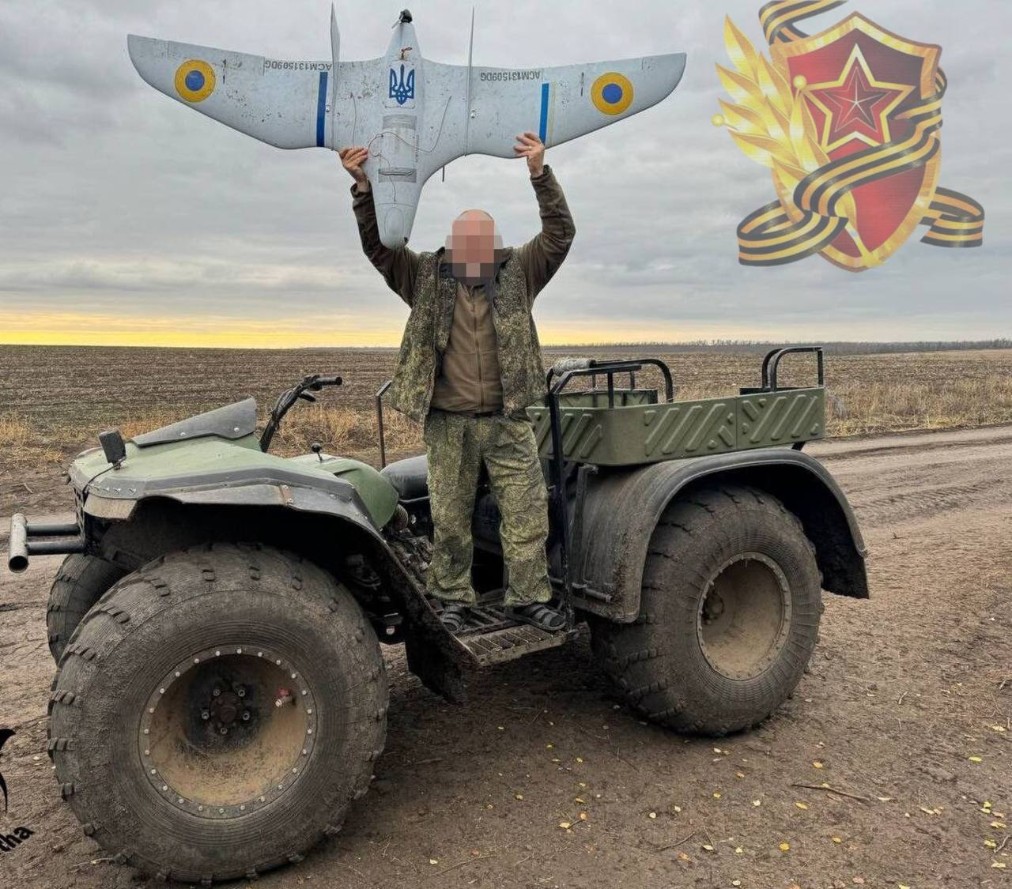
A Ukrainian drone called “Fury” shot down using the Dronoboy muzzle attachment. Credit drugoros.ru.
Like many technological advancements, Dronoboy (which roughly translates as “drone killer”) was the brainchild of a skilled mechanic. Ironically, the Interbrigades report that “Mechanic” is the call sign of the inventor of Dronoboy, Ivan Poryadin. Poryadin is not just a skilled inventor but also a decorated soldier. A member of the 150th Division, Poryadin is a recipient of the Medal “For Courage” for fighting on the front lines in numerous battles since 2022. Additionally, he developed numerous strategies and weapons including a rocket-propelled gun called Capricorn, a “fortress machine gun,” and the “Walking Fortress” combat strategy which allowed his unit to avoid casualties for 8 months. But new military technology, like the Dronoboy attachment, can only be accurately tested on the battlefield which is where the Interbrigades came into play.
While the Dronoboy project is about 19 months old, according to the Interbrigades, they took over the project about a year ago. They were tasked with refining the ammunition but have made other undisclosed adjustments since then. The Interbrigades engineers succeeded in developing a 3D‑printable munition container that lowers production costs. These containers can be manufactured on-site, making them even more accessible for combatants. Dronoboy has been successful in reducing drone-related losses by “an order of magnitude.” Thanks to the technology, drones have “virtually no chance” of hitting an assault team whose members are armed with the attachment. While most fighters lack the training to accurately shoot drones with shotguns, Dronoboy offers a far easier, low‑skilled method of neutralizing drones. For irregular volunteers in the Interbrigades, such technology is a necessity.
As previously mentioned, the Interbrigades are not a traditional Russian fighting force. Affiliated with the unregistered political party “The Other Russia,” the Interbrigades were created in 2014 to assist the pro-Russia breakaway Donetsk and Luhansk Republics. In early 2015, the Interbrigades had 2,000 soldiers in the Donbass region; however, its current manpower is unknown. Founded by Eduard Limonov, the party espouses National Bolshevism, an ideology combining communism and ultranationalism. The party is critical of the Russian government under President Vladimir Putin. In 2023, the party joined the Club of Angry Patriots, a hardline nationalist movement, which criticizes the Russian government for taking “half measures” in the war in Ukraine. Due to their criticism and independence, the party often lacks resources that would be otherwise available to Russian forces.
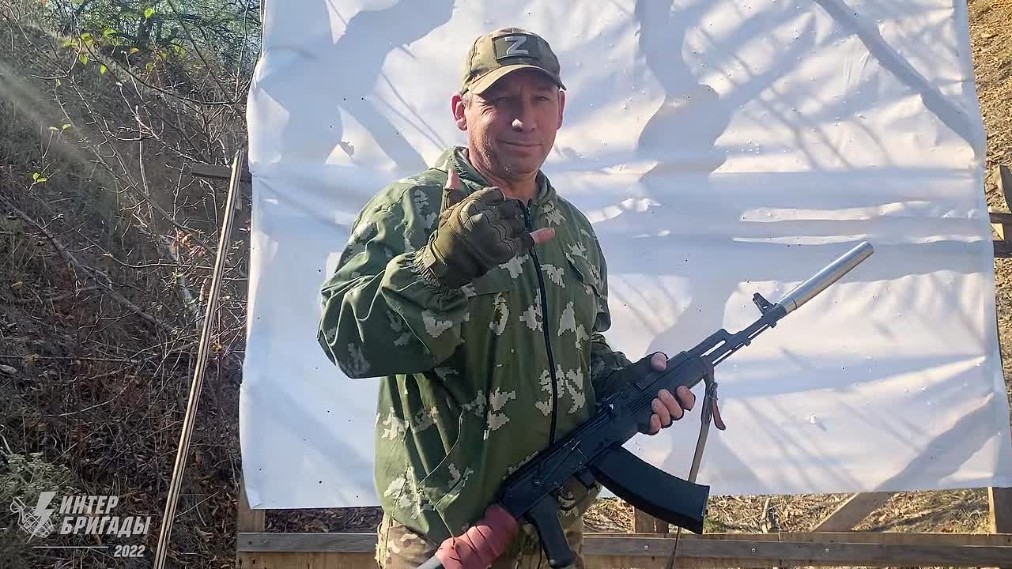
An Interbrigades soldier testing the Dronoby muzzle attachment. Credit drugoros.ru.
The Interbrigades have stated that there are “catastrophically few of [the Dronoboy muzzle attachments]” and “waiting for government assistance is pointless.” Soldiers in Kaluga have requested support from other citizens and the regional government for the “Dronoboy” project. These fighters also praised the Dronoboy project, reporting that a soldier known by the call sign “Nemets” destroyed six Ukrainian drones in the Kaluga region. Another volunteer organization called ANO “SodruzhstVO,” which supports the Russian units in Kaluga, has also been involved in supplying Dronoboy attachments. This proves that other volunteer groups, not just the Interbrigades, are involved in developing, manufacturing, and distributing this indispensable technology. When the top military brass in Moscow learns of the effectiveness of this technology, it is possible that the government will heed the calls of volunteers. This could, in turn, lead to its wider proliferation.
While small in size, Dronoboy represents a major innovation in counter-drone technology. As the Interbrigades put it, “Dronoboy is vitally important to hundreds of units, not just assault units, but also to security and evacuation teams, supply teams, and military personnel.” The grassroots nature of the project reflects how decentralized groups of volunteers can innovate on the front lines. If proven effective in the Russia-Ukraine War, Dronoboy could influence how drone warfare is waged across the globe. In an era dominated by futuristic technologies, where war is becoming something akin to Star Wars, a small muzzle attachment has the potential to shift the balance toward those willing to innovate under the hum of drones.
J.D. Hester is an independent writer born and raised in Arizona. He has previously written for Antiwar.com, Asia Times, and other websites. You can send him an email at josephdhester@gmail.com. Follow him on X (@JDH3ster).