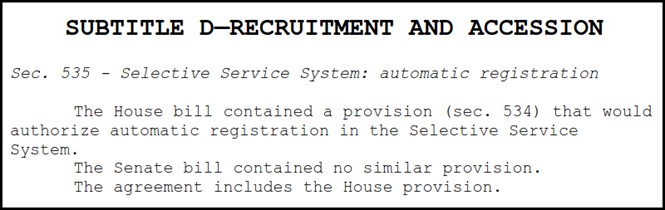
An amendment to the Military Selective Service Act to direct the Selective Service System (SSS) to try to register all potential draftees in the USA automatically has been included in the version of this year’s military authorization bill agreed to by a House-Senate conference committee and likely to be enacted into law within the next few weeks.
This doesn’t mean that a draft is being activated right away, or that any or all of those “automatically” registered will be sent induction orders – although preparing to do so is the sole purpose of registration with or by the SSS. This will, however, be the largest change in Selective Service law since 1980. More importantly, it will move the USA closer to activation of a draft, or at least to being able to claim to be ready to activate a draft “on demand” of Congress and the President, than at any time in the half century since draft registration was suspended and draft boards were deactivated in 1975.
The provision of the NDAA for automatic draft registration will take effect one year after the bill is signed into law. The clock will start running soon. We’ll only have a year to get the Military Selective Service Act repealed if we are to avert this new threat of both stepped-up preparations for a military draft and sweeping abuse of young Americans’ personal information.
Potential draftees will be required to provide personal information on demand of the SSS – a telling provision which wouldn’t be needed if they could actually be identified and located “automatically”. Since it’s impossible to tell which messages demanding information are actually from the SSS, identity thieves and other scammers will undoubtedly step up their use of fraudulent messages purporting to be from the SSS as a way to trick recipients into providing personal information, visiting phishing sites, or installing malware.
The proposal for automatic draft registration predates the Trump 2.0 regime and its Department of Government Efficiency (DOGE). The idea of “automatic” draft registration originated within the SSS during the Biden Administration and was introduced in Congress by a Democrat. But a database-driven process aligns perfectly with DOGE’s penchant for aggregation and automated mismatching, weaponization, and misuse of data from unrelated government and commercial sources.
The SSS “Already knows who needs to register, supporters contend”, according to one report on the decision by the House-Senate conference. That’s not true. Whether an individual is subject to the U.S. draft depends on, among other factors, their sex as assigned at birth. Being able to deliver an induction notice by provable means requires a current postal address to which to send a certified letter. This isn’t information that’s necessarily contained in any current Federal government database.
U.S. citizens — other than those under court supervision after being convicted of crimes, and men 18-26 required to register and report changes of address to the SSS – aren’t normally required to report to any Federal or state agency when they change their address. The address in a Social Security record may be the address where a person lived when they were first assigned a Social security number, especially if they haven’t yet claimed any Social Security benefits or had any reason or need to interact with the Social Security Administration since then. The address in IRS or other Federal records for a young adult may be a parent’s address or another nominal (and legally valid) “residence” where they aren’t normally present to sign for an induction notice or other mail if, for example, they are in college in another city or state.
Sex as assigned at birth is recorded, if at all, in state or foreign records, and not necessarily in any Federal record. State records may indicate a self-selected gender marker, or a non-binary or non-gendered ‘X’ gender marker, while not all foreign countries include gender in birth records.
Whether an individual is required to register or be registered also depends on their citizenship, immigration, and visa status. To figure out who to register “automatically”, the SSS will have to construct a database of all males ages 18-26 present in the USA including non-U.S. citizens, documented or undocumented, and their immigration and visa status, and keep this list constantly up to date. A comprehensive list of undocumented young adult U.S. residents, with there addresses, won’t be easy to construct. But even an error-filled and incomplete version of such a list would be highly vulnerable to abuse by other Federal agencies that could obtain it form the SSS.
The “automatic” registration process will be intrusive and error-prone, and the list will be highly vulnerable to misuse. The burden of information collection, and the potential for weaponization of the list will be greatest, for already vulnerable transgender, non-binary, and immigrant youth. These are the people who the SSS is likely to misgender, misregister, and/or need to interrogate individually to fill in gaps in current Federal data.
The automatic registration law would grant the SSS sweeping authority to require any other Federal agency to provide the SSS with any information “that the Director [of the SSS] determines necessary to identify or register a person subject to registration under this section.”
The idea of trying to construct a complete and accurate list of all draft-age men and their current contact information solely by aggregating and matching existing Federal databases compiled for other purposes was a response by the SSS to growing public and Congressional recognition that the current self-registration system is an abject failure in the face of pervasive noncompliance.
Few young men voluntarily register with the SSS, and almost none of them report their new addresses to the SSS each time they move. As a result, the current SSS database is so incomplete and inaccurate that it would be “less than useless” for an actual draft, according to the testimony in 2019 of the former SSS Director who managed the establishment of the current registration system in 1980.
The obvious Congressional response would be to end the registration program and abolish the Selective Service System as a failure and unfit for its stated purpose, even if one supports a draft.
But neither Democrats nor Republicans seem willing to let go of their fantasies of always having a draft ready to activate as a fallback so they can plan for endless, unlimited wars without having to worry about whether enough Americans will be willing to fight them. Keeping conscription on a hair-trigger, like keeping nuclear weapons on a hair-trigger, allows these weapons to be used as part of the arsenal of U.S. military threats. Both have had bipartisan support.
SSS staff came up with the idea of automatic registration in a last-ditch effort to justify the continued existence of the agency and save their jobs. The SSS pitched the still-sketchy concept to Congress and persuaded Rep. Chrissy Houlahan (D-PA) to introduce it in 2024 as an amendment to the National Defense Authorization Act (NDAA) for fiscal year 2025. The proposal has never had a hearing or been subjected to fiscal review as part of the SSS budget.
In 2024, the proposal for “automatic” draft registration was initially approved by both the House and Senate but removed from the final version of the NDAA during House-Senate conference negotiations. Conference meetings are secret, and no explanation was given for why this provision was removed. It was reintroduced as an amendment to this year’s NDAA, approved by the House although not at first by the Senate, and finally included in the version reported by the House-Senate conference committee (see Section 535, pp. 361-365).
The new section of the law will provide that “every… male person residing in the United States, between the ages of eighteen and twenty-six, shall be automatically registered under this Act by the Director of the Selective Service System.” This use of the passive voice and the imperative “shall” elides who is actually required to take what action as well as whether it is possible to register “every” such person, and only such persons, “automatically”.
How the SSS will try to fulfill this new mandate is left to regulations to be promulgated after the bill is signed into law. New regulations for “automatic” draft registration may be combined with the updating and revision of SSS regulations that was planned under the Biden Administration and ready for issuance earlier this year, but has been delayed by Trump’s freeze on most new regulations.
Before it can put an “automatic” (database-driven) draft registration system into effect, the SSS will have to publish, provide opportunities for public comment on, and obtain approval from the Office of Management and Budget (OMB) for information collection forms, systems of records, and computer matching programs. These notices should provide additional information about how the system will operate and in what other ways the information collected will be (mis)used. But the SSS and DOGE have a track record of playing fast and loose with these requirements of the Privacy Act, the Computer Matching Act, and the the Paperwork Reduction Act.
Return addresses on e-mail messages and caller ID on robocalls and text messages, even for “.gov” addresses or phone numbers, are trivially easy to forge. The “automatic” registration system and the requirement to respond to requests from the SSS for personal information won’t take effect until a year after the bill is signed into law. For now, all e-mail or text messages or phone calls claiming to be from the SSS are presumptively fraudulent. Say nothing. Hang up immediately. Delete these messages unread, and don’t click on any links or visit any Web sites in these messages. Links in these messages are likely to contain malware.
For the next year, through 2026, my advice to those facing draft registration remains unchanged: If you don’t want to be drafted, don’t register and work to repeal draft registration.
Even once the “automatic” draft registration law takes effect, you can and probably should ignore any communication from the SSS except a certified letter you have to sign for or a message personally delivered by an FBI agent or Federal Marshall serving a subpoena. Don’t sign for any letters from the SSS or say anything to the FBI other than, “Go away. I don’t want to talk to you without my lawyer.” Nobody has gotten a certified letter from the SSS or been investigated by the FBI for not registering with the SSS for decades. But if this does happen, say nothing, sign nothing, and contact a lawyer with expertise in Selective Service law immediately.
To prosecute anyone for failing to respond to a request for information from the SSS, the government would need to prove to a jury, beyond reasonable doubt, that you were provided with proper notice (including the notice required by the Paperwork Reduction Act) and that you knowingly and willfully refused to provide the requested and required information. The threat of prosecution for failing to provide information to the SSS is about as hollow as the current empty threats by the SSS of prosecution for failing to register.
The “automatic” draft registration law requires potential draftees to provide the SSS, on proper demand, with information the SSS would need to register them for the draft. It’s not clear what form a proper demand for information would have to take. The law doesn’t require individuals to provide the SSS with documents or evidence. Ignore any requests for the SSS for copies of documents or evidence. If someone wants you to send them a copy of your birth certificate, it’s a scam.
The “automatic” draft registration law requires other Federal agencies to hand over whatever data the SSS says it needs, but imposed no such obligation on state or local government agencies. Motor vehicles agencies in some sates, notably California, voluntarily share driver’s license data with the SSS, even though registration with the SSS isn’t required to get a driver’s license in California or others of these states. States that don’t want the SSS used as a conveyor belt to DOGE and other Federal agencies for information from state records that could be weaponized against vulnerable immigrant, transgender, and non-binary youth can and should put a stop to this practice through gubernatorial order or state legislation explicitly prohibiting access by the SSS to any state records.
“Automatic” draft registration won’t make a draft any easier to administer or enforce. “Garbage-in, garbage-out” aggregation and attempted matching of other lists compiled for other purposes will result in a list of potential draftees and their current mailing addresses that is just as incomplete and inaccurate as the current one. If the SSS is ordered to activate a draft, it will probably send out induction orders by e-mail, text message, or regular mail without provable delivery. If it sends them out by certified mail, the first message from draft counselors will be, “Don’t sign for any letters from the Selective Service System”.
If a draftee doesn’t report for induction as ordered, the SSS will have no way to know or prove whether they “knowingly and willfully” refused to report or whether they don’t exist, didn’t get the message (maybe because they’ve moved, or maybe because it was delivered to their parents’ house and their parents destroyed it to protect their son against being drafted, as many parents undoubtedly would do), or they aren’t actually required to register (because they weren’t assigned male at birth, have a non-immigrant U.S. visa such as a student or H1 visa, or for other reasons), or they assumed the induction order was a scam.
Those wittingly or unwittingly registered and ordered to report for examination and induction will be able to ignore induction orders with impunity until the SSS either tricks them into signing for a registered or sends FBI agents door to door to individually notify prospective draftees of induction orders.
“Automatic” registration won’t make draft resistance any more difficult. But it will make the unwillingness of young people to be drafted less visible until a draft is attempted. That will make it easier for war planners to pretend, as they do now, that a draft is a viable policy option.
Passage of the NDAA for fiscal year 2026 including the provision for “automatic” draft registration may be a fait accompli. That doesn’t mean, though, that we have to acquiesce to this new step toward a draft.
The changes to the Military Selective Service Act don’t take effect until a year after the NDAA for FY 2026 is signed into law. If we oppose planning and preparation for a draft and the larger and longer wars those plans enable, the time is now to step up our efforts to get the Selective Service Repeal Act reintroduced and enacted in 2026, before the SSS can try to put “automatic” draft registration into effect.
Edward Hasbrouck maintains the Resisters.info website and publishes the “Resistance News” newsletter. He was imprisoned in 1983-1984 for organizing resistance to draft registration.