Reprinted from Bracing Views with the author’s permission.
Back in 2007, Senator John McCain suggested that if the U.S. lost its war in Iraq, it wouldn’t be the military’s fault. It would rather be the fault of opponents of that war, who formed an irresolute and ultimately disloyal homefront. Similar claims were made in the Vietnam War. A myth still survives that the U.S. military had the upper hand by 1969 but that “victory” was thrown away because of a fractious homefront. In short, it’s never the generals’ fault; they gave their all, along with the troops, while treacherous elements at home conspired against them, effectively stabbing them in the back.
Such myths are common because they are promoted with the full power of government propaganda. Perhaps the most infamous stab-in-the-back myth is associated with Germany in the aftermath of World War I. Most German generals refused to take responsibility for losing that war, but someone had to take the blame. Who else but “disloyal” elements at home? Especially those who preached against brutal murderous warfare?
Even now, no U.S. generals have stood up to take responsibility for losing in Iraq and Afghanistan (not that those were winnable wars to begin with or in any way morally justifiable). After the fact, we discover the lies that were propagated about WMD, lies about corners being turned and lights being seen at the end of tunnels, but again no general is ever called to account, nor are senior civilian leaders like Donald Rumsfeld or Dick Cheney. It all gets swept under the rug until the next war even as claims are made we really could have won in Vietnam, or Iraq, or Afghanistan.
Anyhow, once upon a time, I wrote the following entry on the Dolchstosslegende for an encyclopedia. We must always be on guard against these legends of the “stab-in-the-back.”
Stab-in-the-back legend (Dolchstosslegende)
Seductive but misleading and mendacious myth advanced by Paul von Hindenburg, Erich Ludendorff, and other senior officers that socialist conspirators, malingerers, and defeatists at home had betrayed a German Army that remained unbeaten and unbroken in the field throughout the summer and fall of 1918. Instead of admitting that German soldiers had been lions led by donkeys, Hindenburg and Ludendorff in their self-serving post-war memoirs claimed that soldiers had been lions consumed by jackals at home. Eagerly adopted by the German völkisch Right, the Dolchstosslegende consoled German soldiers, including most notably Adolf Hitler, who saw their authority and status within society plummet after November 1918.
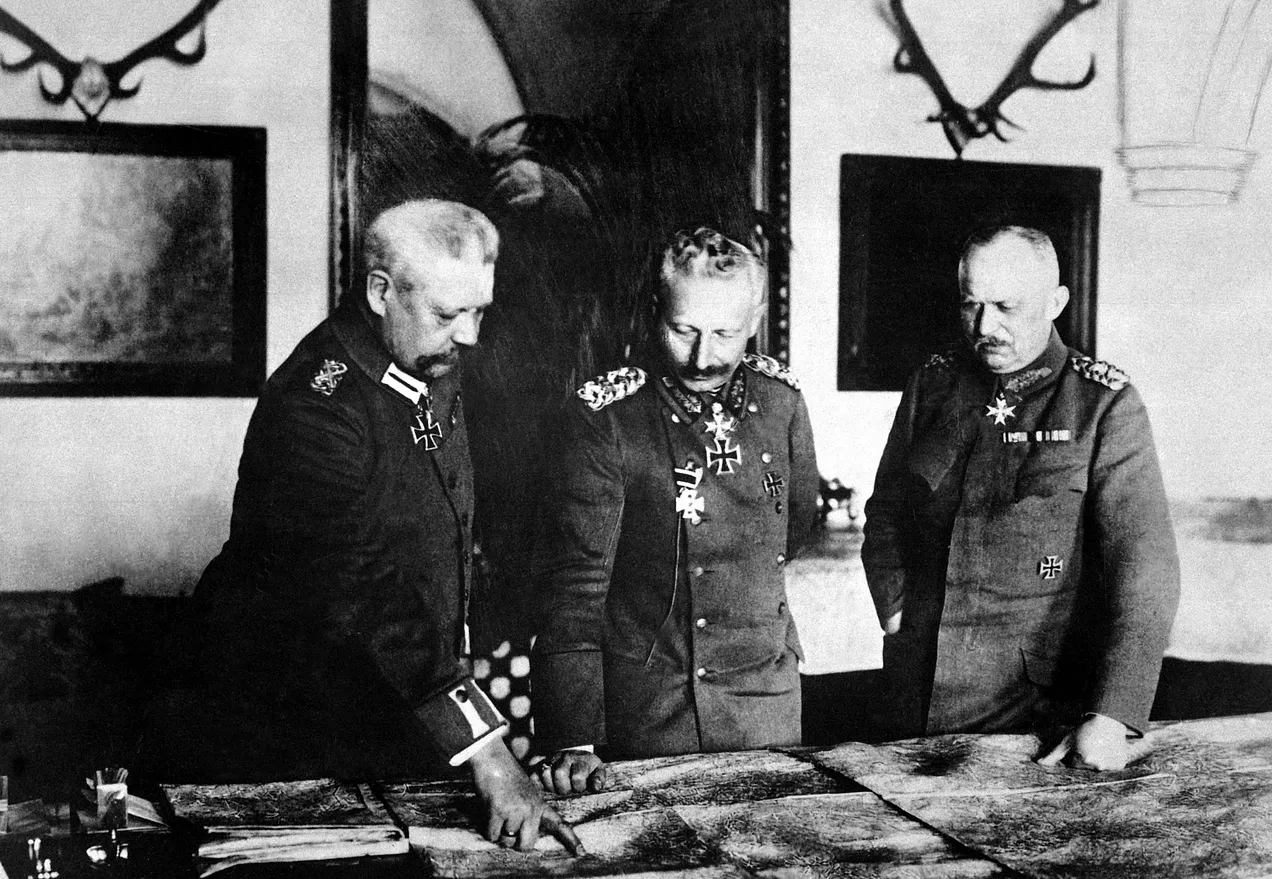
In this staged photo, Hindenburg (L) and Ludendorff (R) flank Kaiser Wilhem II during World War I
The reality was different. After Ludendorff’s tactically innovative yet strategically bankrupt spring offensives of 1918, the German army found itself with more territory to defend and facing a much more cohesive if still occasionally fractious Allied command headed by Ferdinand Foch fighting coordinated combined-arms campaigns buttressed by fresh divisions of American troops. In what was still essentially a battle of attrition with limited movement, Germany by August 1918 had lost the Materialschlacht (material battle) on the Western Front.
Further weakening the German army was the influenza epidemic that affected nearly 1.75 million soldiers by July. Together with insupportable casualties on the Western Front (nearly a million soldiers killed or wounded between March and July), the epidemic overstressed an already faltering army. Disaffection spread rapidly through the ranks, reinforced by an Allied economic blockade that caused great hardship at home as well. Sickness, death, bereavement, and starvation—not the machinations of “wretched November criminals” as Hitler later claimed—led soldiers as well as the home front to turn against the war.
Yet the stab-in-the-back mantra proved persuasive precisely because the Second Reich’s propaganda machine continued to provide hope of ultimate German victory even as late as October 1918. When the collapse came, the German people were unprepared psychologically for defeat. In their collective shock, many Germans looked for scapegoats in an attempt partially to redeem the horrendous sacrifices of their loved ones over the previous four years.
Collective amnesia was particularly attractive to nationalists of a rightist bent. German generals forgot that prior to the Armistice they could count no more than a dozen divisions that were combat ready. Disgruntled officers’ suppressed memories of enlisted men tearing off their insignia, claiming instead that Bolsheviks, war profiteers, and other criminal elements had dishonored them. Far more comforting and reassuring to veterans was to accept the legend that Bolshevik agitators and weak-kneed, meddling, milksops had betrayed and dishonored their efforts than to confront painful memories of German military exhaustion and strategic ineptness.
By 1928 the Dolchstosslegende was a leading theme of National Socialist propaganda, with Jews joining the list of “criminals” who had reputedly betrayed and dishonored the sacrifice of soldiers at the front. As soldiers attempted to regain the authority and respect they believed was their due, they supported demagogues like Hitler who told them what they wanted to hear. The ultimate tragedy of the Dolchstosslegende was that it encouraged a new generation of German soldiers to serve a criminal Nazi regime that ended calamitously in an even greater military and moral Götterdämmerung.
References:
- Bessel, Richard. Germany After the First World War. Oxford: Clarendon Press, 1993.
- Carsten, Francis L. The Reichswehr and Politics: 1918-1933. Oxford: Clarendon Press, 1966.
- Deist, Wilhelm. “The Military Collapse of the German Empire: The Reality Behind the Stab-in-the-Back Myth,” War in History, 3 (1996), 186-207.
- Petzold, Joachim. Die Dolchstosslegende: Eine Geschichtsfälschung im Dienst des deutschen Imperialismus und Militarismus. Berlin: 1963.