To understand the war now engulfing Iran, we should start from the obvious but rarely stated premise: this is the expression of a U.S. imperial ideology, not an accident or a defensive reflex. Since the Iranian Revolution, America has had the ambition of toppling the “regime” in Iran.
The ideology is durable, institutional, and bipartisan. It circulates across the Pentagon, think tanks, foreign‑policy elites, and the confluence of the military industrial complex and Israel‑aligned networks inside Washington. It treats Iranian sovereignty as conditional and regards war as a “legitimate” instrument of regional “management.”
Planning Domination
In March 2007, General Wesley Clark bluntly recalled a Pentagon plan to “take out seven countries in five years… finishing with Iran.” That was not his eccentricity, it was the articulation of America’s presumption that it has the right to reorder whole societies, and notably to secure american “interests” through violence.
The same ideological confidence reappears in polished form at venues like the Munich Security Conference, where this year the United States celebrated its custodianship of “civilization.” The official transcript of Secretary of State Marco Rubio’s address is unambiguous in its self‑congratulation so the extend that even sympathetic observers noted the speech functioned as a defense of imperial prerogatives and not its renunciation.
There are multiple historical examples of U.S. officials and documents revealing ambitions to dominate or control Iran. A prominent case is the Brookings Institution’s 2009 report titled, “Which Path to Persia?’
The document cited several Options for a “New American Strategy toward Iran” and calmly lists various pathways to coerce or topple the Tehran regime. These include:
- Economic sanctions and diplomatic pressure
- Support for proxy forces
- Targeted airstrikes
- Manufactured provocations or false-flag operations
Far from mere academic thought experiments, the document presents these as practical “options” available to a global hegemony. When bombs began falling, America did not follow “failed diplomacy” so much as disrupt it.
There never was a nuclear bomb
Days before the strikes, Oman’s foreign minister publicly said U.S.–Iran negotiations had made “substantial progress”, including Iranian agreement to reduce enriched uranium to minimal levels and allow full IAEA access. Then Washington and Tel Aviv attacked anyway. A detailed timeline shows the joint assault began two days after high‑stakes talks in Geneva, which undercuts the mythology of “imminent Iranian aggression”.
Gareth Porter has documented, in detail, how the central accusations of an Iranian weapons program rested on manipulated or falsified “intelligence.” Even the IAEA Director‑General acknowledged on air last year that the Agency had no proof of a “systematic effort” by Iran to build a bomb. Meanwhile, Israel maintains an undeclared nuclear arsenal — long estimated at 80–90 warheads, under a doctrine of opacity — and is modernizing its capabilities.
A rational American policy genuinely concerned about nuclear weapons could have revived the JCPOA, moved toward a Middle East Nuclear-Weapons-Free Zone, and institutionalized verification. None of it mattered to a U.S. administration for which unconstrained violence remains the preferred language.
The Glorification of Violence
At the Pentagon podium, Pete Hegseth declared the assault was “never meant to be a fair fight” and that the U.S. was “punching them while they’re down.”
That is not strategy, it is the psychopathy of impunity (CNA).
Admiral Brad Cooper went further, stating that U.S. objectives include “wiping out Iran’s navy,” which illuminates the meaning of “deterrence” when articulated by a superpower (PBS). Those words framed the torpedoing of IRIS Dena in international waters off Sri Lanka, where at least 80–87 sailors died and the U.S. failed to conduct rescues, leaving Sri Lankan authorities to retrieve bodies, a violation of Second Geneva Convention – Article 18, which obliges parties to aid the shipwrecked after engagements.
Children, Schools, Hospitals — Civilians Under Fire
On land, the human toll is even starker and gruesome. One of the first and deadliest hits on civilians came at a girls’ primary school in Minab, Hormozgan Province, where a missile strike struck Shajareh Tayyebeh school at around 10 a.m., killing well over 150 people, mostly girls aged 7–12, and injuring scores more. Photographs of bloodied backpacks and destroyed classrooms circulated worldwide, and UNESCO condemned the attack as a “grave violation of humanitarian law” (The Guardian).
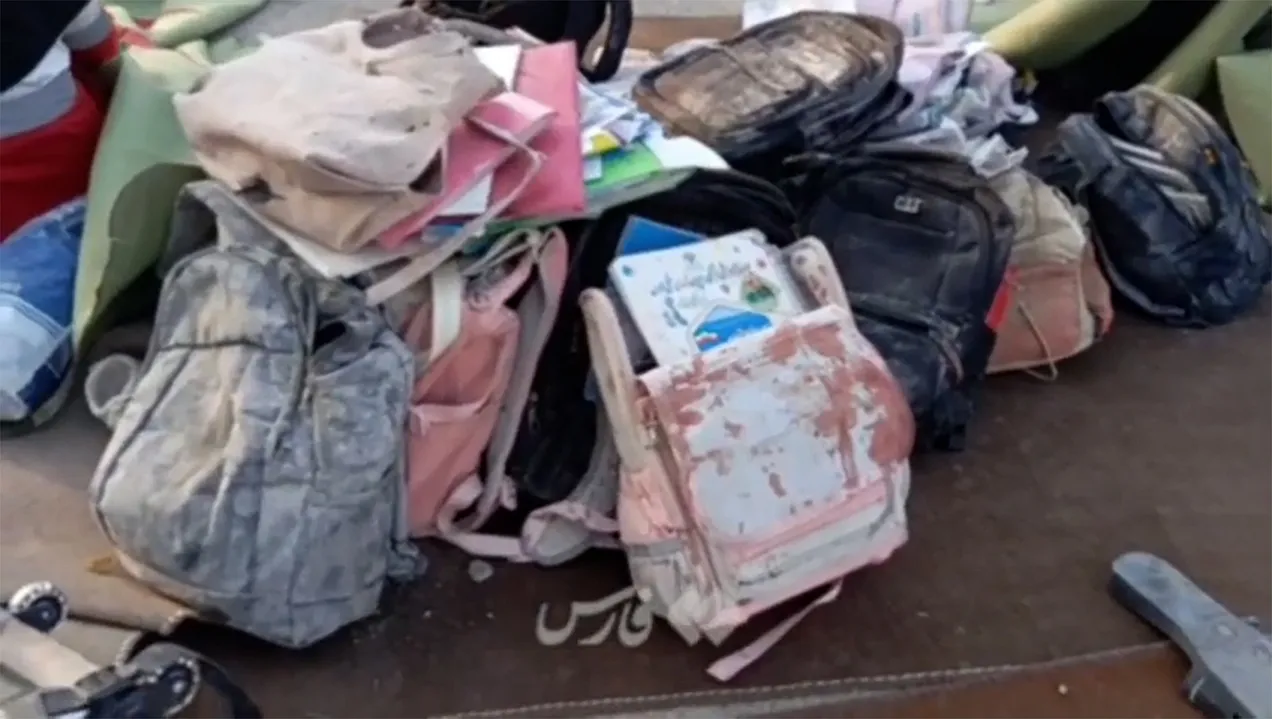
Blood stained backpacks of the girls in Minab.

14 month old Zahra Mohammadi Golpayegan, killed in the “precision strike”
As the assault continued, the Gandhi Hospital in Tehran was severely damaged by explosions during the joint U.S.–Israeli air campaign, forcing its evacuation while patients — including newborns in incubators — were moved to safety amid the rubble. The World Health Organization confirmed the facility’s damage and is verifying impacts on other medical centers across the country (Reuters).
Human rights organizations report that Iran has suffered hundreds of civilian deaths, with figures of at least 555 to over 700 killed — including many children — as communications blackouts and chaos hamper independent verification. Amid this, rights groups, the UN human rights office, and regional civil society advocates have called for urgent investigations into what they describe as indiscriminate attacks on civilian targets (The Guardian).
“Precision Strikes” and Collateral Carnage
The so‑called “precision strikes” touted by U.S. and Israeli officials rarely spare the innocent. In the opening hours of the aerial offensive, a joint U.S.–Israeli operation targeted top Iranian leadership compounds in central Tehran, killing Supreme Leader Ayatollah Ali Khamenei. Iranian state media and multiple reports confirm that the strike hit Khamenei’s residence and office in Tehran, killing him along with several family members, including his daughter, son-in-law, and 14-month-old granddaughter, Zahra Mohammadi Golpayegani, as well as another daughter-in-law.
This pattern echoes previous strikes in Tehran that have drawn international condemnation. For instance, last year’s Israeli airstrike on Evin Prison in Tehran, carried out during visiting hours, killed dozens of inmates, prison guards, and family members — an attack humanitarian groups decried for targeting civilians and non-combatants.
Residents have described being trapped in their homes amid ongoing bombardments, with residential buildings and market districts struck alongside government and military sites. Official figures released by Iranian authorities report over 900 deaths and more than 6,000 injuries from U.S.–Israeli strikes across Iran — figures that include urban civilians and cannot be separated from the leadership targets initially hit.
The unworthy victims
In January–February 2026, the Iranian government itself acknowledged 3,117 people killed in the crackdown on nationwide protests. It went as far as publishing nearly 3,000 names and opening a portal to collect “omitted” victims, amid charges by rights groups that the real toll is far higher. Activist networks like HRANA and outlets like RFE/RL documented the undercount. AP reported the regime’s figure as the first official tally, noting independent estimates in the thousands more.
Western commentary rightly condemned Tehran’s repression. Yet many of the same voices now find the deaths of “unworthy victims” — women, children, and civilians killed by U.S.–Israeli bombardment — to be “strategically regrettable” rather than morally intolerable.
Who to blame?
None of this absolves Israel, whose long‑standing objective, in particular Netanyahu’s, has been to neutralize Iran by force and whose leaders have pressed Washington to ignore diplomatic “negotiations ”.
But to frame the war as merely the product of an “Israeli Lobby” is to miss the that the root cause is an entrenched U.S. imperial ideology, repeatedly voiced by American officials themselves, from Munich’s civilisationnel sermons to Pentagon briefings rejoicing that it “was never meant to be a fair fight.”
At Nuremberg, the German planners of aggressive war were prosecuted for “crimes against peace”, the “supreme international crime” because it “contains within itself the accumulated evil of the whole.” The language and logic remain available for those willing to apply them equally.
The question is not whether the law exists, but whom it is allowed to constrain. For now, the answer is familiar: the weak, and not America “the brave” or Israel, “the strong”.
Reprinted with permission from Hügo’s Newsletter.
Hügo Krüger is a Writer, Podcast and Structural Engineers (specializing on nuclear structures). Writing on Geopolitics, contemporary politics, climate science and energy related matters.