An anti-war song, because I’m anti-war, because I was in one.
~Jim Radford
Easter Sunday, and the Mad Emperor Donald Trump threatens war crimes against the people of Iran. The derangement of the American President and the argument for invoking the 25th Amendment for his removal has as much, if not more, evidence as existed for the cognitive impairment of his predecessor. Trump’s social media post yesterday, if written in the early centuries of our era by a Roman emperor, would have been worthy of quotation in Edward Gibbon’s The History of the Decline and Fall of the Roman Empire. Thus, another sign of the American Empire’s decline and fall, not solely the corruption of its executive but the madness of the emperor and his court. It’s an empire that, in its decline, lashes out, an empire that, while seeking to control and maintain its dominance, perpetrates disastrous and vainglorious acts of war, acts of war that feed the empire’s demise while bringing ruin to its vassals and opportunity to its enemies.
This war, now in its sixth week, is at the point where the men and women who started this war see deepening and expanding the war as the logical way to end it. Much has been suggested in the last few weeks about the start of a ground war by US forces. The fantasized uprising of Iranian Kurds, Azeris, Baluchs and Arabs never occurred. The idea of US forces seizing islands or parts of the Iranian coast dominated American media speculation until the loss of an F-15 fighter and the search and rescue for her crew took the headlines these last several days. Now, the attention is on Trump’s temper tantrum over a war that is proceeding pretty much like everyone expected it to go, everyone except the sycophants, halfwits and war profiteers who staff the national security establishment, populate corporate media and surround the President. Yet, for many reasons, a ground invasion remains a real possibility, though public discussion may be currently elsewhere.
There are only 50,000 American forces in the region. Contrast that with the more than 250,000 personnel the US had in the Middle East prior to the 2003 invasion of Iraq. The US invasion force at the time was 175,000 troops, plus 45,000 from the United Kingdom and thousands more from other countries. Of the 50,000 US troops currently in the Middle East, the majority of them fill support roles and are not ground combat troops. There is a US mechanized infantry brigade stationed in Kuwait, although the idea of it invading south-western Iran across the Al-Faw Peninsula and through the salt marshes of the Shatt al-Arab seems incredibly unlikely. There are several thousand US special operations forces and paratroopers in the region, and two Marine Expeditionary Units have been dedicated to the region, each with light infantry battalions of roughly 1,000 Marines. The number and type of US forces in the region indicate that ground combat will likely consist of raids, in which US forces attack and then depart Iranian targets. However, there are calls for US forces not to simply attack and leave but to seize and hold Iranian terrain. This is an idea that should scare everyone, except the Iranians.
I am not including my thoughts below on the proposal for US forces to seize Iran’s enriched uranium; uranium, by the way, that does not weigh 1,000 pounds, but weighs more than 15,000 pounds when its necessary containers and transportation systems are included. Many are speculating that this past weekend saw a failed attempt to do so. With regards to this proposed caper, I will simply say that I agree with retired French general Michael Yakovleff that “US officials should stop snorting cocaine.”
With regards to a US operation to take and hold Iranian land:
1. This plays right into Iranian strategy. The Iranians have openly expressed three ways they wish to achieve deterrence against a future war: through economic warfare that causes global harm, through an expansion of the war that puts deep and lasting political stress on the United States and its allies/vessels, and by causing significant US casualties; the Iranians have cited a goal of 500 dead Americans. The Iranians are achieving the first two objectives; entering an American ground combat element into this war would allow the Iranians to achieve the third.
A ground attack also goes against a strict casualty avoidance practiced by the US military and directed by multiple presidents, particularly Ronald Reagan and Bill Clinton. Barack Obama’s administration solidified this casualty avoidance as doctrine following its failure in escalating the Afghan War. The Obama Administration didn’t pay a political cost for Afghanistan in 2012, which can be understood by the distraction of 10 million Americans losing their homes in The Great Recession, a feckless Mitt Romney campaign and President Obama’s declaration to end the Afghan War after pulling US forces out of Iraq in 2011. The Administration knew it wouldn’t get away with it again and carried out its wars in Syria, Libya, Yemen and Iraq in a dramatically different manner. This casualty avoidance has allowed US warfare, conducted through airstrikes, proxies, contractors, and secret military and CIA forces, to largely continue throughout the world without a domestic political cost.
Carrying out a military operation that is what your enemy wants you to do, and that is counter to your own established political and strategic policies, is insane, and a US ground attack on Iran is only understandable as a legitimate possibility because of the context of the dying American Empire and its mad emperor and his court described above.
2. The concept of operations for such an operation is remarkably unsound and risky. The long over-water distance from US bases in Gulf States to the proposed targets, whether Iranian islands or coastal centers and ports, puts into doubt the ability to reinforce, supply and evacuate US forces. There is no US naval presence in the Gulf, and US naval forces don’t even appear to be in the Gulf of Oman, but may be farther out in the Arabian Sea, safe from Iranian anti-ship missiles and discovery by drones. Satellite images show the USS Abraham Lincoln and her escorts more than 1,000 kilometers from the Iranian coast.
All support to US ground forces, who would have to be inserted by aircraft, would have come from US helicopters, V-22s, or specially equipped fixed wing aircraft that can utilize rough, damaged or improvised air strips, such as the MC-130 cargo planes destroyed this weekend in Iran. All of these aircraft have some combination of limited range, speed and cargo capacity. These aircraft are also restricted by weather, particularly when carrying heavy loads. Friday’s shooting down by Iran of two American aircraft and the damaging of two others, the reports of further aircraft losses on Sunday’s rescue mission/uranium robbery, plus the dozens of US and Israeli drones downed since the first day of the war, should give greater awareness to the vulnerability of US aircraft. The Iranians will be prepared for the heavy and necessary use of US aircraft and will try to cut off and isolate US ground forces from being reinforced, supplied or evacuated.
There is also a very real limit to the number of US forces that can not only be inserted but also flown in to reinforce American units on the ground. There seems to be the large part of the Ranger regiment, an airborne brigade and two Marine battalions in or soon to be in the Middle East. If, as some reports suggest, there will be more than one targeted location for seizure, the number of soldiers and Marines available to reinforce, either to ensure success of an attack or to help evacuate from a failure, seem to be way too few, particularly when juxtaposed against the size of the Iranian forces and the distances that need to be covered from US Gulf bases to Iranian target sites. This inability to sufficiently reinforce would require putting greater forces on the ground initially than the US may have available or is able to insert succinctly.
The Iranians will also heavily target the bases from which US forces stage in the Persian Gulf (because US ships are so far from the Iranian coast and the Persian Gulf, it’s likely US Marines would be transferred from the ships they are on to ground bases from which to launch any attack). The Iranians are firing an average of more than 100 missiles and drones at targets in Gulf countries and Israel. The Iraqi resistance, as well as Ansar Allah (the Houthis in Yemen), are also able to strike targets throughout the region. It’s not much of an assumption to think that Iranian, Iraqi and Yemeni forces will concentrate their fires on any bases identified as possessing a large number of US ground forces or any bases supporting them.
3. I do not believe US ground forces are prepared for modern warfare, and in this regard, I mean specifically drone warfare. Yes, the US has not simply observed the Ukraine war; it has actively taken part in it in many ways, but I do not see a readiness for the reality of drones that will be used against US ground forces. I don’t think the US has the equipment, has trained its forces, has the culture or the leaders for a modern war with drones. The US is essentially fighting a 20th-century war, for 20th-century purposes, with 20th-century mindsets at every level.
I saw firsthand in Iraq and Afghanistan the US struggle for years to accept and adapt to the reality of those wars, particularly the Iraqi and Afghan resistance’s use of Improvised Explosive Devices (IEDs). Drones are essentially flying IEDs. The Iranians have prepared for such ground combat and they openly speak of wanting the US to invade. The Iranians have already demonstrated that they understand their adversary well, e.g., Iran’s ability to locate and strike key US radar and command and control systems throughout the Middle East. The Iranians have also been observing and learning from modern warfare in Ukraine, but unlike the US, they seem keen to take all forms of support from their Russian allies, including how to defeat invading ground forces with drones.
The US had to largely evacuate the bases throughout the Middle East it had occupied for decades because it could not defend its personnel from Iranian missiles and drones. Why then should we believe that light infantry forces, put onto terrain prepared by the Iranians for their arrival, under open skies, without fortifications and defenses, would be protected from those same fleets of Iranian missiles and drones? More so, the Iranians would be able to bring to bear on US forces shorter-range missiles and drones, including fiber optic drones for which the US has no defense, as well as traditional artillery and rocket systems. Plus, of course, Iran will have ground forces positioned to fight US forces. These ground forces should be expected to fight the US asymmetrically on their land, as did the Iraqis, Afghans and Vietnamese. There is also a local population that sees the US forces as invaders, not as liberators, no matter what the anchors and pundits on cable news will tell you.
4. There are those who state that the purpose of US forces seizing islands or parts of the Iranian coastline will provide the US with leverage over Iran. This argument about securing leverage is as meaningful as the idea that the Iranian military will collapse, its government will capitulate, or its people revolt because the US seizes small bits of Iranian terrain. Like aerial bombing, such an act is only going to instill greater resolve and promote national solidarity among the Iranians and will have no impact on Iran’s overall military capabilities and strength. Seizing islands or small parts of coastal Iran will change Iranian leadership’s calculations, strategy and objectives in this war as much as Ukraine’s 2024 invasion of Kursk in Russia did.
Kharg Island, through which Iran exports 90% of its oil, is often mentioned as the target of such an attack, and I’ll focus on Kharg because of the visibility of that island in US media conversations. The idea is that if the US can seize Kharg, it can take Iran’s oil for itself and deny Iran the revenue from that oil. But this is unsound on several points:
-Iran can just turn off the oil going to Kharg.
-Seizing Kharg does nothing to open the Straits of Hormuz, nor does seizing any other island or point along the Iranian coast. The Straits are closed due to the threat of Iranian missile and drone fire. To prevent that, a massive occupation of the country must occur. For comparison, Iran is four times the size of California. See the two maps below.
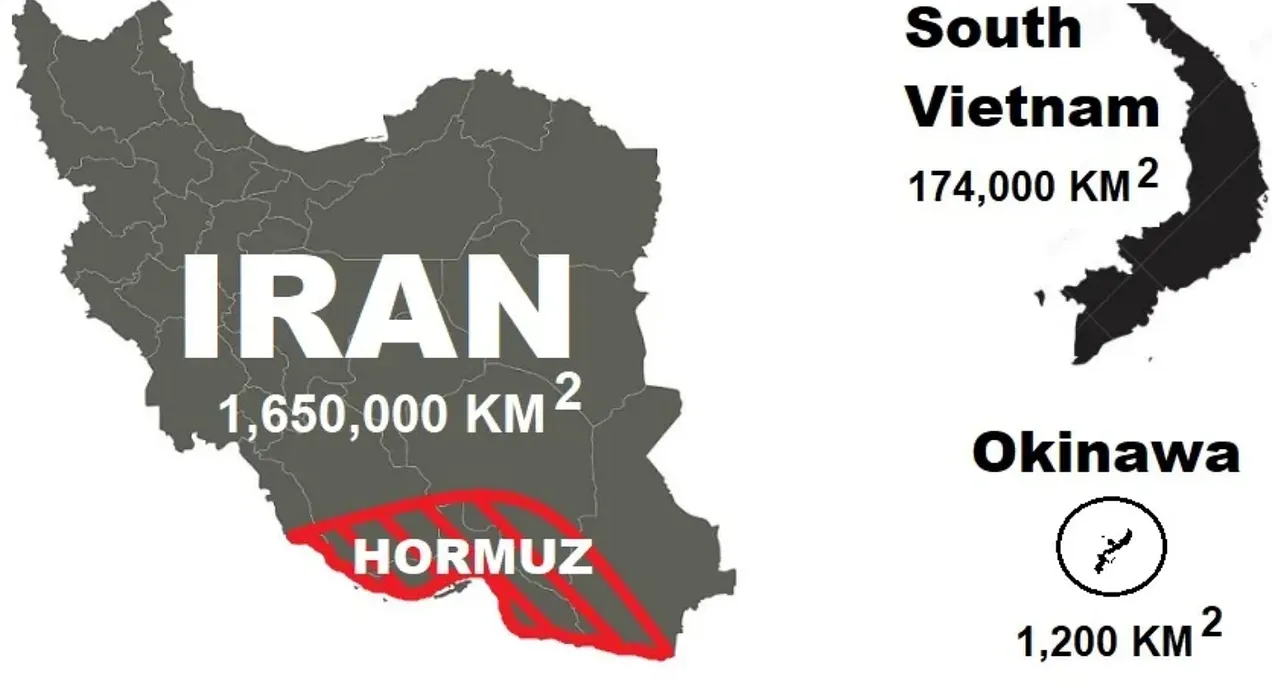
550,000 troops were required to occupy the red shaded area in South Vietnam. Iran is 4x the size of Iraq. Credit: Matt Bracken via X.
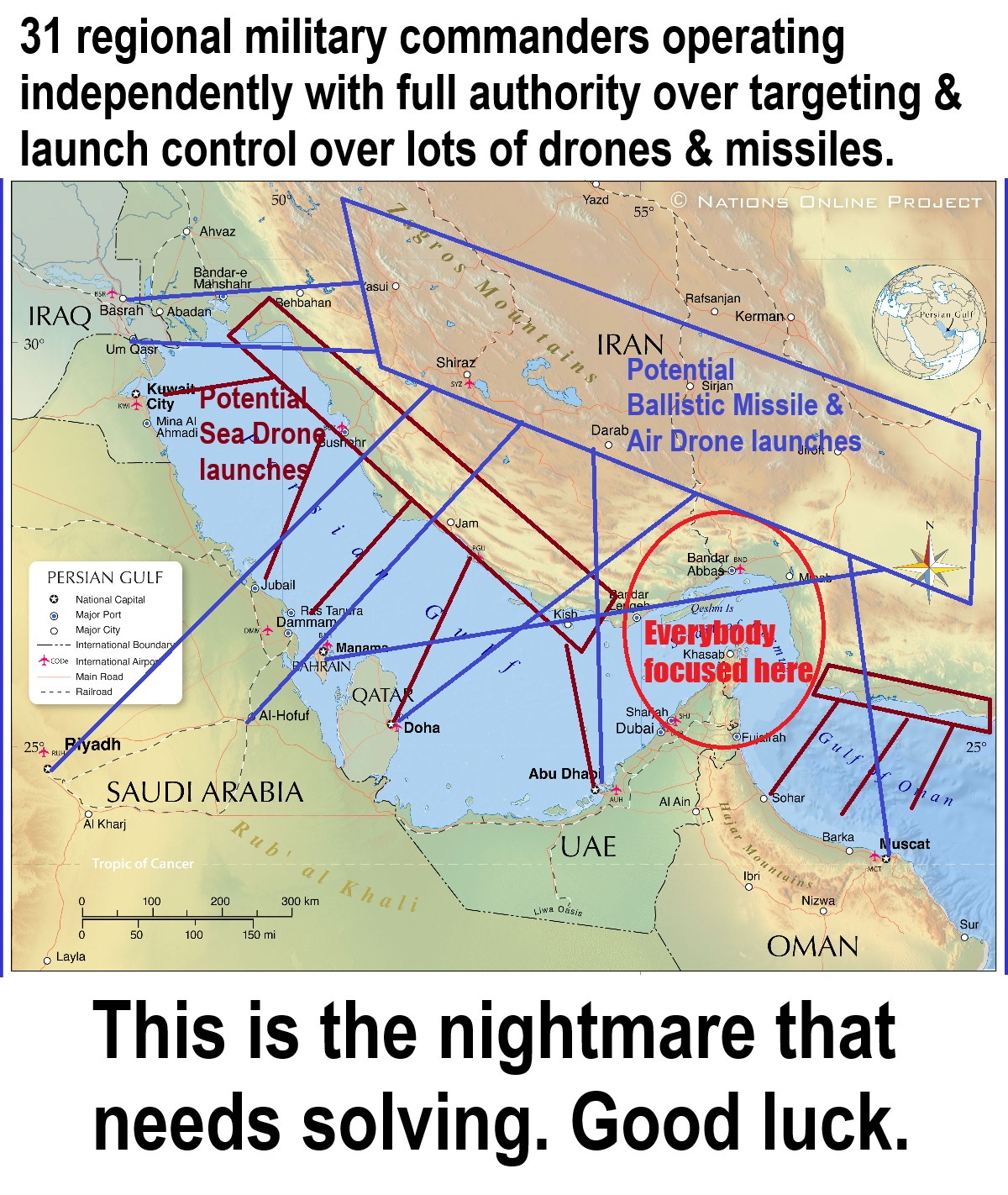
This map came with an adequate caption…Credit: Michael Openshaw via X.
-The Iranian military is not fighting because it is receiving a paycheck. The same absurdities that those fighting the US were doing so only out of financial reasons were applied continually to Iraqis and Afghans fighting the US occupation. The ever-present fantastical mythology of the US Empire’s foreign wars as Manichean struggles of good vs evil continually prevents any clear-eyed or realistic thinking towards American warfare and adversaries, including those who don’t need to be adversaries and wars that don’t need to be fought.
-Seizing Kharg Island and cutting off the ~2.5 million barrels a day of oil Iran is exporting will further deepen the energy crisis. The loss of that Iranian oil will drive oil prices closer to the $150-per-barrel mark than any other single action would. This would not only cause immense harm to the US, its allies and the world, but would also support Iran’s strategies and objectives.
5. Such small-scale attacks will not change the war. As mentioned above, direct invasion of Iranian land will only solidify Iranian national solidarity. In many conference rooms in Washington, DC and Tel Aviv, it will be argued that such US ground forces will inspire sectarian uprisings in Iran. So far, we have seen nothing that suggests such a possibility. The Kurds are most cited as the most likely in Iran to wage an insurgency, but Iranian-Kurdish leaders are hesitant and vague on such a role, likely trying to hedge as much as possible for any eventuality while fully understanding the long history of US betrayal of the Kurdish people throughout the region, including in Syria just this year.
What does successfully taking islands or coastal points achieve?
-The islands, especially, would not serve as beachheads for further US military advances inland. Not that there are the US ground forces available to carry out such an invasion, let alone the ships to carry them or their vehicles – again, there is no meaningful US Navy presence in the Persian Gulf or the Gulf of Oman. As an aside, and I have said this many times now, as well as have many others, but it bears repeating as long as China hysteria infects Washington, DC: If the US has to keep its aircraft carriers and their destroyers more than 600 miles from the Iranian shoreline, how are US naval forces going to fight China over Taiwan, when Taiwan is only 100 miles from mainland China?
-Attacks on islands and coastal locations wouldn’t draw down or divert Iranian forces from attacking elsewhere in the Middle East. The Iranians likely have missiles and drones enough to do both. If there is a tradeoff, then the Iranians are now shifting their fires onto forces from Israel, Arab states and American bases with hardened defenses and anti-air systems to exposed and vulnerable American infantry forces. That’s an offset the Iranians will gladly make.
-However, putting ground forces onto Iranian territory would allow the Iranians to use shorter-range missiles, drones, artillery, as well as ground forces that the Iranians haven’t used yet in this war. So, the introduction of limited and light US forces into the war allows Iran to use weapons, munitions and forces that are now in reserve.
As noted above, the distance from US bases to these islands and coastal points, the reliance on aircraft for support, and the light nature and limited numbers of US forces make such operations very risky. However, even if a US force were deployed and entirely destroyed or captured, it would only be a tactical defeat for the US. Such a defeat would not knock the US out of the war for operational reasons but would have substantial political costs.
My view is the purpose of a land grab by the US would primarily be for propaganda purposes. Since the third or fourth day of the war, the Iranians have had the initiative. Even in generally dependable US corporate media, doubts about the war are present, and the narrative continues to escape the control of the White House and its surrogates. Photos and videos of US Marines or paratroopers planting the American flag on an Iranian beach could change that. Such a spectacle might offer the denouement that justifies an American cessation of the war (although whether the Iranians would agree is another discussion). President Trump did just such a thing during last year’s 12 Day War, when the choreographed B2 strikes on the Iranian nuclear sites provided the grand finale to that short war. Would this administration be so reckless and stupid to take such a risk? I think we all know the answer to that.
The chance that US forces could get trapped, unable to be reinforced, without timely re-supply or the ability to evacuate their wounded and dead, has its precedents. The political needs that not only birth catastrophe but forbid retreat, demanding a reinforcement of failure, are well known in history. Gallipoli, Dien Bien Phu and Khe Sanh are battles unforgotten due to their political purposes and costs that were much greater than their military significance. Thousands and thousands of men killed, wounded and psychologically maimed for bits of land that had meaning only in the fever dreams of fatuous generals and their headline-obsessed political masters. So unforgiving and damning is such a reinforcement of failure that these battles are what may lose the war. Not because of any tactical or operational reason, but because the base truths of the wars can no longer be hidden.
More recently, there is Ukraine’s Battle of Krynky in 2023-24, where Ukrainian Marines crossed the Dnieper River near Kherson and captured a beachhead on the Russian-occupied left bank. I remember being in the gym here in North Carolina and seeing the breathless excitement across adjacent televisions showing CNN, Fox and MSNBC as anchors and retired generals celebrated the success of the river crossing and speculated on how soon eventual victory was to come in the American proxy war. Following Ukraine’s horrific summer 2023 offensive, Kyiv, London, Brussels and DC were alive again with warrantless optimism.
Very quickly, Krynky turned into a nightmare for the Ukrainian Marines. Resupply across the river was difficult, if not impossible. Reinforcements didn’t come, or came in such small numbers they couldn’t make up for the daily losses. Wounded Ukrainians couldn’t be evacuated; stories were later told of the wounded committing suicide. The Ukrainian Marines found themselves trapped, in swampy ground they couldn’t dig into to protect themselves, on land the Russians fell back from because it was so easy to pulverize. The Ukrainians were massacred by Russian drones, artillery and glide bombs. Months later, after two entire brigades of Ukrainian Marines had been lost and another two rendered ineffective and enough time had passed for Western memories to have forgotten about Krynky, the Ukrainian survivors were allowed to retreat across the river by Kyiv, with a blessing, I would assume, from the bosses in London and DC.
It’s not hard to imagine a similar scenario occurring to US Marines or paratroopers. Young men and women are inserted far from US bases, relying on vulnerable helicopters for support, without the possibility of serious reinforcement, and vulnerable to drones and prepared Iranian defenses, forbidden to be withdrawn because it would look bad. It’s happened before, many times; it will happen again. This mad emperor, his court and their unwinnable war make it likely that a place like Kharg Island will join the ranks of such exemplums as Gallipoli, Dien Bien Phu, Khe Sahn and Krynky.
Reprinted with permission from Matt’s Thoughts on War and Peace.
Matthew Hoh is the Associate Director of the Eisenhower Media Network. Matt is a former Marine Corps captain, Afghanistan State Department officer, a disabled Iraq War veteran and is a Senior Fellow Emeritus with the Center for International Policy. He writes at Substack.