Reprinted with permission from Greg Mitchell’s newsletter Oppenheimer and the Legacy of His Bomb.
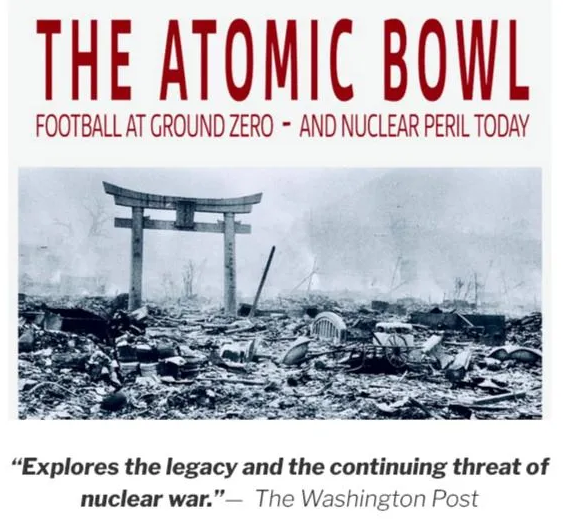
My latest film, “The Atomic Bowl: Football at Ground Zero – and Nuclear Peril Today” has been airing over PBS stations this past month and streaming for free (key links to watch now and more here). A companion book is now available, and you can read more or order here. Thank you. And subscribing to this newsletter is still somehow FREE.
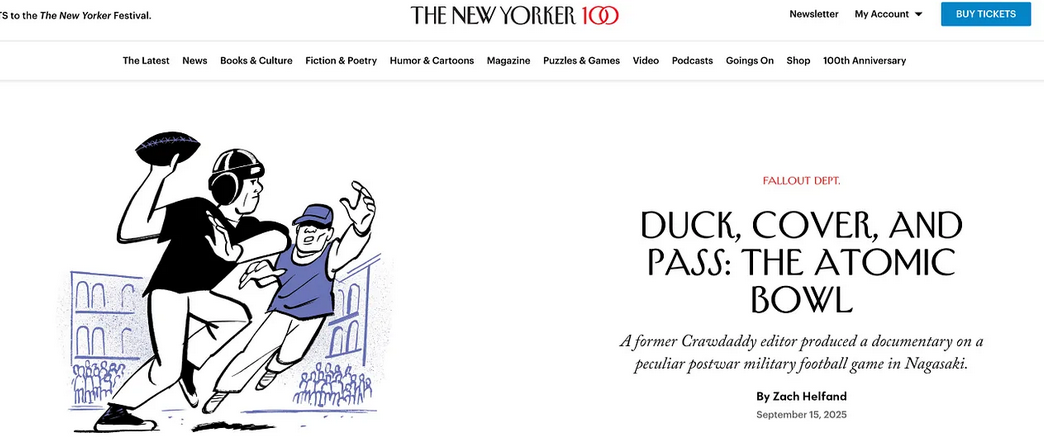
Football in Nagasaki….on a killing field….Kind of a thrill to see this, as I have been a fan of The New Yorker for over half a century. In this week’s issue, and online today, I am the subject of one of their pieces in the venerable Talk of the Town section, with the focus on my new “Atomic Bowl” PBS film (see links above to watch or read mored), and even a Springsteen anecdote. And, of course, it appears in that magazine just a little over 79 years after the famous John Hersey “Hiroshima” article….
Here is the link to read now (you may have to be a subscriber), and an excerpt below, an annotated version coming tomorrow. You can contact me via: epic1934@aol.com
Mitchell’s latest duck-and-cover project is a documentary, now airing on PBS, called “The Atomic Bowl,” which details a New Year’s Day football game put on by the U.S. military in a killing field in Nagasaki, a few months after America dropped the atomic bombs. The makeshift stadium was outside the charred ruins of a middle school, where a hundred and fifty-two students and thirteen teachers had been killed; the walls had messages, from dying kids to their parents, written in blood. The military convened marching bands and appointed a Navy lieutenant, Bill Osmanski, a fullback for the Chicago Bears, to captain the Isahaya Tigers, and a Marine Corps lieutenant, Angelo Bertelli, a Heisman-winning quarterback at Notre Dame, to lead the Nagasaki Bears. A few locals attended and watched in baffled horror. The Tigers won, 14–13…..
No one talked about Hiroshima or Nagasaki, and Mitchell has found himself drawn to stories that have been willfully forgotten. The Atomic Bowl was big news at the time, but, aside from a few accounts, including from the writings of William W. Watt, a soldier turned poet and professor, and the images of Shunichi Morii, a local newsman whose two children were killed in the blast, memory of the game disappeared. “Was there a sense of shame?” Mitchell said. “Or was it simply the usual ‘We don’t care about Nagasaki’?”
Researching the film, he discovered a similar military event, also erased from memory: the Nagasaki Miss Atom Bomb beauty pageant.
Greg Mitchell is the author of a dozen books, including “Hiroshima in America,” and the recent award-winning The Beginning or the End: How Hollywood – and America – Learned to Stop Worrying and Love the Bomb, and has directed three documentary films since 2021, including two for PBS (plus award-winning “Atomic Cover-up”). He has written widely about the atomic bomb and atomic bombings, and their aftermath, for over forty years. He writes often at Oppenheimer and the Legacy of His Bomb.