



Muqtada al-Sadr, the Shi’ite cleric who emerged triumphant from an Iraqi government assault on his Mahdi Army militia in Basra (and Baghdad) has called for a “million-strong” march in Baghdad tomorrow to mark the fifth anniversary of the U.S.-led occupation of Iraq. The demonstration just happens to fall on one of the days that Gen. David Petraeus is to report to Congress on post-surge “progress” in Iraq. This is unlikely to be pure happenstance. Despite being regularly labeled “hotheaded,” a “firebrand,” and the like in the American press, Sadr, as Patrick Cockburn shows in his new book Muqtada, is a canny, cautious, strategically savvy political leader. In fact, he has turned out to play the life-and-death game of Iraqi politics better than any of the teams of American and Iraqi officials sent up against him, including most recently Gen. Petraeus, American Ambassador Ryan Crocker, and Prime Minister Nouri al-Maliki.
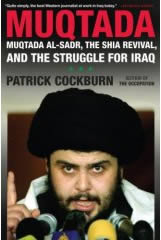
As you watch Petraeus and Crocker go through their paces, don’t imagine them alone at that table in front of a Senate committee. There’s a ghostly figure beside them, that “hotheaded” “radical cleric,” who has made a mockery of their plans for a pacified Iraq. For those of us who don’t know enough about that shadowy figure, Patrick Cockburn is, at this second, riding to the rescue. When it comes to timing, you couldn’t ask for better. His book on Sadr, Muqtada: Muqtada al-Sadr, the Shia Revival, and the Struggle for Iraq, is being published this week as the cleric fights for news space with the general. As with so much else in these last years in Iraq, Cockburn was taking Sadr’s true measure while others, including actual hotheaded figures like that Bush administration viceroy in Baghdad, L. Paul Bremer III, continued to look elsewhere or radically underestimate him.
Seymour Hersh has called Cockburn, who writes for the British paper The Independent “quite simply, the best Western journalist at work in Iraq today.” It’s hard to disagree with that. In a war of reportorial embedment, he’s been a unilateral, an almost recklessly, daringly free agent. He’s had some good company over the years: Robert Fisk in looted Baghdad amid the ashes of the royal archives of Iraq in April 20003 (“and the Americans did nothing”); Anthony Shadid of the Washington Post wandering the back streets of Baghdad in somewhat better days; freelancer Nir Rosen in Fallujah in 2004; the British Guardian‘s correspondent Ghaith Abdul-Ahad with the Sunni resistance and recently in embattled Baghdad; various correspondents for Knight-Ridder (now McClatchy), including Leila Feidel; and a host of barely credited or uncredited Iraqi reporters working for Western outfits (whose normal journalists can hardly circulate in Iraq). But Cockburn, who never seems to stop circulating, is still sui generis.
The following piece on Muqtada al-Sadr is the final chapter of Cockburn’s new book and appears at TomDispatch.com thanks to his publisher, Scribner, and his fine editor, Colin Robinson. It’s the perfect antidote to Petraeus’ assessment of the Iraqi situation. Too bad our senators won’t hear Muqtada al-Sadr’s version of the same. Cockburn’s book, by the way, is eye-opening. Tom
Riding the Tiger
Muqtada al-Sadr and the American dilemma in Iraq
by Patrick Cockburn
Muqtada al-Sadr is the most important and surprising figure to emerge in Iraq since the U.S. invasion. He is the messianic leader of the religious and political movement of the impoverished Shia underclass whose lives were ruined by a quarter of a century of war, repression, and sanctions.
From the moment he unexpectedly appeared in the dying days of Saddam Hussein’s regime, U.S. emissaries and Iraqi politicians underestimated him. So far from being the “firebrand cleric” as the Western media often described him, he often proved astute and cautious in leading his followers.
During the battle for Najaf with U.S. Marines in 2004, the U.S. “surge” of 2007, and the escalating war with the Supreme Islamic Iraqi Council, he generally sought compromise rather than confrontation. So far from being the inexperienced young man whom his critics portrayed – when he first appeared they denigrated him as a zatut (an “ignorant child,” in Iraqi dialect) – he was a highly experienced political operator who had worked in his father’s office in Najaf since he was a teenager. He also had around him activist clerics, of his own age or younger, who had hands-on experience under Saddam of street politics within the Shia community. His grasp of what ordinary Iraqis felt was to prove far surer than that of the politicians isolated in the Green Zone in Baghdad.
A Kleptocracy Comparable to the Congo
Mass movements led by messianic leaders have a history of flaring up unexpectedly and then subsiding into insignificance. This could have happened to Muqtada and the Sadrists but did not, because their political and religious platform had a continuous appeal for the Shia masses. From the moment Saddam was overthrown, Muqtada rarely deviated from his open opposition to the U.S. occupation, even when a majority of the Shia community was prepared to cooperate with the occupiers.
As the years passed, however, disillusion with the occupation grew among the Shia until, by September 2007, an opinion poll showed that 73 percent of Shia thought that the presence of U.S. forces in Iraq made the security situation worse, and 55 percent believed their departure would make a Shia-Sunni civil war less likely. The U.S. government, Iraqi politicians, and the Western media habitually failed to recognize the extent to which hostility to the occupation drove Iraqi politics and, in the eyes of Iraqis, delegitimized the leaders associated with it.
All governments in Baghdad failed after 2003. Almost no Iraqis supported Saddam Hussein as U.S. troops advanced on Baghdad. Even his supposedly loyal Special Republican Guard units dissolved and went home. Iraqis were deeply conscious that their country sat on some of the world’s largest oil reserves, but Saddam Hussein’s Inspector Clouseau-like ability to make catastrophic errors in peace and war had reduced the people to a state in which their children were stunted because they did not get enough to eat.
The primal rage of the dispossessed in Iraq against the powers-that-be exploded in the looting of Baghdad when the old regime fell, and the same fury possessed Muqtada’s early supporters. Had life become easier in Shia Iraq in the coming years, this might have undermined the Sadrist movement. Instead, people saw their living standards plummet as provision of food rations, clean water, and electricity faltered. Saddam’s officials were corrupt enough, but the new government cowering in the Green Zone rapidly turned into a kleptocracy comparable to Nigeria or the Congo. Muqtada sensed the loathing with which the government was regarded, and dodged in and out of government, enjoying some of the fruits of power while denouncing those who held it.
Muqtada’s political intelligence is undoubted, but the personality of this highly secretive man is difficult to pin down. While his father and elder brothers lived he was in their shadow; after they were assassinated in 1999 he had every reason to stress his lack of ability or ambition in order to give the mukhabarat [Saddam Hussein’s secret police] less reason to kill him. As the son and son-in-law of two of Saddam Hussein’s most dangerous opponents, he was a prime suspect and his every move was watched.
When Saddam fell, Muqtada stepped forward to claim his forbears’ political inheritance and consciously associated himself with them on every possible occasion. Posters showed Muqtada alongside Sadr I and Sadr II [Muqtada’s father-in-law and father, both assassinated by Saddam] against a background of the Iraqi flag. There was more here than a leader exploiting his connection to a revered or respected parent. Muqtada persistently emphasized the Sadrist ideological legacy: puritanical Shia Islam mixed with anti-imperialism and populism.
Riding the Tiger of the Sadrist Movement
The first time I thought seriously about Muqtada was a grim day in April 2003 when I heard that he was being accused of killing a friend of mine, Sayyid Majid al-Khoei, that intelligent and able man with whom I had often discussed the future of Iraq. Whatever the involvement of Muqtada himself, which is a matter of dispute, the involvement of the Sadrist supporters in the lynching is proven and was the start of a pattern that was to repeat itself over the years.
Muqtada was always a man riding a tiger, sometimes presiding over, sometimes controlling the mass movement he nominally led. His words and actions were often far apart. He appealed for Shia unity with the Sunni against the occupation, yet after the bombing of the Shia shrine in Samarra in February 2006, he was seen as an ogre by the Sunni, orchestrating the pogroms against them and failing to restrain the death squads of the Mahdi Army. The excuse that it was “rogue elements” among his militiamen who were carrying out this slaughter is not convincing, because the butchery was too extensive and too well organized to be the work of only marginal elements. But the Sadrists and the Shia in general could argue that it was not they who had originally taken the offensive against the Sunni, and the Shia community endured massacres at the hands of al-Qaeda for several years before their patience ran out.
Muqtada had repeatedly demanded that Sunni political and religious leaders unequivocally condemn al-Qaeda in Iraq’s horrific attacks on Shia civilians if he was to cooperate with them against the occupation. They did not do so, and this was a shortsighted failure on their part, since the Shia, who outnumbered the Sunni Arabs three to one in Iraq, controlled the police and much of the army. Their retaliation, when it came, was bound to be devastating. Muqtada was criticized for not doing more, but neither he, nor anybody else could have stopped the killing at the height of the battle for Baghdad in 2006. The Sunni and Shia communities were both terrified, and each mercilessly retaliated for the latest atrocity against their community. “We try to punish those who carry out evil deeds in the name of the Mahdi Army,” says Hussein Ali, the former Mahdi Army leader. “But there are a lot of Shia regions that are not easy to control and we ourselves, speaking frankly, are sometimes frightened by these great masses of people.”
American officials and journalists seldom showed much understanding of Muqtada, even after [U.S. Coalition Provisional Authority head] Paul Bremer’s disastrous attempt to crush him [in 2004]. There were persistent attempts to marginalize him or keep him out of government instead of trying to expand the Iraqi government’s narrow support base to include the Sadrists. The first two elected Shia prime ministers, Ibrahim al-Jaafari and Nouri al-Maliki, came under intense pressure from Washington to sever or limit their connection with Muqtada. But government officials were not alone in being perplexed by the young cleric. In a lengthy article on him published in its Dec. 4, 2006, issue, Newsweek admitted that “Muqtada al-Sadr may end up deciding America’s fate in Iraq.” But the best the magazine could do to assist its readers in understanding Muqtada was to suggest that they should “think of him as a young Mafia don.”
Of course, Muqtada was the complete opposite to the type of Iraqi leader who proponents of the war in Washington had suggested would take over from Saddam Hussein. Instead of the smooth, dark-suited, English-speaking exiles who the White House had hoped would turn Iraq into a compliant U.S. ally, Muqtada looked too much like a younger version of Ayatollah Khomeini.
Muqtada epitomized the central dilemma of the United States in Iraq, which it has never resolved. The problem was that the overthrow of Saddam Hussein and his Sunni regime was bound to be followed by elections that would produce a government dominated by the Shia allied to the Kurds. It soon became evident that the Shia parties that were going to triumph in any election would be Islamic parties, and some would have close links to Iran.
The Arab Sunni states were aghast at the sight of Iran’s defeat in the Iran-Iraq war being reversed, and spoke of a menacing “Shia axis” developing in Iran, Iraq, and Lebanon. Much of this was ignorance and paranoia on the part of the Arab leaders. Had the Iranians been tempted to make Iraq a client state they would have found the country as prickly a place for Iranians as it was to be for Americans. It was the U.S. attempt to create an anti-Iranian Iraq that was to play into Iranian hands and produce the very situation that Washington was trying to avoid.
The more Washington threatened air strikes on Iran because of its nuclear program, the more the Iranians sought to make sure that it had the potential to strike back at American forces in Iraq. Before he was executed, Sadr I believed that he had been let down by Iran; Sadr II had bad relations with Tehran; and at first Muqtada denounced his Shia opponents in SCIRI and the Marji’iyyah as being Iranian stooges. But American pressure meant that the Sadrists had to look to Iran for help, and in a military confrontation the Mahdi Army saw Iran as an essential source of weapons and military expertise.
The New Iraqi Political Landscape
On reappearing after his four-month disappearance in May 2007, Muqtada called for a united front of Sunni and Shia and identified the U.S. occupation and al-Qaeda in Iraq as the enemies of both communities. The call was probably sincere, but it was also too late. Baghdad was now largely a Shia city, and people were too frightened to go back to their old homes. The U.S. “surge” had contributed to the sharp drop in sectarian killings, but it was also true that the Shia had won and there were few mixed areas left.
The U.S. commander Gen. David Petraeus claimed that security was improving, but only a trickle of Iraqis who had fled their homes were returning. Muqtada was the one Shia leader capable of uniting with the Sunni on a nationalist platform, but the Sunni Arabs of Iraq had never accepted that their rule had ended. If Sunni and Shia could not live on the same street, they could hardly share a common identity.
The political and military landscape of Iraq changed in 2007 as the Sunni population turned on al-Qaeda. This started before the “surge,” but it was still an important development. Al-Qaeda’s massive suicide bombs targeting civilians had been the main fuel for Shia-Sunni sectarian warfare since 2003. The Sunni Arabs and many of the insurgent groups had turned against al-Qaeda after it tried to monopolize power within the Sunni community at the end of 2006 by declaring the Islamic State of Iraq. Crucial in the change was al-Qaeda’s attempt to draft one son from every Sunni family into its ranks. Sunni with lowly jobs with the government such as garbage collectors were killed.
By the fall of 2007 the U.S. military command in Baghdad was trumpeting successes over al-Qaeda, saying it had been largely eliminated in Anbar, Baghdad, and Diyala. But the Sunni Arab fighters, by now armed and paid for by the United States, did not owe their prime loyalty to the Iraqi government. Muqtada might speak of new opportunities for pan-Iraqi opposition to the U.S. occupation, but many anti-al-Qaeda Sunni fighters had quite different ideas. They wanted to reverse the Shia victory in the 2006 battle of Baghdad.
A new breed of American-supported Sunni warlords was emerging. One of them, Abu Abed, is a former member of the insurgent Islamic Army. He operates in the Amariya district of west Baghdad, where he is a commander of the U.S.-backed Amariya Knights, whom the U.S. calls Concerned Citizens. His stated objectives show that the rise of the new Sunni militias may mark only a new stage in a sectarian civil war. “Amariya is just the beginning,” says Abu Abed. “After we finish with al-Qaeda here, we will turn towards our main enemy, the Shia militias. I will liberate Jihad [the mixed Sunni-Shia area near Amariya taken over by the Mahdi Army], then Saadiya and the whole of west Baghdad.”
The al-Sadr family has an extraordinary record of resistance to Saddam Hussein, for which they paid a heavy price. One of the gravest errors in Iraq by the United States was to try to marginalize Muqtada and his movement. Had he been part of the political process from the beginning, the chances of creating a peaceful, prosperous Iraq would have been greater.
In any real accommodation between Shia and Sunni, the Sadrists must play a central role. Muqtada probably represented his constituency of millions of poor Shia better than anybody else could have done. But he never wholly controlled his own movement, and never created as well-disciplined a force as Hezbollah in Lebanon. None of his ambitions for reconciliation with the Sunni could take wing unless the Mahdi Army ceased to be identified with death squads and sectarian cleansing.
The war in Iraq has gone on longer than World War I and, while violence diminished in the second half of 2007, nothing has been resolved. The differences between Shia and Sunni, the disputes within the respective communities, and the antagonism against the U.S. occupation are all as great as ever. The only way the Sadrists and the Mahdi Army could create confidence among the Sunni that Muqtada meant what he said when he called for unity, would be for them to be taken back voluntarily into the areas in Baghdad and elsewhere from which they have been driven. But there is no sign of this happening. The disintegration of Iraq has probably gone too far for the country to exist as anything more than a loose federation.
Patrick Cockburn is the Iraq correspondent for The Independent in London. He has visited Iraq countless times since 1977 and was recipient of the 2004 Martha Gellhorn Prize for war reporting as well as the 2006 James Cameron Memorial Award. His book The Occupation: War and Resistance in Iraq was short-listed for a National Book Critics Circle Award in 2007. This essay is the last chapter in his new book Muqtada: Muqtada al-Sadr, the Shia Revival, and the Struggle for Iraq, just published by Scribner.
From Muqtada by Patrick Cockburn. Copyright © 2008 by Patrick Cockburn. Reprinted by permission of Scribner, an Imprint of Simon & Schuster, Inc.
