They may have been the most disastrous dreamers, the most reckless gamblers, and the most vigorous imperial hucksters and grifters in our history. Selling was their passion. And they were classic American salesmen – if you’re talking about underwater land in Florida, or the Brooklyn Bridge, or three-card monte, or bizarre visions of Iraqi unmanned aerial vehicles armed with chemical and biological weaponry let loose over the U.S., or Saddam Hussein’s mushroom clouds rising over American cities, or a full-scale reordering of the Middle East to our taste, or simply eternal global dominance.
When historians look back, it will be far clearer that the “commander in chief” of a “wartime” country and his top officials were focused, first and foremost, not on the shifting “central theaters” of the Global War on Terror, but on the theater that mattered most to them – the “home front,” where they spent inordinate amounts of time selling the American people a bill of goods. Of his timing in ramping up a campaign to invade Iraq in September 2002, White House Chief of Staff Andrew Card infamously explained: “From a marketing point of view, you don’t introduce new products in August.”
Indeed.
From a White House where “victory strategies” meant purely for domestic consumption poured out, to the Pentagon where bevies of generals, admirals, and other high officers were constantly being mustered, not to lead armies but to lead public opinion, their selling focus was total. They were always releasing “new product.”
And don’t forget their own set of soaring inside-the-Beltway fantasies. After all, if a salesman is going to sell you some defective product, it always helps if he can sell himself on it first. And on this score, they were world champs.
Because events made it look so foolish, the phrase “shock and awe” that went with the initial attack on Iraq in March 2003 has now passed out of official language and (together with “mission accomplished”) into the annals of irony. Back then, though, as bombs and missiles blew up parts of Baghdad – to fabulous visual effect in that other “theater” of war, television – the phrase was constantly on official lips and in media reports everywhere. It went hand-in-glove with another curious political phrase: regime change.
Given the supposed unique technological proficiency of the U.S. military and its array of “precision” weapons, the warriors of Bushworld convinced themselves that a new era in military affairs had truly dawned. An enemy “regime” could now be taken out – quite literally and with surgical precision, in its bedrooms, conference rooms, and offices, thanks to those precision weapons delivered long-distance from ship or plane – without taking out a country. Poof! You only had to say the word and an oppressive regime would be, as it was termed, “decapitated.” Its people would then welcome with open arms relatively small numbers of American troops as liberators.
It all sounded so good, and high tech, and relatively simple, and casualty averse, and clean as a whistle. Even better, once there had been such a demonstration, a guaranteed “cakewalk” – as, say, in Iraq – who would ever dare stand up to American power again? Not only would one hated enemy dictator be dispatched to the dustbin of history, but evildoers everywhere, fearing the Bush equivalent of the wrath of Khan, would be shock-and-awed into submission or quickly dispatched in their own right.
In reality (ah, “reality” – what a nasty word!), the shock-and-awe attacks used on Iraq got not a single leader of the Saddamist regime, not one of that pack of 52 cards (including of course the ace of spades, Saddam Hussein, found in his “spiderhole” so many months later). Iraqi civilians were the ones killed in that precise and shocking moment, while Iraqi society was set on the road to destruction, and the world was not awed.
Strangely enough, though, the phrase, once reversed, proved applicable to the Bush administration’s seven-year post-9/11 history. They were, in a sense, the awe-and-shock administration. Initially, they were awed by the supposedly singular power of the American military to dominate and transform the planet; then, they were continually shocked and disbelieving when that same military, despite its massive destructive power, turned out to be incapable of doing so, or even of handling two ragtag insurgencies in two weakened countries, one of which, Afghanistan, was among the poorest and least technologically advanced on the planet.
The Theater of War
In remarkably short order, historically speaking, the administration’s soaring imperial fantasies turned into planetary nightmares. After 9/11, of course, George W. and crew promised Americans the global equivalent – and Republicans the domestic equivalent – of a 36,000 stock market and we know just where the stock market is today: only about 27,000 points short of that irreality.
Once upon a time, they really did think that, via the U.S. armed forces, or, as George W. Bush once so breathlessly put it, “the greatest force for human liberation the world has ever known,” they could dominate the planet without significant help from allies or international institutions of any sort. Who else had a shot at it? In the post-Soviet world, who but a leadership backed by the full force of the U.S. military could possibly be a contender for the leading role in this epic movie? Who else could even turn out for a casting call? Impoverished Russia? China, still rebuilding its military and back then considered to have a host of potential problems? A bunch of terrorists? I mean… come on!
 As they saw it, the situation was pretty basic. In fact, it gave the phrase “power politics” real meaning. After all, they had in their hands the reins attached to the sole superpower on this small orb. And wasn’t everyone – at least, everyone they cared to listen to, at least Charles Krauthammer and the editorial page of the Washington Post – saying no less?
I mean, what else would you do, if you suddenly, almost miraculously (after an election improbably settled by the Supreme Court), found yourself in sole command of the globe’s only “hyperpower,” the only sheriff on planet Earth, the New Rome. To make matters more delicious, in terms of getting just what you wanted, those hands were on those reins right after “the Pearl Harbor of the twenty-first century,” when Americans were shocked and awed and terrified enough that anything-goes seemed a reasonable response?
It might have gone to anyone’s head in imperial Washington at that moment, but it went to their heads in such a striking way. After all, theirs was a plan – labeled in 2002 the Bush Doctrine – of global domination conceptually so un-American that, in my childhood, the only place you would have heard it was in the mouths of the most evil, snickering imperial Japanese, Nazi, or Soviet on-screen villains. And yet, in their moment of moments, it just rolled right out of their heads and off their tongues – and they were proud of it.
Here’s a question for 2009 you don’t have to answer: What should the former “new Rome” be called now? That will, of course, be someone else’s problem.
The Cast of Characters
And what a debacle the Bush Doctrine proved to be. What a legacy the legacy president and his pals are leaving behind. A wrecked economy, deflated global stock markets, collapsing banks and financial institutions, soaring unemployment, a smashed Republican Party, a bloated Pentagon overseeing a strained, overstretched military, mired in an incoherent set of still-expanding wars gone sour, a network of secret prisons, as well as Guantanamo, that “jewel in the crown” of Bush’s Bermuda Triangle of injustice, and all the grim practices that went with those offshore prisons, including widespread torture and abuse, kidnapping, assassination, and the disappearing of prisoners (once associated only with South America dictatorships and military juntas).
They headed a government that couldn’t shoot straight or plan ahead or do anything halfway effectively, an administration that emphasized “defense” – or “homeland security” as it came to be called in their years – above all else; yet they were always readying themselves for the last battle, and so were caught utterly, embarrassingly unready for 19 terrorists with box-cutters, a hurricane named Katrina, and an arcane set of Wall Street derivatives heading south.
As the supposed party of small government, they succeeded mainly in strangling civilian services, privatizing government operations into the hands of crony corporations, and bulking up state power in a massive way – making an already vast intelligence apparatus yet larger and more labyrinthine, expanding spying and surveillance of every kind, raising secrecy to a first principle, establishing a new U.S. military command for North America, endorsing a massive Pentagon buildup, establishing a second Defense Department labeled the Department of Homeland Security with its own mini-homeland-security-industrial complex, evading checks and powers in the Constitution whenever possible, and claiming new powers for a “unitary executive” commander-in-chief presidency.
No summary can quite do justice to what the administration “accomplished” in these years. If there was, however, a single quote from the world of George W. Bush that caught the deepest nature of the president and his core followers, it was offered by an “unnamed administration official” – often assumed to be Karl Rove – to journalist Ron Suskind back in October 2004:
“He] said that guys like me were ‘in what we call the reality-based community,’ which he defined as people who ‘believe that solutions emerge from your judicious study of discernible reality.’ I nodded and murmured something about enlightenment principles and empiricism. He cut me off. ‘That’s not the way the world really works anymore,’ he continued. ‘We’re an empire now, and when we act, we create our own reality. And while you’re studying that reality – judiciously, as you will – we’ll act again, creating other new realities, which you can study too, and that’s how things will sort out. We’re history’s actors … and you, all of you, will be left to just study what we do.'”
“We create our own reality. … We’re history’s actors.”
It must for years have seemed that way, and everything about the lives they lived only reinforced that impression. After all, the president himself, as so many wrote, lived in a literal bubble world. Those who met him were carefully vetted; audiences were screened so that no one who didn’t fawn over him got near him; and when he traveled through foreign cities, they were cleared of life, turned into the equivalent of Potemkin villages, while he and his many armored cars and Blackhawk helicopters, his huge contingent of Secret Service agents and White House aides, his sniffer dogs and military sharpshooters, his chefs and who knows what else passed through.
Of course, the president had been in a close race with the reality principle (which, in his case, was the principle of failure) all his life – and whenever reality nipped at his heels, his father’s boys stepped in and whisked him off stage. He got by at his prep school, Andover, and then at Yale, a C-level legacy student and, appropriately enough when it came to sports, a cheerleader and, at Yale, a party animal as well as the president of the hardest-drinking fraternity on campus. He was there in the first place only because of who he wasn’t (or rather who his relations were).
Faced with the crises of the Vietnam era, he joined the Texas Air National Guard and more or less went missing in action. Faced with life, he became a drunk. Faced with business, he failed repeatedly and yet, thanks to his dad’s friends, became a multi-millionaire in the process. He was supported, cosseted, encouraged, and finally – to use an omnipresent word of our moment – bailed out. The first MBA president was a business bust. A certain well-honed, homey congeniality got him to the governorship and then to the presidency of the United States without real accomplishments. If there ever was a case for not voting for the guy you’d most like to “have a beer with,” this was it.
On that pile of rubble at Ground Zero on Sept. 14, 2001, with a bullhorn in his hands and various rescuers shouting, “USA! USA!” he genuinely found his “calling” as the country’s cheerleader in chief (as he had evidently found his religious calling earlier in life). He not only took the job seriously, he visibly loved it. He took a childlike pleasure in being in the “theater” of war. He was thrilled when some of the soldiers who captured Saddam Hussein in that “spiderhole” later presented him with the dictator’s pistol. (“‘He really liked showing it off,’ says a … visitor to the White House who has seen the gun. ‘He was really proud of it.'”) He was similarly thrilled, on a trip to Baghdad in 2007, to meet the American pilot “whose plane’s missiles killed Iraq’s al-Qaeda leader, Abu Musab al-Zarqawi” and “returned to Washington in a buoyant mood.”
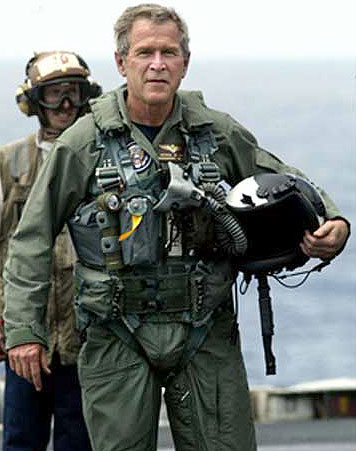
While transforming himself into the national cheerleader in chief, he even kept “his own personal scorecard for the war” in a desk drawer in the Oval Office – photos with brief biographies and personality sketches of leading al-Qaeda figures, whose faces could be satisfyingly crossed out when killed or captured. He clearly adored it when he got to dress up, whether in a flight suit landing on the deck of an aircraft carrier in May 2003, or in front of hoo-aahing crowds of soldiers wearing a specially tailored military-style jacket with “George W. Bush, Commander In Chief” hand-stitched across the heart. As earlier in life, he was supported (Karl Rove), enabled (Condoleezza Rice), cosseted (various officials), and so became “the decider,” a willing figurehead (as he had been, for instance, when he was an “owner” of the Texas Rangers), manipulated by his co-president Dick Cheney. In these surroundings, he was able to take war play to an imperial level. In the end, however, this act of his life, too, could lead nowhere but to failure.
As it happened, reality possessed its own set of shock-and-awe weaponry. Above all, reality was unimpressed with history’s self-proclaimed “actors,” working so hard on the global stage to create their own reality. When it came to who really owned what, it turned out that reality owned the works and that possession was indeed nine-tenths of one law that even George Bush’s handlers and his fervent neocon followers couldn’t suspend.
Exit Stage Right
The results were sadly predictable. The bubble world of George W. Bush was bound to be burst. Based on fantasies, false promises, lies, and bait-and-switch tactics, it was destined for foreclosure. At home and abroad, after all, it had been created using the equivalent of subprime mortgages, and the result, unsurprisingly, was a dismally subprime administration.
Now, of course, the bill collector is at the door and the property – the USA – is worth a good deal less than on Nov. 4, 2000. George W. Bush is a discredited president; his job approval ratings could hardly be lower; his bubble world gone bust.
Nonetheless, let’s remember one other theme of his previous life. Whatever his failures, Bush always walked away from disastrous dealings enriched, while others were left holding the bag. Don’t imagine for a second that the equivalent isn’t about to repeat itself. He will leave a country functionally under the gun of foreclosure, a world far more aflame and dangerous than the one he faced on entering the Oval Office. But he won’t suffer.
He will have his new house in Dallas (not to speak of the “ranch” in Crawford) and his more than $200 million presidential “library” and “freedom institute” at Southern Methodist University; and then there’s always that 20 percent of America – they know who they are – who think his presidency was the greatest thing since sliced bread. Believe me, 20 percent of America is more than enough to pony up spectacular sums, once Bush takes to the talk circuit. As the president himself put it enthusiastically,”‘I’ll give some speeches, just to replenish the ol’ coffers.’ With assets that have been estimated as high as nearly $21 million, Mr. Bush added, ‘I don’t know what my dad gets – it’s more than 50-75’ thousand dollars a speech, and ‘Clinton’s making a lot of money.'”
This is how a legacy-student-turned-president fails upward. Every disaster leaves him better off.
The same can’t be said for the country or the world, saddled with his “legacy.”
Still, his administration has been foreclosed. Perhaps there’s ignominy in that. Now, the rest of us need to get out the brooms and start sweeping the stables.
Copyright 2008 Tom Engelhardt