



One of the eerier reports on the deteriorating situation in Afghanistan appeared recently in the New York Times. Journalist John Burns visited the Russian ambassador in Kabul, Zamir N. Kabulov, who, back in the 1980s, when the Russians were the Americans in Afghanistan, and the Americans were launching the jihad that would eventually wend its way to the 9/11 attacks… well, you get the idea…
In any case, Kabulov was, in the years of the Soviet occupation, a KGB agent in the same city and, in the 1990s, an adviser to a UN peacekeeping envoy during the Afghan civil war that followed. “They’ve already repeated all of our mistakes,” he told Burns, speaking of the American/NATO effort in the country. “Now,” he added, “they’re making mistakes of their own, ones for which we do not own the copyright.” His list of Soviet-style American mistakes included: underestimating “the resistance,” an over-reliance on air power, a failure to understand the Afghan “irritative allergy” to foreign occupation, “and thinking that because they swept into Kabul easily, the occupation would be untroubled.” Of present occupiers who have stopped by to catch his sorry tale, Kabulov concludes world-wearily, “They listen, but they do not hear.”
The question is: Does this experience really have to be repeated to the bitter end – in the case of the Soviets, a calamitous defeat and retreat from Afghanistan, followed by years of civil war in that wrecked country, and finally the rise of the Pakistani-backed Taliban? The answer is: perhaps. There is no question that the advisers President Obama will be listening to are already exploring more complex strategies in Afghanistan, including possible negotiations with “reconcilable elements” of the Taliban. But these all remain military-plus strategies at whose heart lies the kind of troop surge that candidate Obama called for so vehemently – and, given the fate of the previous 2007 U.S./NATO “surge” in Afghanistan, this, too, has failure written all over it.
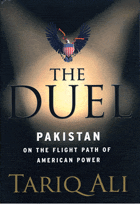
If you want a glimmer of hope when it comes to the spreading Afghan War – American missile-armed drones have been attacking across the Pakistani border regularly in recent months – consider that Barack Obama has made ex-CIA official Bruce Reidel a key adviser on the deteriorating Pakistani situation. And Reidel recently reviewed startlingly favorably Tariq Ali’s must-read, hard-hitting new book on Pakistan (and so Afghanistan and so American policy), The Duel: Pakistan on the Flight Path of American Power for the Washington Post. (“My employers of the past three decades, the CIA and the Brookings Institution, get their share of blame,” Reidel wrote. “So do both of the current presidential candidates….”)
Ali believes that there could be a grand, brokered regional solution to the Afghan War, essentially a military-minus strategy. Let’s hope Reidel and others are willing to listen to that, too; otherwise it will certainly be “Obama’s war,” and – for anyone old enough to remember – haven’t we been through that before? Tom
Operation Enduring Disaster
Breaking with Afghan policy
by Tariq Ali
Afghanistan has been almost continuously at war for 30 years, longer than both World Wars and the American war in Vietnam combined. Each occupation of the country has mimicked its predecessor. A tiny interval between wars saw the imposition of a malignant social order, the Taliban, with the help of the Pakistani military and the late Benazir Bhutto, the prime minister who approved the Taliban takeover in Kabul.
Over the last two years, the U.S./NATO occupation of that country has run into serious military problems. Given a severe global economic crisis and the election of a new American president – a man separated in style, intellect, and temperament from his predecessor – the possibility of a serious discussion about an exit strategy from the Afghan disaster hovers on the horizon. The predicament the U.S. and its allies find themselves in is not an inescapable one, but a change in policy, if it is to matter, cannot be of the cosmetic variety.
 Washington’s hawks will argue that, while bad, the military situation is, in fact, still salvageable. This may be technically accurate, but it would require the carpet-bombing of southern Afghanistan and parts of Pakistan, the destruction of scores of villages and small towns, the killing of untold numbers of Pashtuns and the dispatch to the region of at least 200,000 more troops with all their attendant equipment, air, and logistical support. The political consequences of such a course are so dire that even Dick Cheney, the closest thing to Dr. Strangelove that Washington has yet produced, has been uncharacteristically cautious when it comes to suggesting a military solution to the conflict.
It has, by now, become obvious to the Pentagon that Afghan President Hamid Karzai and his family cannot deliver what is required, yet it is probably far too late to replace him with UN Ambassador Zalmay Khalilzad. On his part, fighting for his political (and probably physical) existence, Karzai continues to protect his brother Ahmad Wali Karzai, accused of being involved in the country’s staggering drug trade, but has belatedly sacked Hamidullah Qadri, his transport minister, for corruption.
Qadri was taking massive kickbacks from a company flying pilgrims to Mecca. Is nothing sacred?
A Deteriorating Situation
Of course, axing one minister is like whistling in the wind, given the levels of corruption reported in Karzai’s government, which, in any case, controls little of the country. The Afghan president parries Washington’s thrusts by blaming the U.S. military for killing too many civilians from the air. The bombing of the village of Azizabad in Herat province last August, which led to 91 civilian deaths (of which 60 were children), was only the most extreme of such recent acts. Karzai’s men, hurriedly dispatched to distribute sweets and supplies to the survivors, were stoned by angry villagers.
Given the thousands of Afghans killed in recent years, small wonder that support for the neo-Taliban is increasing, even in non-Pashtun areas of the country. Many Afghans hostile to the old Taliban still support the resistance simply to make it clear that they are against the helicopters and missile-armed unmanned aerial drones that destroy homes, and to “Big Daddy” who wipes out villages, and to the flames that devour children.
Last February, Director of National Intelligence Michael McConnell presented a bleak survey of the situation on the ground to the House Permanent Select Committee on Intelligence:
“Afghan leaders must deal with the endemic corruption and pervasive poppy cultivation and drug trafficking. Ultimately, defeating the insurgency will depend heavily on the government’s ability to improve security, deliver services, and expand development for economic opportunity.
“Although the international forces and the Afghan National Army continue to score tactical victories over the Taliban, the security situation has deteriorated in some areas in the south and Taliban forces have expanded their operations into previously peaceful areas of the west and around Kabul. The Taliban insurgency has expanded in scope despite operational disruption caused by the ISAF [NATO forces] and Operation Enduring Freedom operations. The death or capture of three top Taliban leaders last year – their first high level losses – does not yet appear to have significantly disrupted insurgent operations.”
Since then the situation has only deteriorated further, leading to calls for sending in yet more American and NATO troops – and creating ever deeper divisions inside NATO itself. In recent months, Sir Sherard Cowper-Coles, the British ambassador to Kabul, wrote a French colleague (in a leaked memo) that the war was lost and more troops were not a solution, a view reiterated recently by Air Marshal Sir Jock Stirrup, the British defense chief, who came out in public against a one-for-one transfer of troops withdrawn from Iraq to Kabul. He put it this way:
“I think we would all take some persuading that there would have to be a much larger British contingent there. … So we also have to get ourselves back into balance; it’s crucial that we reduce the operational tempo for our armed forces, so it cannot be, even if the situation demanded it, just a one for one transfer from Iraq to Afghanistan, we have to reduce that tempo.”
The Spanish government is considering an Afghan withdrawal and there is serious dissent within the German and Norwegian foreign policy elites. The Canadian foreign minister has already announced that his country will not extend its Afghan commitment beyond 2011. And even if the debates in the Pentagon have not been aired in public, it’s becoming obvious that, in Washington, too, some see the war as unwinnable.
Enter former Iraq commander Gen. David Petraeus, center stage as the new Centcom commander. Ever since the “success” of “the surge” he oversaw in Iraq (a process designed to create temporary stability in that ravaged land by buying off the opposition and, among other things, the selective use of death squads), Petraeus sounds, and behaves, more and more like Lazarus on returning from the dead – and before his body could be closely inspected.
The situation in Iraq was so dire that even a modest reduction in casualties was seen as a massive leap forward. With increasing outbreaks of violence in Baghdad and elsewhere in Iraq, however, the talk of success sounds ever hollower. To launch a new “surge” in Afghanistan now by sending more troops there will simply not work, not even as a public relations triumph. Perhaps some of the 100 advisers that Gen. Petraeus has just appointed will point this out to him in forceful terms.
Flight Path to Disaster
Obama would be foolish to imagine that Petraeus can work a miracle cure in Afghanistan. The cancer has spread too far and is affecting U.S. troops as well. If the American media chose to interview active-duty soldiers in Afghanistan (on promise of anonymity), they might get a more accurate picture of what is happening inside the U.S. Army there.
I learned a great deal from Jules, a 20-year-old American soldier I met recently in Canada. He became so disenchanted with the war that he decided to go AWOL, proving – at least to himself – that the Afghan situation was not an inescapable predicament. Many of his fellow soldiers, he claims, felt similarly, hating a war that dehumanized both them and the Afghans. “We just couldn’t bring ourselves to accept that bombing Afghans was no different from bombing the landscape” was the way he summed up the situation.
Morale inside the Army there is low, he told me. The aggression unleashed against Afghan civilian often hides a deep depression. He does not, however, encourage others to follow in his footsteps. As he sees it, each soldier must make that choice for himself, accepting with it the responsibility that going AWOL permanently entails. Jules was convinced, however, that the war could not be won, and he did not want to see any more of his friends die. That’s why he was wearing an “Obama out of Afghanistan” T-shirt.
Before he revealed his identity, I mistook this young soldier – a Filipino-American born in southern California – for an Afghan. His features reminded me of the Hazara tribesmen he must have encountered in Kabul. Trained as a mortar gunner and paratrooper from Fort Benning, Georgia, he was later assigned to the 82nd Airborne at Fort Bragg. Here is part of the account he offered me:
“I deployed to southeastern Afghanistan in January 2007. We controlled everything from Jalalabad down to the northernmost areas of Kandahar province in Regional Command East. My unit had the job of pacifying the insurgency in Paktika, Paktia, and Khost provinces – areas that had received no aid, but had been devastated during the initial invasion. Operation Anaconda [in 2002] was supposed to have wiped out the Taliban. That was the boast of the military leaders, but ridiculed by everyone else with a brain.”
He spoke also of how impossible he found it to treat the Afghans as subhumans:
“I swear I could not for a second view these people as anything but human. The best way to fashion a young, hard DICK like myself – DICK being an acronym for ‘dedicated infantry combat killer’ – is simple and the effect of racist indoctrination. Take an empty shell off the streets of L.A. or Brooklyn, or maybe from some podunk town in Tennessee… and these days America isn’t in short supply… I was one of those no-child-left behind products…
“Anyway, you take this empty vessel and you scare the living sh*t out of him, break him down to nothing, cultivate a brotherhood and camaraderie with those he suffers with, and fill his head with racist nonsense like all Arabs, Iraqis, Afghans are Hajj. Hajj hates you. Hajj wants to hurt your family. Hajj children are the worst because they beg all the time. Just some of the most hurtful and ridiculous propaganda, but you’d be amazed at how effective it’s been in fostering my generation of soldiers.”
As this young man spoke to me, I felt he should be testifying before the Senate Foreign Relations Committee. The effect of the war on those carrying out the orders is leaving scars just as deep as the imprints of previous imperial wars. Change we can believe in must include the end of this, which means, among other things, a withdrawal from Afghanistan.
In my latest book, The Duel: Pakistan on the Flight Path of American Power, I have written of the necessity of involving Afghanistan’s neighbors in a political solution that ends the war, preserves the peace, and reconstructs the country. Iran, Russia, India, and China, as well as Pakistan, need to be engaged in the search for a political solution that would sustain a genuine national government for a decade after the withdrawal of the Americans, NATO, and their quisling regime. However, such a solution is not possible within the context of the plans proposed by both present Secretary of Defense Robert Gates and President-elect Barack Obama, which focus on a new surge of American troops in Afghanistan.
The main task at hand should be to create a social infrastructure and thus preserve the peace, something that the West and its horde of attendant non-governmental organizations have failed to do. School buildings constructed, often for outrageous sums, by foreign companies that lack furniture, teachers, and kids are part of the surreal presence of the West, which cannot last.
Whether you are a policymaker in the next administration or an AWOL veteran of the Afghan War in Canada, Operation Enduring Freedom of 2001 has visibly become Operation Enduring Disaster. Less clear is whether an Obama administration can truly break from past policy or will just create a military-plus add-on to it. Only a total break from the catastrophe that George W. Bush, Dick Cheney, and Donald Rumsfeld created in Afghanistan will offer pathways to a viable future.
For this to happen, both external and domestic pressures will probably be needed. China is known to be completely opposed to a NATO presence on, or near, its borders, but while Beijing has proved willing to exert economic pressure to force policy changes in Washington – as it did when the Bank of China “cut its exposure to agency debt last summer,” leaving U.S. Treasury Secretary Paulson with little option but to functionally nationalize the mortgage giants – it has yet to use its diplomatic muscle in the region.
But don’t think that will last forever. Why wait until then? Another external pressure will certainly prove to be the already evident destabilizing effects of the Afghan war on neighboring Pakistan, a country in a precarious economic state, with a military facing growing internal tensions.
Domestic pressure in the U.S. to pull out of Afghanistan remains weak, but it could grow rapidly as the extent of the debacle becomes clearer and NATO allies refuse to supply the shock-troops for the future surge.
In the meantime, they’re predicting a famine in Afghanistan this winter.
Tariq Ali, writer, journalist, filmmaker, contributes regularly to a range of publications including the Guardian, the Nation, and the London Review of Books. His most recent book, just published, is The Duel: Pakistan on the Flight Path of American Power (Scribner, 2008). In a two-part video released by TomDispatch.com, he offers critical commentary on Barack Obama’s plans for Afghanistan and Pakistan, as well as on the tangled U.S.-Pakistani relationship.
Copyright 2008 Tariq Ali
