It’s the ultimate argument, the final bastion against withdrawal, and over these last years, the Bush administration has made sure it would have plenty of heft. Ironically, its strength lies in the fact that it has nothing to do with the vicissitudes of Iraqi politics, the relative power of Shiites or Sunnis, the influence of Iran, or even the riptides of war. It really doesn’t matter what Iraqi Prime Minister Nouri al-Maliki or oppositional cleric Muqtada al-Sadr think about it. In fact, it’s an argument that has nothing to do with Iraq and everything to do with us, with the American way of war (and life), which makes it almost unassailable.
And this week Chairman of the Joint Chiefs Mike Mullen – the man President-elect Obama plans to call into the Oval Office as soon as he arrives – wheeled it into place and launched it like a missile aimed at the heart of Obama’s 16-month withdrawal plan for US combat troops in Iraq. It may not sound like much, but believe me, it is. The Chairman simply said, “We have 150,000 troops in Iraq right now. We have lots of bases. We have an awful lot of equipment that’s there. And so we would have to look at all of that tied to, obviously, the conditions that are there, literally the security conditions? Clearly, we’d want to be able to do it safely.” Getting it all out safely, he estimated, would take at least “two to three years.”
For those who needed further clarification, the Wall Street Journal’s Yochi J. Dreazen spelled it out: “In recent interviews, two high-ranking officers stated flatly that it would be logistically impossible to dismantle dozens of large US bases there and withdraw the 150,000 troops now in Iraq so quickly. The officers said it would take close to three years for a full withdrawal and could take longer if the fighting resumed as American forces left the country.”
As for the Obama plan, if the military top brass have anything to say about it, sayonara. It’s “physically impossible,” says “a top officer involved in briefing the President-elect on US operations in Iraq,” according to Time Magazine. The Washington Post reports that, should Obama continue to push for his two brigades a month draw-down, a civilian-military “conflict is inevitable,” and might, as the Nation’s Robert Dreyfuss suggests, even lead to an Obama “showdown” with the military high command in his first weeks in office.
In a nutshell, the Pentagon’s argument couldn’t be simpler or more red-bloodedly American: We have too much stuff to leave Iraq any time soon. In war, as in peace, we’re trapped by our own profligacy. We are the Neiman Marcus and the Wal-Mart of combat. Where we go, our “stuff” goes with us – in such prodigious quantities that removing it is going to prove more daunting than invading in the first place. After all, it took less than a year to put in place the 130,000-plus invasion force, and all its equipment and support outfits from bases all around the world, as well as the air power and naval power to match.
Some have estimated, however, that simply getting each of the 14 combat brigades still stationed in Iraq on January 20, 2009, out with all their equipment might take up to 75 days per brigade. (If you do the math, that’s 36 months, and even that wouldn’t suffice if you wanted to remove everything else we now have in that California-sized country.)
Getting out? Don’t dream of it.
Going to War with the Society You Have
Back in December 2004, when a soldier at a base in Kuwait asked about the lack of armor on his unit’s Humvees, Secretary of Defense Donald Rumsfeld famously said, “As you know, you have to go to war with the Army you have?”
Rumsfeld was then still focused on his much-ballyhooed “transformation” in warfare. He was intent on creating a Military Lite – the most pared down, totally agile, completely networked, highest of all high-tech forces that was going to make the US the dominant power on the planet for eons. As it turned out, that force was a mirage. In reality, the US military in Iraq proved to be a Military Heavy. In retrospect, Rumsfeld might have more accurately responded: You have to go to war with the society you have.
In fact, the Bush administration did just that – with a passion. After the attacks of 9/11, the President famously pleaded with the American public to return to normal life by shopping, flying, and visiting Disney World. (“Take your families and enjoy life, the way we want it to be enjoyed.”) The administration and the Pentagon led the way. As the Pentagon’s budget soared, its civilians and the high command went on an imperial spending spree the likes of which may never have been seen on this planet.
For them, Iraq has been war as cornucopia, war as a consumer’s paradise. Arguably, on a per-soldier basis, no military has ever occupied a country with a bigger baggage train. On taking Iraq, they promptly began constructing a series of gigantic military bases, American ziggurats meant to outlast them. These were full-scale “American towns,” well guarded, 15-20 miles around, with multiple PXes, fitness clubs, brand fast-food outlets, traffic lights, the works. (This, in a country where, for years after the invasion, nothing worked.)
To the tune of multi-billions of dollars, they continued to build these bases up, and then, in Baghdad, put the icing on the Iraqi cake by constructing an almost three-quarter-billion dollar embassy of embassies, a veritable citadel in the heart of the capital’s American-controlled Green Zone, meant for 1,000 “diplomats” with its own pool, tennis courts, recreation center, post exchange/community center, commissary, retail and shopping areas, and restaurants – again, the works.
In other words, abroad, we weren’t the Spartans, we were the Athenians on steroids. And then, of course, there was the “equipment” that Mullen referred to, the most expensive and extensive collection you could find. As the Washington Times’s Arnaud de Borchgrave wrote back in October 2007: “Watching them drive by at 30 miles per hour, would take 75 days. Bumper-to-bumper, they would stretch from New York City to Denver. That’s how US Air Force logistical expert Lenny Richoux described the number of vehicles that would have to be shipped back from Iraq when the current deployment is over. These include, among others, 10,000 flatbed trucks, 1,000 tanks and 20,000 Humvees.” And don’t forget “the 300,000 ‘heavy’ items that would have to be shipped back, such as ice-cream machines that churn out different flavors upon request at a dozen bases?”
As Dr. Seuss might have put it: and that is not all, oh no, that is not all. In July 2007, for instance, the Associated Press’s Charles Hanley described US bases holding “more than the thousands of tanks, other armored vehicles, artillery pieces and Humvees assigned to combat units. They’re also home to airfields laden with high-tech gear, complexes of offices filled with computers, furniture and air conditioners, systems of generators and water plants, PXs full of merchandise, gyms packed with equipment, big prefab latrines and ranks of small portable toilets, even Burger Kings and Subway sandwich shops.”
And it doesn’t stop there. In mid-2007, when the issue of our “stuff” first became part of the withdrawal news, Secretary of Defense Robert Gates pointed out: “You’re talking about not just US soldiers, but millions of tons of contractor equipment that belongs to the United States government, and a variety of other things? This is a massive logistical undertaking whenever it takes place.” So, one might ask, what about those many tens of thousands of private contractors in Iraq and all their materiel? Presumably, some of them, too, would have to withdraw, mainly through the bottleneck of Kuwait and its overburdened ports. This would, as the military now portrays it, be an American Dunkirk stretching on for years.
The Argument of Last Resort
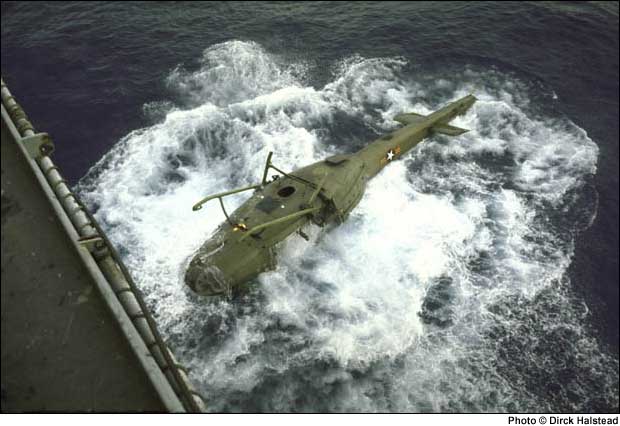
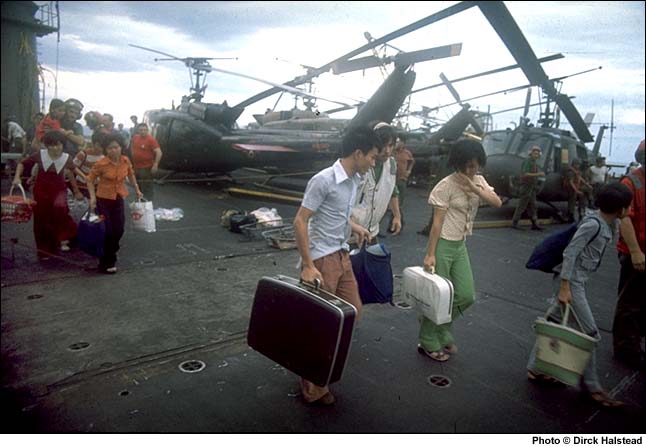
Now, back in the days when we had less experience fighting losing wars, Americans in retreat simply shoved those extra helicopters off the decks of aircraft carriers in chaos, burned free-floating cash in tin drums, and left tons of expensive equipment and massive bases behind for the enemy to turn into future industrial parks. At the US Embassy in Saigon in April 1975, while everything in sight was being burned or destroyed including precious advanced electronic equipment, money actually rained down from the Embassy incinerator on the roof upon amazed Vietnamese allies huddled below, waiting for a promised airlift to safety that, for most, never came.
Withdrawal then was unsightly, unseemly, and environmentally unsound. But, as we know, the lessons of Vietnam were subsequently learned.
Today, the Pentagon and the military top command plan to be far more responsible consumers and far better environmentalists, however long it takes, and the Department of Agriculture’s “stringent requirements” for the “power-washing” – this, in the desert, of course – of every object to be returned to the US will help ensure that this is so. “Ever since US authorities found plague-infected rats in cargo returning from the Vietnam War,” the AP’s Hanley has written, “the decontamination process has been demanding: water blasting of equipment, treatment with insecticide and rodenticide, inspections, certifications.”
And don’t forget the shrink-wrapping of those helicopters – who knows how many – for that long, salt-free sea voyage home.
Think of this as a version of the Pottery Barn Rule that Secretary of State Colin Powell supposedly cited in warning President Bush on the dangers of invading Iraq: “You break it, you own it.” For the departure from Iraq, this might be rewritten as: You bring it, you own it.
You might say that, in the end, Bush’s secret plan for never withdrawing from Iraq was but an extension of his shop-till-you-drop response to 9/11. The idea was to put so much stuff in the country that we’d have to stay.
And now, as the mission threatens to wind down, the top brass are evidently claiming that an Obama timeline for withdrawal would violate our property rights and squander a vast array of expensive equipment. You’ll hear no apologies from the military for traveling heavy, despite the fact that they are now arguing against a reasonable withdrawal timetable based on the need to enact a kind of 12-step program for armed consumer sobriety.
Ever since the President’s surge strategy was launched in January 2007, this argument has been a background hum in the withdrawal debate. Now, it’s evidently about to come front and center.
A new president will be taking office. His withdrawal plan – he spoke of it more accurately on CBS’s 60 Minutes as “a plan that draws down our troops” – is a modest one. After those American “combat brigades” are out, it’s still possible, as one of his key security advisers, former Navy Secretary Richard Danzig, told National Public Radio last summer, that as many as 55,000 US troops might remain in an advisory capacity or as residual forces. And yet, with the Iraqis urging us on, so many of the arguments against withdrawal have fallen away, which is why, when Barack Obama sits down in the Oval Office with his top commanders, he’s going to hear about all that “stuff.” For those who want to drag their feet on leaving Iraq, this is the argument of last resort.
As Donald Rumsfeld so classically said, in reference to the looting of Baghdad in April 2003 after American troops entered the city, “stuff happens.” How true that turns out to be. When it comes to withdrawal, the most militarily profligate administration in memory has seemingly ensured that the highest military priority in 2009 will be frugality – that is, saving all American “stuff” in Iraq.
Irony hardly covers this one. The Bush administration may have succeeded in little else, but it did embed the US so deeply in that country that leaving can now be portrayed as the profligate thing to do.
By the way, in case anyone thinks that the soon-to-be-Bush-less Pentagon has drawn the obvious lessons from its experience in Iraq, think again. It still seems eager to visit Disney World.
According to Wired Magazine’s reliable Danger Room blog, military officials are now suggesting to the Obama transition team that the next Pentagon budget should come in at $581 billion, a staggering $67 billion more than the previous one (and that’s without almost all the costs of the Afghan and Iraq wars being included).
But like Rumsfeld’s Military Lite, the Pentagon’s Military Heavy plans are likely to prove a mirage in the economic future that awaits us. Perhaps the US should indeed salvage every bit of its equipment in Iraq. After all, one thing seems certain: Washington may continue in some fashion to garrison an economically desperate world, but it will never again have the money to occupy a country in the style of Iraq – largely because the Bush administration managed to squander the American imperial legacy in eight short years.
Someday, Iraq and all those massive bases, all that high-tech equipment, all those ice-cream machines and portajohns, will seem like part of an American dream life. Money may never again rain from the sky.
Copyright 2008 Tom Engelhardt