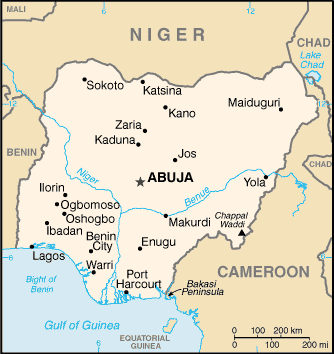
CARACAS – Fighting between the Nigerian government and an ethnic rebel militia in the country’s eastern oil-producing Niger Delta region helped drive the price of oil up to $53 a barrel this week in a market that analysts say is experiencing a "new order" marked by lower spare production capacity.
The price of U.S. benchmark West Texas Intermediate (WTI) ranged between $52.42 and $52.80 a barrel in New York Friday after hitting the $53 mark on Thursday.
In London, the Brent crude price also set a new record, of $49.30 a barrel.
Prices for the week averaged $51.10 a barrel for WTI, $47.57 a barrel for Brent, and $44.13 a barrel (another new record) for the Organization of Petroleum Exporting Countries (OPEC) reference basket of seven leading types of crude, reported the Energy Ministry in Venezuela, the only Latin American member of the oil cartel.
"Continued concern over supplies, given the low levels of reserves, particularly in the United States, the decline in production in the Gulf of Mexico, and the instability in producer countries like Iraq and Nigeria were the factors prompting the rise" in prices, said an Energy Ministry report.
Venezuelan oil industry expert Alberto Quirós told IPS that prices were going up "due to a long list of elements that influence demand, which has grown much more than expected." One of those factors, he said, is the fact that "only one million barrels of spare production capacity are left" in the world, which consumes 82 million barrels a day.
That surplus production capacity "is in Saudi Arabia, and how quickly it could place it on the market remains to be seen. For that reason, the jitters add at least $10 to every barrel," said Quirós, a former president of Shell, the Dutch-Anglo oil giant, in Venezuela.
The analyst also noted that the new types of crude that have begun to be produced, especially due to the hikes in output by OPEC, are heavy, "which makes them easy to pump but difficult for the refineries to digest, which means they must make large investments to adapt, something that not only requires capital but also time."
Refineries seeking to cut costs thus turn to lighter crudes like Nigeria’s Bonny.
Nigeria produces 2.3 million barrels a day, of which it exports 2.0 million – half of which goes to the United States.
The West African nation is the fifth largest source of oil for the U.S. market, after Canada, Mexico, Venezuela and Saudi Arabia.
But Nigeria’s oil industry employees are threatening to join labor strikes, although representatives of the oilworkers say they will not shut down production.
The threatened walkouts would compound an already touchy situation in which an armed rebel militia from the Ijaw ethnic group is fighting for greater autonomy in Nigeria’s eastern delta region and a larger share of oil revenues.
The Nigeria Delta People’s Volunteers Force warned that it would declare an "all-out war" on the Niger Delta region, and recommended that all foreign oil workers leave the area. On Friday, the group’s leader, Mujahid Dokubo-Asari, resumed peace talks with the government.
The market has read the situation as a threat to supplies, coming on top of the war and instability in Iraq and delays and disruptions to petroleum output and shipping in the Gulf of Mexico, an area that has been hit by four hurricanes in just two months.
OPEC President Purnomo Yusgiantoro insists that the world has enough supplies and says prices would fall below $40 a barrel if factors that do not involve the fundamentals of the market were eliminated, like the U.S.-led war on Iraq.
OPEC is made up of Algeria, Indonesia, Iran, Iraq (although it has not participated since 1990), Kuwait, Libya, Nigeria, Qatar, Saudi Arabia, United Arab Emirates and Venezuela. The member states produce 30 million barrels a day and account for just over half of all crude sold on the world market.
The U.S. Department of Energy stated in its latest weekly report that because global production capacity nearly matches demand, there is little flexibility in the markets to respond to the slightest interruption of supplies.
Furthermore, the reserves of the large consumer countries have not recovered fast enough or to the necessary degree. Although U.S. inventories of crude grew by 1.1 million barrels to 274 million barrels in the week that ended Oct. 1, that total was 12.2 million barrels down from the level seen a year ago.
Another price-setting factor is the approach of winter in the industrialized North, where consumer nations need to stock up on heating oil, supplies of which depend on the refineries.
"I do not think that the global petroleum industry will have at its disposal, in the future, spare capacity equivalent to that of the 1990s," Sadek Boussena, a special adviser to the Société Générale (SG), a French bank, wrote in an article presented at an OPEC International Seminar held in Vienna in September.
"The market should adapt itself to this ‘new order’ which implies among other things, as I mentioned earlier, a far higher volatility in crude oil prices," he added.