



BAGHDAD – Despite promises of over $1 billion in U.S. funding, hospital patients in Iraq continue to suffer ongoing hardship. Problems plaguing Iraqi hospitals fifteen months into what has been a brutal, bloody occupation range from ongoing medicine and equipment shortages to an overall lack of proper medical infrastructure.
“We are getting less medical supplies now than we were during the sanctions,” said Dr. Namin Rashid, the Chief Resident Doctor at Yarmouk Hospital. “Paul Bremer came here and talked a lot at the beginning of the occupation, but nothing has changed,” Rashid added, referring to the recently departed civilian administrator of the Coalition Provision Authority.
Standing near an overcrowded and understaffed emergency room, Dr. Rashid additionally pointed out that his hospital is getting only half the supplies it received prior to the U.S.-led invasion in March 2003.
At Al-Kerkh General Hospital, Dr. Sarmad Raheem is an orthopedic surgeon who is also the assistant manager of the hospital’s chief doctors. “We are short of everything here,” he said. According to Dr. Raheem, the hospital was suffering from a shortage of basic antibiotics and medications such as hydrocortisone and painkillers. “We even have to send our patients to the market to buy plates and screws they need for their own operations,” he said.
During a tour of the hospital’s critical care unit, Dr. Raheem stopped to point out an overflowing toilet, from which human feces spilled onto an already messy bathroom floor. “We can’t afford cleaners,” he said, “and [we] even lack ultra-violet lights for sterilizing our equipment.”
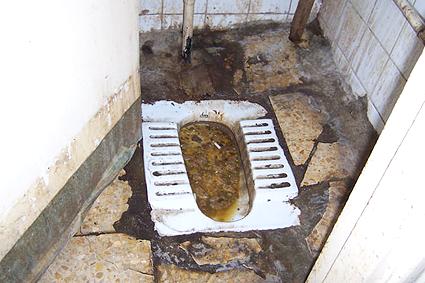
A toilet in the critical care unit at Al-Kerkh general hospital. Like many Iraqi hospitals, Al-Kerkh is drastically undersupplied and understaffed. (Dahr Jamail/NewStandard)
A recent report by the International Committee of the Red Cross (ICRC) stated that hospitals in Baghdad are running out of medicine and facing water and electricity shortages. Florian Westphal, a spokesperson for the ICRC, told reporters in Geneva, “There is no doubt really that the resources and staff of these places are really stretched to the limit.”
In the impoverished slum area of Sadr City, home to over 1.2 million people, doctors in Chuwader General Hospital spoke of even worse shortages. “We are short of every medicine,” said Dr. Qasim Al-Nuwesri, the General Manager of the hospital. “This rarely occurred before the invasion. It is forbidden, but sometimes we have to reuse [intravenous kits], even the needles, because we have no choice.”
Chuwader Hospital has endured outbreaks of diseases that Dr. Al-Nuwesri says could have been avoided. “Of course we have typhoid, cholera, kidney stones,” he said. “But we now even have the very rare Hepatitis Type-E … and it has become common in our area.”
Hepatitis E is associated primarily with ingestion of drinking water contaminated by human feces. Miscarriage during pregnancy is a common result of the disease, and perinatal transmission of Hepatitis E has become common at Chuwader Hospital.
The disease can be easily averted as long as hospital staff and patients are able to avoid contaminated food and water. Unfortunately, Dr. Al-Nuwesri said, the hospital only receives fifteen percent of the clean water necessary for adequate operations.
Many doctors throughout hospitals in Baghdad complain of insufficient electricity and clean water, for which they blame foreign companies who have failed to live up to their reconstruction contracts. Under the Geneva Conventions, which the United States has signed, occupying powers are responsible for supplying and maintaining the civilian infrastructure of occupied territory.
Ahlan Bari, the Head Manager of nurses at Yarmouk Teaching Hospital, said that the hospital only has eight hours of electricity per day without generators. “Our generators often break down, and we lack fuel for them at times,” she said, standing inside the hospital’s busy lobby. “Just last week we had a patient die on the operating table because we had a power outage and couldn’t run our equipment.”
Dr. Abdullah Younis, the head manager at Al-Noman Hospital in the Adhamiya district of Baghdad, said he faced many equipment shortages as well.
“We only have two X-ray machines, and one is very old,” Younis said while pointing out the 1970s vintage diagnostics appliance. “And of our five cardiac monitors, the two primary units are broken, and the three that are functioning are of very bad quality.”
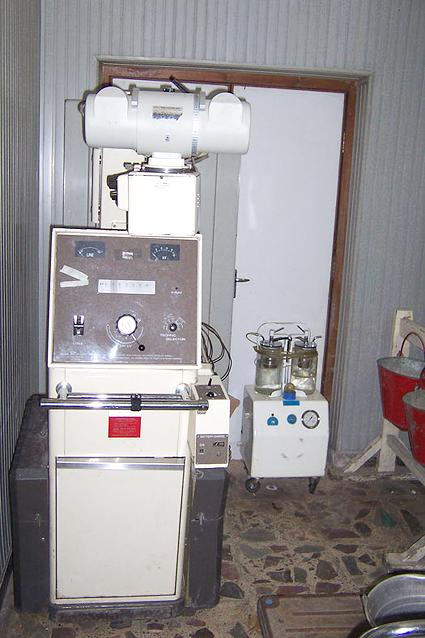
Al-Noman Hospital actually relies on this ancient X-Ray machine on a regular basis. (Dahr Jamail/NewStandard)
The blood cooler lacked parts, the intensive care unit needed monitors and one of their two ambulances was out of order, according to Dr. Younis. He also said that their laboratory lacked basic testing equipment, and the hospital sometimes lacked supplies such as gauze and rubber gloves.
After a recent fact-finding mission to Iraq where he surveyed 25 hospitals, clinics and pharmacies, Dr. Geert Van Moorter, a Belgian physician, found that the health care system had deteriorated since his previous study a year earlier. His report, published by Medical Aid for the Third World, observed: “Nowhere had any new medical material arrived since the end of the war. The medical material, already outdated, broken down or malfunctioning after twelve years of embargo [international sanctions], had further deteriorated over the past year.” Medical Aid for the Third World is a Belgian non-governmental health and human rights organization that strongly opposed the U.S.-led invasion of Iraq.
According to Dr. Talat Al-Mukhtar, a medical doctor in Baghdad, corruption and the lack of infrastructure are the leading problems plaguing the Iraqi health care system. He said that pharmacies overcharge hospitals for medications, and there was nothing that doctors could do about it. “There is no government office to complain to when the pharmacies are overcharging us or our patients because we have no infrastructure,” he said angrily.
“Medicines are pouring in from everywhere now and are unregulated and uncertified,” complained Dr. Al-Mukhtar. “The main problem is that the distribution of narcotics is out of control, and there are unregistered HIV patients who are giving blood because there is no longer mandatory testing [of donors].”
He added, “Everything is worse now for doctors in Iraq than [it was] during the sanctions, except the pay.”
Dr. Mukhtar said that under Saddam Hussein’s rule, doctors only earned $3 per month and sometimes sold medications on the black market to augment their income. But while corruption existed before the invasion, he said, it is far worse now.
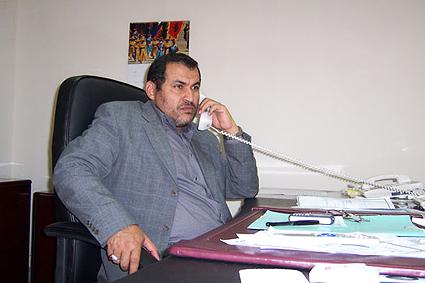
Dr. Amer Al Khuzaie, Iraq’s Deputy Minister of Health, is frustrated by the failure of the US to allow Iraqi companies to rehabilitate the country’s hospitals. (Dahr Jamail/NewStandard)
The Deputy Minister of Health, Dr. Amer Al-Khuzaie, said that his ministry was allocated $1 billion of the $18.6 billion set aside by the US government for rebuilding Iraq.
But Al-Khuzaie says the Ministry of Health does not have control over the funds. Instead, USAID, the governmental body responsible for allocating Iraq reconstruction funds, distributes all money through contracts to foreign corporations on behalf of Iraq. The corporations then spend the funds as they see fit.
“Bechtel, via USAID, has the contracts for distributing the subcontracts and money for rebuilding and rehabilitating our hospitals,” Al-Khuzaie said in his office at the Health Ministry.
Asked why the lack of supplies and rehabilitation of the hospitals was still a problem fifteen months after the invasion, the deputy minister replied: “Usually they use the excuse of the security situation in Iraq. But then why don’t they allow Iraqi companies to do the work?”
Al-Khuzai didn’t seem surprised that the U.S. government would favor American companies when handing out lucrative reconstruction contracts. “Surely every country passes their money through their contractors,” he said. “We could do the work and use Iraqi subcontractors. The problem is that they want their own companies to do it.”
According to Agence France-Presse, former occupation chief Paul Bremer admitted in February that Coalition spending on the Iraqi medical system was inadequate. “It’s not nearly enough to cover the needs in the health care field,” Bremer said.
Dr. Khuzaie said that he knew the hospitals were recently due to receive $300 million from the Coalition Provisional Authority, but they have not received anything yet.
The Coalition’s own Health Ministry spokesperson did not return calls or emails before the CPA was dissolved and its staff departed from Iraq last week, and as of July 4 had still not responded.
The deputy minister said that every time a request has been made for more funding from the Coalition, responses have been delayed for up to two months. “We have requested over $500 million for equipment and only have $300 million of this amount promised,” he said frankly. “Yet we still only have promises.”
