



Kingdoms have risen and fallen in China’s Xinjiang region for the past 2000 years. In the early 20th century, foreign archaeologists were surprised and delighted to find Muslim communities built upon Tang dynasty ruins built upon Tibetan villages built upon Han forts built upon Indian Buddhist monasteries – with Roman and Bactrian frescos thrown in for good measure.
The Silk Road brought two of the world’s most influential religions, Islam and Buddhism, together, and the two struggled with each other for hundreds of years – Buddhists reigning supreme up until the Tang Dynasty, and Islam wresting away control after the Mongol period.
Eventually, Islam came to dominate the western half of this region and reached past Dunhuang (Blazing Beacon) in Gansu Province – long China’s gate to the west – while Buddhism retreated back into India, Tibet, and China’s heartland.
The people of the region retain the traces of the past in their buildings, mode of life, and faces – local Uighur populations range from dark and heavily bearded to green-eyed and pale. Kazakhs, Tajiks, Uzbeks, Han, Hui, and Mongolians have carved out niches and held on to cultural traditions strong enough to withstand any onslaught.
Even the cultural menace modernization.
Tension
Much has been written about China’s Xinjiang policy. By most accounts, China is considered a repressive and destructive influence on local culture and religion but an energetic and positive force in terms of economic development.
Take for instance the Uighur Muslims and the Han – probably just about the least compatible cultures in the world. But in the provinces east of Xinjiang, especially Gansu, Qinghai, and Ningxia, the Hui Muslim minority has managed to live in peace with the Han and still visit the mosques and refrain from various sins.
But many Uighurs look down upon Hui and never resist a chance to crack a joke about the alleged duplicity and lack of character of the average Hui. According to more prejudiced Uighur, Hui are donkeys – bastard offspring of Han and Muslim. According to the less prejudiced, Hui are bad Muslims who have been corrupted by the Han.
The Hotan region is a good example of what happens when Han and Uighur are thrown together. Hotan was and still is a center of Islam in Xinjiang – the tomb of Imam Asim, one of the first missionaries of Islam in the region is a pilgrimage spot and site of a festival and market every Thursday, pretty much year round.
The gates to the festival, which I visited, are manned by Han and Uighur opportunists, who charge five yuan per person. On Wednesday, 138 buses full of Muslims bounced down the road through the fields and into the desert where the imam’s tomb lies. A banner hangs above the entrance proclaiming “The greatest threat to Xinjiang stability are the splittists” in Uighur Arabic script.
Uighur police stroll through the sands with an eye out for suspicious foreigners. One displayed his loyalty to the center by calling in my presence and demanding my passport number.
But the overall atmosphere of the festival is relaxed and religious – musician-preachers strut up and down aisles formed by sitting Muslims and bark out wisdom from the Quran and “the University of Life.” Beggars line the path toward the tomb and benefit from the generosity of Muslims attending a holy event.
Uighur don’t have much of a chance of gaining a passport from the government, so this is as close to Mecca as any of them will get .…
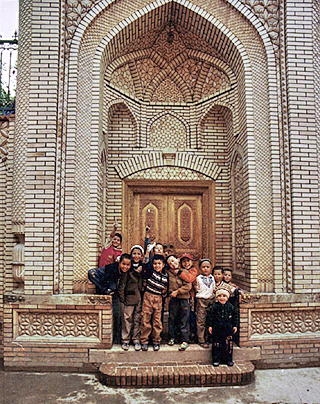
Uighur children in front of a mosque in Kashgar’s old city
In Hotan city center a recently finished plaza that knocked out most of the ancient wall boasts a large statue of Mao Zedong meeting Durban Tulum, a local farmer who made his way to Beijing in the 1950’s. The other night children sat around a stage built around the statue, accompanied by local Public Security Bureau (PSB) and waited for a government-sponsored dance and song show to begin. While they waited, Cultural-Revolution-era ballads about “beloved Chairman Mao” blasted across the square.
The city displays the benefits of development, a medical and teachers’ university, paved roads and a surplus of goods – but also the dark side – Sichuan and Hunan prostitutes have shown up, and public drunkenness under neon lights makes the beard of an old Uighur tremble.
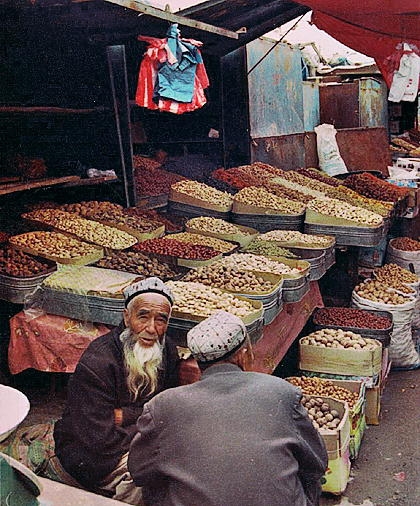
Resting in the bazaar
Get ’em While They’re Young
Children in Xinjiang are not allowed to attend Islamic school until the age of 18, and they do not have leave to attend prayers on Friday due to school. This grates on locals who see Islam as the core of their culture.
In Kashgar, the former palace of King Said, one of the last kings of Kashgaria, is now the Communist Party headquarters, and the Islamic school he founded is now the site of a “Patriotic Religious Training Center.” This training center meets ten times a year, and Imams from around the Kashgar area gather to learn how to pray, when to pray, and what new laws have been established to enforce the Party line.
Teaching Islam at home is a crime in Xinjiang, and many have been arrested in southern Xinjiang since 1995 when the police began enforcing the law. Schoolchildren spend much of their time learning Party theory (Mao, Deng, Jiang) by rote. Clerks in the Executive Administration – a puppet government subordinate to the Party – also spend at least six hours a week studying Party Policy and are required to monitor the mosques every Friday. Names are taken and ages are checked and any mistake by the clerk means their job.
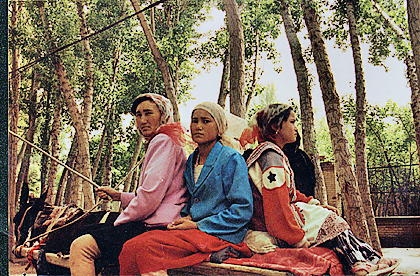
A Uighur girl on her way to bazaar in Opal, near Kashgar
Who Is Native?
Han who came here in the 1960’s and have lived here and had children tend to speak a little Uighur and have reached an agreement with their Muslim neighbors. There is mutual respect, business, and even friendship – but people eat, drink, and play separately. Han who arrived in the past 30 years refer to themselves as natives.
There is a Uighur part and a Han part of the city – the separation is as clear as the “Peace Wall” that divided Ireland’s Falls and Shankhill neighborhoods. The Uighur part of town tends to be poorer and less developed, but a swath of locals have taken advantage of Xinjiang’s importance to Beijing to make themselves rich and powerful. There are as many Uighur police as there are Han patrolling the streets and for every ten soldiers living at the base between Hotan and Kashgar, one is a Uighur.
Two boys I talked to near the tomb of Mahmood Kashgaria, a scholar of the 10th century who translated the Quran into Uighur, hail from Hunan and Sichuan. But they were born here, their parents live here, they speak in the Xinjiang dialect with but a smidgeon of their grandparents’ mode of speech to be detected.
Are they natives? Most of their friends are Han, but they play in the deserts and fields of Xinjiang. They eat lamb and bread as much as they eat rice and pork, and they have no desire to return to a home they have never known.
Uighur farmers and small time entrepreneurs say they do not have the same access to loans as the Han. When money from the center arrives in Urumqi and is dispersed throughout the regions, Han businessmen flock to the small towns and gobble up the loans, acting on tips from Party and bank officials.
Justification?
How can China justify prohibiting children from visiting the mosques? What possible purpose could Cultural Revolution songs blasted into the ears of the populace serve? Why occupy the center of Kashgar’s old city, unless you are a conqueror?
The answer is simple – China aspires to superpower status. And if China has learned anything from superpowers past and present, it has learned that there can only be one power in a nation.
The only other culture as diametrically opposed to Islam as the Han is American culture. For China, to tolerate a Muslim enclave is to tolerate the Black Panthers. To consider any other status for Xinjiang would be to reconsider the US’s southwest.
But unlike the US, China’s policy is to take Islam away from the children and replace it with desire – desire for wealth, desire for love in a “non-traditional” sense, and desire to assimilate into the nation as a whole. Not unlike the US, desire in Xinjiang is combined with a healthy fear of prison and death at the hands of the PSB.
America’s policy is purely to conquer in the classical sense – to replace Islam with fear and submission. Both nations intend to destroy the religion and plunder the resources – but what China has in its favor is that Xinjiang lies within its borders.
