



I knew there was very little media coverage in Falluja, and the entire city had been sealed and was suffering from collective punishment in the form of no water or electricity for several days now. With only two journalists there that I’d read and heard reports from, I felt pulled to go and witness the atrocities that were surely being committed.
With the help of some friends, we joined a small group of internationals to ride a large bus there carrying a load of humanitarian supplies, and with the hopes of bringing some of the wounded out prior to the next American onslaught, which was due to kick off at any time now.
Even leaving Baghdad now is dangerous. The military has shut down the main highway between here and Jordan. The highway, even while just outside Baghdad, is desolate and littered with destroyed fuel tanker trucks – their smoldering shells littered the highway. We rolled past a large M-1 Tank that was still burning under an overpass which had just been hit by the resistance.

Fuel tanker destroyed by resistance fighters along the highway near Abu Ghraib
At the first U.S. checkpoint the soldiers said they’d been there for 30 hours straight. After being searched, we continued along bumpy dirt roads, winding our way through parts of Abu Ghraib, steadily but slowly making our way towards besieged Falluja. While we were passing one of the small homes in Abu Ghraib, a small child yelled at the bus, "We will be mujahedeen until we die!"
We slowly worked our way back onto the highway. It was strewn with smoking fuel tankers, destroyed military tanks and armored personnel carriers, and a lorry that had been hit that was currently being looted by a nearby village, people running to and from the highway carrying away boxes. It was a scene of pure devastation, with barely any other cars on the road.
Once we turned off the highway, which the U.S. was perilously holding onto, there was no U.S. military presence visible at all as we were in mujahedeen-controlled territory. Our bus wound its way through farm roads, and each time we passed someone they would yell, "God bless you for going to Falluja!" Everyone we passed was flashing us the victory sign, waving, and giving the thumbs-up.
As we neared Falluja, there were groups of children on the sides of the road handing out water and bread to people coming into Falluja. They began literally throwing stacks of flat bread into the bus. The fellowship and community spirit was unbelievable. Everyone was yelling for us, cheering us on, groups speckled along the road.
As we neared Falluja a huge mushroom caused by a large U.S. bomb rose from the city. So much for the cease fire.
The closer we got to the city, the more mujahedeen checkpoints we passed – at one, men with kefir around their faces holding Kalashnikovs began shooting their guns in the air, showing their eagerness to fight.
The city itself was virtually empty, aside from groups of mujahedeen standing on every other street corner. It was a city at war. We rolled towards the one small clinic where we were to deliver our medical supplies from INTERSOS, an Italian NGO. The small clinic is managed by Mr. Maki Al-Nazzal, who was hired just 4 days ago to do so. He is not a doctor.
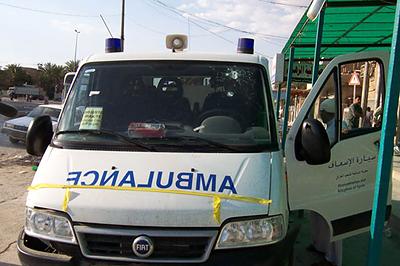
Ambulances in Falluja are being shot by American snipers.
He hadn’t slept much, along with all of the doctors at the small clinic. It started with just three doctors, but since the Americans bombed one of the hospitals, and were currently sniping people as they attempted to enter/exit the main hospital, effectively there were only 2 small clinics treating all of Falluja. The other has been set up in a car garage.

Iraqi woman wounded in the neck by an American sniper. Doctors predicted the wound would be fatal.
As I was there, an endless stream of women and children who’d been sniped by the Americans were being raced into the dirty clinic, the cars speeding over the curb out front as their wailing family members carried them in.
One woman and small child had been shot through the neck – the woman was making breathy gurgling noises as the doctors frantically worked on her amongst her muffled moaning.
The small child, his eyes glazed and staring into space, continually vomited as the doctors raced to save his life.
After 30 minutes, it appeared as though neither of them would survive.
One victim of American aggression after another was brought into the clinic, nearly all of them women and children.
This scene continued, off and on, into the night as the sniping continued. As evening approached the nearby mosque loudspeaker announced that the mujehadeen had completely destroyed a U.S. convoy. Gunfire filled the streets, along with jubilant yelling. As the mosque began blaring prayers, the determination and confidence of the area was palpable.
One small boy of 11, his face covered by a kefir and toting around a Kalashnikov that was nearly as big as he was, patrolled areas around the clinic, making sure they were secure. He was confident and very eager for battle. I wondered how the U.S. soldiers would feel about fighting an 11 year-old child? For the next day, on the way out of Falluja, I saw several groups of children fighting as mujahedeen.
After we delivered the aid, three of my friends agreed to ride out on the one functioning ambulance for the clinic to retrieve the wounded. Although the ambulance already had three bullet holes from a U.S. sniper through the front windshield on the driver’s side, having westerners on board was the only hope that soldiers would allow them to retrieve more wounded Iraqis. The previous driver was wounded when one of the sniper’s shots grazed his head.
Bombs were heard sporadically exploding around the city, along with random gunfire.
It grew dark, so we ended up spending the night with one of the local men who had filmed the atrocities. He showed us footage of a dead baby who he claimed was torn from his mother’s chest by Marines. Other horrendous footage of slain Iraqis was shown to us as well.
My entire time in Falluja there was the constant buzzing of military drones. As we walked through the empty streets towards the house where we would sleep, a plane flew over us and dropped several flares. We ran for a nearby wall to hunker down, afraid it was dropping cluster bombs. There had been reports of this, as two of the last victims that arrived at the clinic were reported by the locals to have been hit by cluster bombs – they were horribly burned and their bodies shredded.
It was a long night-between being sick from drinking unfiltered water and the nagging concern of the full invasion beginning, I didn’t sleep. Each time I would begin to slip into sleep, a jet would fly over and I wondered if the full scale bombing would commence. Meanwhile, the drones continued to buzz throughout Falluja.
The next morning we walked back to the clinic, and the mujahedeen in the area were extremely edgy, expecting the invasion anytime. They were taking up positions to fight. One of my friends who’d done another ambulance run to collect two bodies said that a Marine she encountered had told them to leave, because the military was about to use air support to begin ‘clearing the city.’ One of the bodies they brought to the clinic was that of an old man who was shot by a sniper outside of his home, while his wife and children sat wailing inside.
The family couldn’t reach his body, for fear of being sniped by the Americans themselves. His stiff body was carried into the clinic with flies swarming above it.
The already insane situation continued to degrade, and by the time the wounded from the clinic were loaded onto our bus and we prepared to leave, everyone felt the invasion was looming near. American bombs continued to fall not far from us, and sporadic gunfire continued. Jets were circling the outskirts of the city.
We drove out, past loads of mujahedeen at their posts along the streets. In a long line of vehicles loaded with families, we slowly crept out of the embattled city, passing several military vehicles on the outskirts town. When we took a wrong turn at one point and tried to go down a road controlled by a different group of mujeheen, we were promptly surrounded by men cocking their weapons and aiming them at us. The doctors and patients on board explained to them we were coming from Falluja and on a humanitarian aid mission, so they let us go.
The trip back to Baghdad was slow, but relatively uneventful. We passed several more smoking shells of vehicles destroyed by the freedom fighters; more fuel tankers, more military vehicles destroyed.
What I can report from Falluja is that there is no ceasefire, and apparently there never was. Iraqi women and children are being shot by American snipers. Over 600 Iraqis have now been killed by American aggression, and the residents have turned two football fields into graveyards. Ambulances are being shot by the Americans. And now they are preparing to launch a full-scale invasion of the city.
All of which is occurring under the guise of catching the people who killed the four Blackwater Security personnel and hung two of their bodies from a bridge.

Young Iraqi boy shot in the neck by a U.S. sniper in Falluja.
