



For some, patriotism is the last refuge of a scoundrel. For others, it means dissent against a government’s abuse of the people’s rights.
I have never met a politician in Washington or any American, for that matter, who chose to be called unpatriotic. Nor have I met anyone who did not believe he wholeheartedly supported our troops, wherever they may be.
What I have heard all too frequently from various individuals are sharp accusations that, because their political opponents disagree with them on the need for foreign military entanglements, they were unpatriotic, un-American evildoers deserving contempt.
The original American patriots were those individuals brave enough to resist with force the oppressive power of King George. I accept the definition of patriotism as that effort to resist oppressive state power.
The true patriot is motivated by a sense of responsibility and out of self-interest for himself, his family, and the future of his country to resist government abuse of power. He rejects the notion that patriotism means obedience to the state. Resistance need not be violent, but the civil disobedience that might be required involves confrontation with the state and invites possible imprisonment.
Peaceful, nonviolent revolutions against tyranny have been every bit as successful as those involving military confrontation. Mahatma Gandhi and Dr. Martin Luther King, Jr., achieved great political successes by practicing nonviolence, and yet they suffered physically at the hands of the state. But whether the resistance against government tyrants is nonviolent or physically violent, the effort to overthrow state oppression qualifies as true patriotism.
True patriotism today has gotten a bad name, at least from the government and the press. Those who now challenge the unconstitutional methods of imposing an income tax on us, or force us to use a monetary system designed to serve the rich at the expense of the poor are routinely condemned. These American patriots are sadly looked down upon by many. They are never praised as champions of liberty as Gandhi and Martin Luther King have been.
Liberals, who withhold their taxes as a protest against war, are vilified as well, especially by conservatives. Unquestioned loyalty to the state is especially demanded in times of war. Lack of support for a war policy is said to be unpatriotic. Arguments against a particular policy that endorses a war, once it is started, are always said to be endangering the troops in the field. This, they blatantly claim, is unpatriotic, and all dissent must stop. Yet, it is dissent from government policies that defines the true patriot and champion of liberty.
It is conveniently ignored that the only authentic way to best support the troops is to keep them out of dangerous undeclared no-win wars that are politically inspired. Sending troops off to war for reasons that are not truly related to national security and, for that matter, may even damage our security, is hardly a way to patriotically support the troops.
Who are the true patriots, those who conform or those who protest against wars without purpose? How can it be said that blind support for a war, no matter how misdirected the policy, is the duty of a patriot?
Randolph Bourne said that, "War is the health of the state.” With war, he argued, the state thrives. Those who believe in the powerful state see war as an opportunity. Those who mistrust the people and the market for solving problems have no trouble promoting a "war psychology” to justify the expansive role of the state. This includes the role the Federal Government plays in our lives, as well as in our economic transactions.
Certainly, the neoconservative belief that we have a moral obligation to spread American values worldwide through force justifies the conditions of war in order to rally support at home for the heavy hand of government. It is through this policy, it should surprise no one, that our liberties are undermined. The economy becomes overextended, and our involvement worldwide becomes prohibited. Out of fear of being labeled unpatriotic, most of the citizens become compliant and accept the argument that some loss of liberty is required to fight the war in order to remain safe.
This is a bad trade-off, in my estimation, especially when done in the name of patriotism. Loyalty to the state and to autocratic leaders is substituted for true patriotism; that is, a willingness to challenge the state and defend the country, the people and the culture. The more difficult the times, the stronger the admonition comes that the leaders be not criticized.
Because the crisis atmosphere of war supports the growth of the state, any problem invites an answer by declaring war, even on social and economic issues. This elicits patriotism in support of various government solutions, while enhancing the power of the state. Faith in government coercion and a lack of understanding of how free societies operate encourages big-government liberals and big-government conservatives to manufacture a war psychology to demand political loyalty for domestic policy just as is required in foreign affairs.
The long-term cost in dollars spent and liberties lost is neglected as immediate needs are emphasized. It is for this reason that we have multiple perpetual wars going on simultaneously. Thus, the war on drugs, the war against gun ownership, the war against poverty, the war against illiteracy, the war against terrorism, as well as our foreign military entanglements are endless.
All this effort promotes the growth of statism at the expense of liberty. A government designed for a free society should do the opposite, prevent the growth of statism and preserve liberty.
Once a war of any sort is declared, the message is sent out not to object or you will be declared unpatriotic. Yet, we must not forget that the true patriot is the one who protests in spite of the consequences. Condemnation or ostracism or even imprisonment may result.
Nonviolent protesters of the Tax Code are frequently imprisoned, whether they are protesting the code’s unconstitutionality or the war that the tax revenues are funding. Resisters to the military draft or even to Selective Service registration are threatened and imprisoned for challenging this threat to liberty.
Statism depends on the idea that the government owns us and citizens must obey. Confiscating the fruits of our labor through the income tax is crucial to the health of the state. The draft, or even the mere existence of the Selective Service, emphasizes that we will march off to war at the state’s pleasure.
A free society rejects all notions of involuntary servitude, whether by draft or the confiscation of the fruits of our labor through the personal income tax. A more sophisticated and less well-known technique for enhancing the state is the manipulation and transfer of wealth through the fiat monetary system operated by the secretive Federal Reserve.
Protesters against this unconstitutional system of paper money are considered unpatriotic criminals and at times are imprisoned for their beliefs. The fact that, according to the Constitution, only gold and silver are legal tender and paper money outlawed matters little. The principle of patriotism is turned on its head. Whether it’s with regard to the defense of welfare spending at home, confiscatory income tax, or an immoral monetary system or support for a war fought under false pretense without a legal declaration, the defenders of liberty and the Constitution are portrayed as unpatriotic, while those who support these programs are seen as the patriots.
If there is a war going on, supporting the state’s effort to win the war is expected at all costs, no dissent. The real problem is that those who love the state too often advocate policies that lead to military action. At home, they are quite willing to produce a crisis atmosphere and claim a war is needed to solve the problem. Under these conditions, the people are more willing to bear the burden of paying for the war and to carelessly sacrifice liberties, which they are told is necessary.
The last 6 years have been quite beneficial to the health of the state, which comes at the expense of personal liberty. Every enhanced unconstitutional power of the state can only be achieved at the expense of individual liberty. Even though in every war in which we have been engaged civil liberties have suffered, some have been restored after the war ended, but never completely. That has resulted in a steady erosion of our liberties over the past 200 years. Our government was originally designed to protect our liberties, but it has now, instead, become the usurper of those liberties.
We currently live in the most difficult of times for guarding against an expanding central government with a steady erosion of our freedoms. We are continually being reminded that 9/11 has changed everything.
Unfortunately, the policy that needed most to be changed, that is, our policy of foreign interventionism, has only been expanded. There is no pretense any longer that a policy of humility in foreign affairs, without being the world’s policemen and engaging in nation building, is worthy of consideration.
We now live in a post-9/11 America where our government is going to make us safe no matter what it takes. We are expected to grin and bear it and adjust to every loss of our liberties in the name of patriotism and security.
Though the majority of Americans initially welcomed the declared effort to make us safe, and we are willing to sacrifice for the cause, more and more Americans are now becoming concerned about civil liberties being needlessly and dangerously sacrificed.
The problem is that the Iraq war continues to drag on, and a real danger of it spreading exists. There is no evidence that a truce will soon be signed in Iraq or in the war on terror or the war on drugs. Victory is not even definable. If Congress is incapable of declaring an official war, it is impossible to know when it will end. We have been fully forewarned that the world conflict in which we are now engaged will last a long, long time.
The war mentality and the pervasive fear of an unidentified enemy allows for a steady erosion of our liberties, and, with this, our respect for self-reliance and confidence is lost. Just think of the self-sacrifice and the humiliation we go through at the airport screening process on a routine basis. Though there is no scientific evidence of any likelihood of liquids and gels being mixed on an airplane to make a bomb, billions of dollars are wasted throwing away toothpaste and hair spray, and searching old women in wheelchairs.
Our enemies say boo, and we jump, we panic, and then we punish ourselves. We are worse than a child being afraid of the dark. But in a way, the fear of indefinable terrorism is based on our inability to admit the truth about why there is a desire by a small number of angry radical Islamists to kill Americans. It is certainly not because they are jealous of our wealth and freedoms.
We fail to realize that the extremists, willing to sacrifice their own lives to kill their enemies, do so out of a sense of weakness and desperation over real and perceived attacks on their way of life, their religion, their country, and their natural resources. Without the conventional diplomatic or military means to retaliate against these attacks, and an unwillingness of their own government to address the issue, they resort to the desperation tactic of suicide terrorism. Their anger toward their own governments, which they believe are coconspirators with the American Government, is equal to or greater than that directed toward us.
These errors in judgment in understanding the motive of the enemy and the constant fear that is generated have brought us to this crisis where our civil liberties and privacy are being steadily eroded in the name of preserving national security.
We may be the economic and the military giant of the world, but the effort to stop this war on our liberties here at home in the name of patriotism is being lost.
The erosion of our personal liberties started long before 9/11, but 9/11 accelerated the process. There are many things that motivate those who pursue this course, both well-intentioned and malevolent, but it would not happen if the people remained vigilant, understood the importance of individual rights, and were unpersuaded that a need for security justifies the sacrifice for liberty, even if it is just now and then.
The true patriot challenges the state when the state embarks on enhancing its power at the expense of the individual. Without a better understanding and a greater determination to rein in the state, the rights of Americans that resulted from the revolutionary break from the British and the writing of the Constitution will disappear.
The record since September 11th is dismal. Respect for liberty has rapidly deteriorated. Many of the new laws passed after 9/11 had, in fact, been proposed long before that attack. The political atmosphere after that attack simply made it more possible to pass such legislation. The fear generated by 9/11 became an opportunity for those seeking to promote the power of the state domestically, just as it served to falsely justify the long-planned invasion of Iraq.
The war mentality was generated by the Iraq war in combination with the constant drumbeat of fear at home. Al Qaeda and Osama bin Laden, who is now likely residing in Pakistan, our supposed ally, are ignored, as our troops fight and die in Iraq and are made easier targets for the terrorists in their backyard. While our leaders constantly use the mess we created to further justify the erosion of our constitutional rights here at home, we forget about our own borders and support the inexorable move toward global government, hardly a good plan for America.
The accelerated attacks on liberty started quickly after 9/11. Within weeks, the PATRIOT Act was overwhelmingly passed by Congress. Though the final version was unavailable up to a few hours before the vote, no Member had sufficient time to study it. Political fear of not doing something, even something harmful, drove the Members of Congress to not question the contents, and just voted for it. A little less freedom for a little more perceived safety was considered a fair trade-off, and the majority of Americans applauded.
The PATRIOT Act, though, severely eroded the system of checks and balances by giving the government the power to spy on law-abiding citizens without judicial supervision. The several provisions that undermine the liberties of all Americans include sneak-and-peek searches, a broadened and more vague definition of domestic terrorism, allowing the FBI access to library and bookstore records without search warrants or probable cause, easier FBI initiation of wiretaps and searches, as well as roving wiretaps, easier access to information on American citizens’ use of the Internet, and easier access to e-mail and financial records of all American citizens.
The attack on privacy has not relented over the past 6 years. The Military Commissions Act is a particularly egregious piece of legislation and, if not repealed, will change America for the worse as the powers unconstitutionally granted to the executive branch are used and abused. This act grants excessive authority to use secretive military commissions outside of places where active hostilities are going on. The Military Commissions Act permits torture, arbitrary detention of American citizens as unlawful enemy combatants at the full discretion of the President and without the right of habeas corpus, and warrantless searches by the NSA. It also gives to the President the power to imprison individuals based on secret testimony.
Since 9/11, Presidential signing statements designating portions of legislation that the President does not intend to follow, though not legal under the Constitution, have enormously multiplied. Unconstitutional Executive Orders are numerous and mischievous and need to be curtailed.
Extraordinary rendition to secret prisons around the world have been widely engaged in, though obviously extralegal.
A growing concern in the post-9/11 environment is the Federal Government’s list of potential terrorists based on secret evidence. Mistakes are made, and sometimes it is virtually impossible to get one’s name removed even though the accused is totally innocent of any wrongdoing.
A national ID card is now in the process of being implemented. It is called the REAL ID card, and it is tied to our Social Security numbers and our State driver’s license. If REAL ID is not stopped, it will become a national driver’s license ID for all Americans. We will be required to carry our papers.
Some of the least-noticed and least-discussed changes in the law were the changes made to the Insurrection Act of 1807 and to posse comitatus by the Defense Authorization Act of 2007. These changes pose a threat to the survival of our Republic by giving the President the power to declare martial law for as little reason as to restore public order. The 1807 act severely restricted the President in his use of the military within the United States borders, and the Posse Comitatus Act of 1878 strengthened these restrictions with strict oversight by Congress. The new law allows the President to circumvent the restrictions of both laws. The Insurrection Act has now become the "Enforcement of the Laws to Restore Public Order Act.” This is hardly a title that suggests that the authors cared about or understood the nature of a constitutional Republic.
Now, martial law can be declared not just for insurrection, but also for natural disasters, public health reasons, terrorist attacks or incidents, or for the vague reason called "other conditions.” The President can call up the National Guard without congressional approval or the Governors’ approval, and even send these State Guard troops into other States.
The American Republic is in remnant status. The stage is set for our country eventually devolving into a military dictatorship, and few seem to care. These precedent-setting changes in the law are extremely dangerous and will change American jurisprudence forever if not revised. The beneficial results of our revolt against the King’s abuses are about to be eliminated, and few Members of Congress and few Americans are aware of the seriousness of the situation. Complacency and fear drive our legislation without any serious objection by our elected leaders. Sadly, though, those few who do object to this self-evident trend away from personal liberty and empire-building overseas are portrayed as unpatriotic and uncaring.
Though welfare and socialism always fails, opponents of them are said to lack compassion. Though opposition to totally unnecessary war should be the only moral position, the rhetoric is twisted to claim that patriots who oppose the war are not supporting the troops. The cliché "Support the Troops” is incessantly used as a substitute for the unacceptable notion of supporting the policy, no matter how flawed it may be.
Unsound policy can never help the troops. Keeping the troops out of harm’s way and out of wars unrelated to our national security is the only real way of protecting the troops. With this understanding, just who can claim the title of "patriot”?
Before the war in the Middle East spreads and becomes a world conflict for which we will be held responsible, or the liberties of all Americans become so suppressed we can no longer resist, much has to be done. Time is short, but our course of action should be clear. Resistance to illegal and unconstitutional usurpation of our rights is required. Each of us must choose which course of action we should take: education, conventional political action, or even peaceful civil disobedience to bring about necessary changes.
But let it not be said that we did nothing. Let not those who love the power of the welfare/warfare state label the dissenters of authoritarianism as unpatriotic or uncaring. Patriotism is more closely linked to dissent than it is to conformity and a blind desire for safety and security. Understanding the magnificent rewards of a free society makes us unbashful in its promotion, fully realizing that maximum wealth is created and the greatest chance for peace comes from a society respectful of individual liberty.
Ron Paul
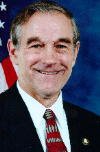 Ron Paul is a former Republican congressman from Texas. He was the 1988 Libertarian Party candidate for president.
View all posts by Ron Paul
Ron Paul is a former Republican congressman from Texas. He was the 1988 Libertarian Party candidate for president.
View all posts by Ron Paul
