



In finally accepting the 9/11 Commission’s request for public testimony under oath from National Security Adviser Condoleezza Rice, the White House was not the one that flinched. It was the 9/11 Commission.
The fine print of the deal takes the chance of the commission taking sworn public testimony from any other White House official – including Rice’s deputy Stephen Hadley, Bush’s political adviser Karl Rove, President Bush himself or Vice President Dick Cheney – completely off the table. It also precludes the panel from having the option of calling Rice, who’s made media statements contradicting evidence and sworn statements by other officials, back to testify.
It’s a one-shot deal. And it stinks.
Even under oath, Rice can dodge tough questions by claiming her answers would jeopardize national security or the war on terror. “I’m sorry, Mr. Chairman, but again, that’s a classified area, and I just can’t get into it,” she could say. Or she could come down with Washington amnesia – “I have no recollection of that.” And she and everyone else in the White House could skate. The commission has no recourse at that point.
Other compromises are curious. Why did the panel, which has subpoena power and could compel Rice to testify, originally bow to White House demands not to even tape-record the statements they were “allowed” to take from her in private? Why will it let Bush tag-team with Cheney in a joint Q&A in the White House without oaths or even tape recorders? Why has it agreed to let just four panel officials lay eyes on a key intelligence briefing Bush got a month before the 9/11 attacks?
Why is the commission bending over backwards to please the White House when it’s supposed to be fiercely independent and bipartisan, made up of five Republicans and five Democrats?
The answer may lie in the little-known fact that the White House has a friend on the inside. And not just any friend, either.
His name is Philip D. Zelikow, the executive director of the commission. Though he has no vote, the former Texas lawyer arguably has more sway than any member, including the chairman. Zelikow picks the areas of investigation, the briefing materials, the topics for hearings, the witnesses, and the lines of questioning for witnesses. He also picks which fights are worth fighting, legally, with the White House, and was involved in the latest round of capitulations – er, negotiations – over Rice’s testimony. And the commissioners for the most part follow his recommendations. In effect, he sets the agenda and runs the investigation.
He also carries with him a downright obnoxious conflict-of-interest odor, one that somehow went undetected by the lawyers who vetted him for one of the most important investigative positions in U.S. history.
| There’s a raft of evidence to suggest that Zelikow has personal, professional and political reasons not to see the commission hold Rice and other Bush officials accountable for pre-9/11 failings, and may be the de facto swing vote for Republicans on the panel. Here are just a few of them: | 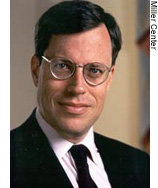 Philip D. Zelikow |
-
He and Rice worked closely together in the first Bush White House as aides to former National Security Adviser Brent Scowcroft. Zelikow was director of European security affairs, and Rice was senior director of Soviet and East European affairs, as well as special assistant to the president. Rice reportedly hired Zelikow. Both started in 1989 and left in 1991.
-
A few years after leaving the White House, Zelikow and Rice wrote a book together called, “Germany Unified and Europe Transformed: A Study in Statecraft.”
-
The two associated again when Zelikow directed the Aspen Strategy Group, a foreign-policy strategy body co-chaired by Rice’s mentor Scowcroft. Rice, along with Dick Cheney and Paul Wolfowitz, were members.
-
Zelikow also directed the Markle Foundation’s Task Force on National Security in the Information Age under co-chairman James Barksdale, a Bush adviser and major Bush-Cheney donor. A 9/11 commissioner, Republican Sen. Slade Gorton, also served with Zelikow on the task force. (Interestingly, the pair serves together on yet another panel – The National Commission on Federal Election Reform – with Gorton acting as vice-chairman and Zelikow as executive director.)
-
After the 2000 election, Zelikow and Rice were reunited when George W. Bush named him to his transition team for the National Security Council. Rice reportedly asked Zelikow to help organize the NSC under the Scowcroft model, which was insular and steeped in Cold War worldview.
-
Former White House terrorism czar Richard Clarke says he briefed not only Rice and Hadley, but also Zelikow about the growing al-Qaida threat during the transition period. Zelikow sat in on the briefings, he says.
-
A month after the 9/11 al-Qaida attacks, President Bush appointed Zelikow to the President’s Foreign Intelligence Advisory Board, which is chaired by Scowcroft.
-
Zelikow’s regular job, the one he’ll return to after the commission releases it final report in late July, is director of the Miller Center of Public Affairs at the University of Virginia. The center is dedicated to the study of the presidency, and maintains contact with the Bush White House, which fought the creation of the commission.
Kristen Breitweiser, a 9/11 widow, insists Zelikow has a “clear conflict of interest.” And she suspects he is in touch with Bush’s political adviser, Rove, which she says would explain why the White House granted him, along with just one other commission official, the greatest access to the intelligence briefing Bush got a month before the 9/11 suicide hijackings.
The two-page memo in question mentions “al-Qaida” and “hijackings,” that much we know. What we don’t know is if it gets any more specific about the threat. And the White House won’t let us find out. It refuses to declassify any of the August memo (or any of the other briefings Bush got before 9/11, for that matter), and it won’t even let most commissioners review it.
Bush and his top security adviser insist they have nothing to hide.
Rice pal Zelikow, for his part, says he’s recused himself from any part of the probe that deals with the roughly one-month period after the election when he worked with Rice on the transition, as if any potential conflicts he might have would end there. Commission spokesman Al Felzenberg doesn’t understand the fuss over Zelikow. “He has not served in the Bush administration,” he argues more technically than convincingly.
The fuss, Mr. Felzenberg, is that 9/11 relatives like the wife of the late Ronald Breitweiser want to know they are getting an honest investigation into what their government did to protect their loved ones from a foreign-ordered attack on American soil.
But the way key pre-9/11 documents and sworn testimony from top officials are being denied the public, it looks like the fix is in.
To be sure, Zelikow could be a remarkably objective fellow and not let his close ties to the Bush administration influence his final report in any way.
But with the commission still refusing to subpoena the documents and caving to White House ground rules on testimony, the stench of political bias has become too strong, and Zelikow should nonetheless step down, immediately, for the sake of the families, many of whom are demanding his resignation. And the commission should vote to further extend its deadline while it finds a more politically detached replacement for him and redoubles its efforts to deliver the “full and complete” and “independent” investigation it originally promised the country.
