The following interview was conducted by Rick Sterling on June 30, 2025. This is the first in a series of interviews of Anti-Zionist Jewish Americans.
Marvin Cohen is a longtime member and former board member of the Mt. Diablo Peace & Justice Center in Contra Costa, California. In 2010 he co-founded the Rossmoor club known as Voices for Justice in Palestine. The club is very active and hosts educational and fundraising events every month.
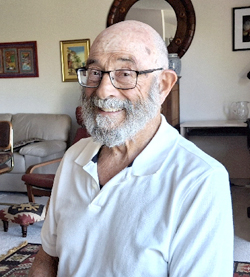 Q: Where did you grow up and where do you live now?
A: I grew up in Brooklyn, New York, beginning in 1937. Right now, I’m living in Rossmoor, an adult community in Walnut Creek, California. And I’ve been here for 20 years in this community.
Q: When you were growing up, did you encounter discrimination or antisemitism?
A: I’d have to say very, very little to me personally. I can’t think of any at all. When my father stopped working in the shipyards in San Francisco as a draftsman, when they stopped building all the Liberty ships, he was trying to get a job with a good company in San Francisco. He didn’t get it. And he was really an excellent draftsman. And I think at that time, 1946, it’s probably pretty safe to say that it was antisemitism. By the way, later in his life, he got a job as a draftsman working for NASA. So he was obviously a very competent artist and draftsman.
As for me, come to think of it, the only antisemitism I experienced was right here in this community. And it came from zionist Jewish people.
Q: What do you mean? Could you explain that?
A: I received a lot of hate mail from the zionists, telling me that I’m a traitor and a self-hating Jew and things of that nature. They slandered me and vandalized my car because I’m a Jewish person, especially a Cohen, and against Israeli policy. I can’t help it. I’m against injustice. I feel sorry for those people. They’re so full of hate.
When I was very young, I had a very close friend named Alex Weiss. He and his family came from Europe. They barely escaped with their lives from Austria. And when we were six years old, living in the Fillmore District in San Francisco, we were busted by the police because we were throwing dirt clogs at streetcars, imagining that they were Nazi tanks, and we were winning the war against the Nazis. Alex was a Holocaust survivor with his family: his father,mother, and sister. They lost almost everything they had. They were an upper middle class family in Austria, and they barely escaped.
Alex had a big influence on me. He was like an older brother, and he was totally against injustice anywhere. When he was in his early twenties, he got busted in Mississippi because he was a freedom rider. Later, he helped to save the prison on Angel Island when he was a state park ranger there. They were going to destroy the evidence of having had all these Asian people in jail on Angel Island, and he said, “No, that’s injustice. An injustice to anyone is not fair. We’re all human beings.”
So that was my buddy Alex.
Q: I know that you spent some time in Israel; you migrated to Israel at one point. What was your experience there?
A: Well, I went there when I was 40 years old. My wife at that time and I were living on Sonoma Mountain, about an hour north of San Francisco. I had previously worked as a school counselor for the San Francisco schools. One Sunday, I saw an advertisement in the Sunday Chronicle: the Israeli government was looking for school counselors. That sounded like a really interesting adventure. I had never been there, and my Italian-American wife knew I liked languages. I already spoke Italian and Spanish, and oh, I could learn Hebrew. I had Hebrew when I was 12 years old for my bar mitzvah. But that’s not the same as speaking fluently with the people that you’re working with. So I went to Israel to work as a school counselor. I was living in Ashkelon about eight miles up the coast from Gaza and living there with a bunch of other immigrants who were learning to speak Hebrew. This was called an absorption center. There were Jewish immigrants from all over the world, but the majority of them were Russian. So, six hours a day, six days a week, we had intensive Hebrew lessons.
And that was all fine. I was doing just fine. There were some Jewish holidays along the way, and for me, that meant free time because I was not into going to a synagogue. I finished with my Judaism when I was Bar Mitzvah at 13.
So the holy days were an opportunity to travel around a little bit. It’s not a big place. So I went to Jerusalem a couple of times. I went to Jericho; I went to the Sinai. And in Jericho – Wow. I had such an experience with a Palestinian family in Jericho. I was so impressed with the warmth of these people.
Living in Ashkelon and being busy six days a week, six hours a day, learning Hebrew, I had a little bit of free time. So meeting these Palestinian people was really something. It started opening up my eyes to the terrible reality of how life is there in Israel. And I didn’t like what I was seeing there.
Then I had another experience at the Dome of the Rock, the beautiful mosque with the gold dome that you often see in photos of Jerusalem. So I went in and sat down. There were about 30 people sitting down with their eyes closed in meditation. I sat down and was in meditation for 10 or 15 minutes. When I opened my eyes, I was looking into the eyes of a guy across from me. And we kind of nodded to each other. He was wearing glasses like me. He had a beard like me. He was balding like me, and we just nodded to each other. I got up to leave, and as I’m outside putting my shoes on, he came out and was putting his shoes on, and he started a conversation with me. He looked Arab, probably Palestinian, but he spoke really good English. I only knew a couple of words of Arabic. So he said, “Hello, my name is Marwan. What’s your name?” I thought it was funny that he’s Marwan and I’m Marvin. So we both got a kick out of that. He says, “So you don’t look like you’re from around here.” I said, “No, I’m not.” Maybe he thought I was not from around. I had a long ponytail at that time; I don’t think too many people around at that time had long ponytails. So I said, “Well, yeah, I’m from the USA.” He said, “Really? Where in the USA?” I said, “Well, Brooklyn, New York. Actually, I was born there in ’37.”
And he says, “’37? , you were born in 1937?” I said, “Yeah. He says, “I was also born in 1937.” We thought that was pretty funny. He says, “So where do you live now?” I said, “I live here. I live in Ashkelon.”
He says, “You live in Ashkeon? You left San Francisco to live in Ashkeon?” I said, “Yeah. He says, “Why would you want to live in Ashkeon when you’re living in San Francisco? Everyone wants to go to San Francisco and see the Golden Gate Bridge.” So I said, “Well, actually, I went there for work. I went there to work as a school counselor.” And he gets really wild-eyed and starts laughing. I said, “What’s funny about that?” And he says, “I’m a high school counselor in Gaza.” I thought, “Are you kidding me? That blew me away.” So then I said, “Wow. I am only eight miles north of where you are, and I just got my bicycle delivered from San Francisco, and I’ve been bicycling. Whenever I get a chance, I go bicycling. I go bicycling to a nice beach that I know up north. But I’d like to bicycle down and visit you in your high school. And he was silent. And then he said, “That might not be a good idea.”
And that just pointed out to me how ridiculous this whole thing is.
Q: What year was that?
A: That was in 1977. If you look back in history, I was living there when Anwar Sadat, the president of Egypt, visited Jerusalem, and it was a really big deal. There were Egyptian flags all over the place, and of course, they did away with Sadat. They don’t like anyone who’s trying to make peace. That was in 1977, I was 40 years old.
Do you know why he thought it was not a good idea for you to visit Gaza?
A: Well, he was thinking that there are some people in Gaza who don’t have really good feelings about what Jewish people have done. I could understand that, but that hit me.
Q: So what is your hope for Israel-Palestine now?
A: Peace. Justice should be a real democracy for everyone. It’s just an incredible place on this planet. People all over this planet want to visit that place. Three huge religions that are important to so many people in the world, and people around the world want to visit that area because of that. And it’s not big. It’s easy to get around. And the weather’s kind of neat. Living in Ashkelon was kind of similar to San Diego because just a couple of miles inland from there, you have desert. But you have the ocean or Mediterranean right there with nice warm water.
Q: What do you think is the main thing holding back a solution?
A: Racism. That’s what Zionism is. A group of people that says they are superior. They’re superior to those people there. They believe, “We’re up here, we’re above everyone else. We’re better than all these other people. God told us. So we have rights. We can do what we want. We got a pass from God.” They’ve been getting away with murder, literally. Genocide, bombing, starving people. How crazier can you get than that?
Rick Sterling is an independent journalist in the San Francisco Bay Area. He can be contacted at rsterling1@gmail.com