Reprinted from John’s Substack:
On 10 April 2026, I was on Glenn Diesen’s popular podcast, mainly talking about the disastrous war in Iran. Toward the end of our discussion, Glenn raised the issue of how one determines whether a particular policy that a state follows is rational or not. Of course, this is a hot topic these days.
Sebastian Rosato, who teaches at Notre Dame, and I recently wrote a book on the subject:
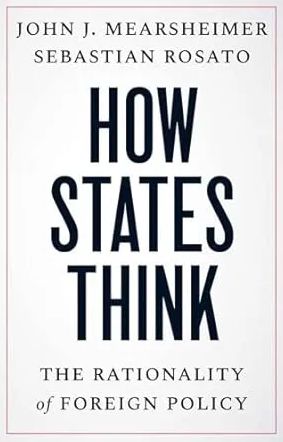
So, I was primed to answer Glenn’s question and relate it to contemporary events. Our argument in the book is that policies are based on theories about how the world works. In other words, if you are Prime Minister Netanyahu and thinking about attacking Iran in February 2026 or if you are Adolf Hitler thinking about invading France in 1940, you need a theory of victory. In effect you need to be able to tell a causal story — which is what theories are all about — that explains how launching an offensive is likely to produce the desired result.
Policies are rational when they are based on a credible theory, which is to say a theory that is logically sound and supported by substantial evidence. If a policy is based on a noncredible theory — one that is either logically flawed or not supported by much evidence — it is an irrational policy.
President Trump’s decision to attack Iran on 28 February 2026 was irrational because it was based on a noncredible or flawed theory of victory. He assumed that independent air power alone could cause regime change in Iran, which would lead to a new regime that would surrender to US and Israeli demands. However, it is widely recognized in the literature on air power — and from a quick look at the historical record — that air power alone is extremely unlikely to produce regime change. Thus, Trump’s theory of victory was not credible and therefore his policy was irrational.