Reprinted from Bracing Views with the author’s permission.
You can’t make this stuff up. The “liberal” New York Times has now explained why the U.S. has so many overseas military bases in the Middle East and elsewhere.
Anton Troianovski, who covers global diplomacy, writes:
The Persian Gulf war in 1991 ushered in the era of permanent, large-scale military bases in the Middle East — in part to protect oil supplies. The rationale evolved to include crushing Al Qaeda, promoting democracy and fighting the Islamic State. The bases are part of a military network spanning the globe that officials say helps project America’s economic and political power. Russia and China also have global ambitions, but their military footprint is much smaller. Russia’s main military presence outside the former Soviet Union is in Syria, where its influence has declined after the fall of the Assad regime in 2024. China has an African base near the Red Sea and is expanding elsewhere — Cambodia, for instance.
Where to begin?
1. The U.S. military has had a large military presence in the Middle East beginning with the Carter Doctrine in 1980, if not decades before then. Israel and Iran (from 1953 to 1979) were the main U.S. proxies in the region. The NYT’s answer suggests the large permanent U.S. military presence dates only from 1991 and was almost an accident of that war. At least the answer mentions oil, though U.S. designs weren’t so much about “protecting” the oil – more like securing or stealing it.
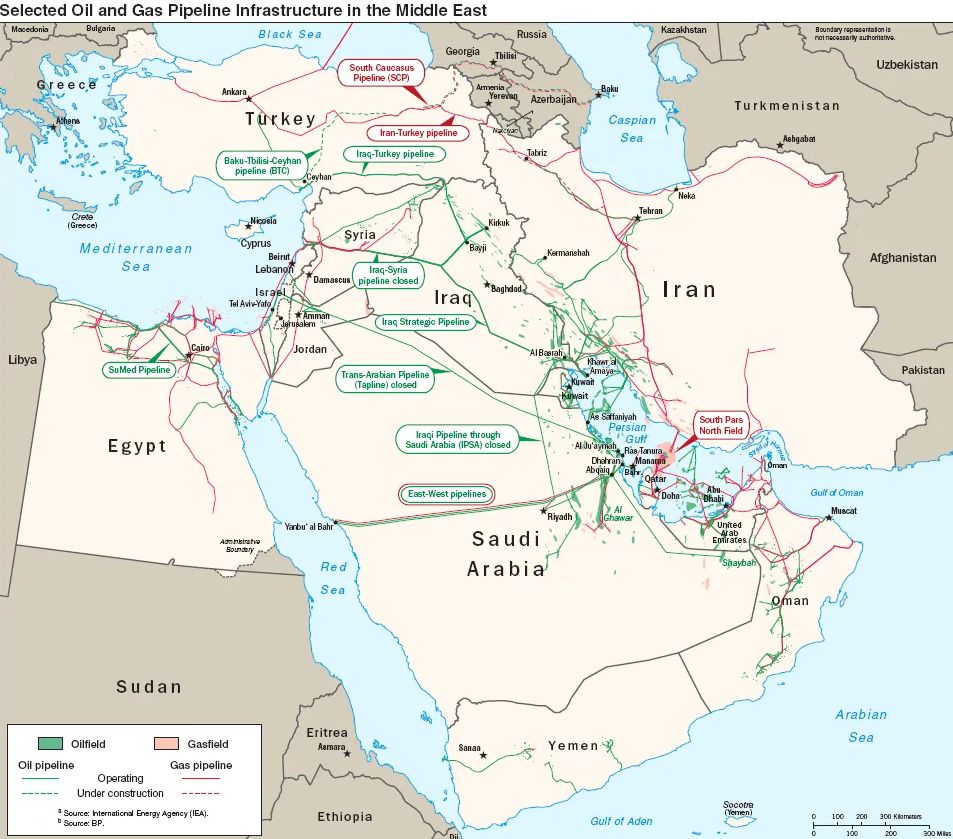
Oil? What oil?
2. Yes, the rationale sure did “evolve.” But there’s no mention of how the growing U.S. military presence in the region inspired the 9/11 attack on the U.S. in 2001. Osama bin Laden specifically called out the U.S. military’s presence in Islam’s sacred areas as inflammatory and intolerable.
3. “Promoting Democracy.” How has that worked in Iraq? Libya? Syria? Elsewhere? Sorry, democracy isn’t spread by Hellfire missiles and decapitation strikes.
4. “Officials say” the U.S. global network of 800 or so military bases (no number or cost figures provided by the NYT) helps “project” economic and military power. At least the NYT said “project” and not “protect.” No mention here of the effectiveness of these bases in defending the United States. Consider this a tiny burst of honesty from the NYT about how these bases are truly intended to project power.
5. And then there’s the kicker about Russia and China having “global ambitions,” even though “their military footprint” is much (MUCH!) smaller overseas. We’re talking a handful of bases compared to nearly a thousand for the U.S. empire.
By the way, here was the original question addressed to the NYT:
Why does the United States maintain so many military bases in the Middle East? How do we compare with Russia and China? How many military bases do they have in foreign countries? | Tom Ahlberg | Gig Harbor, Washington
Poor Tom Ahlberg. He can’t even get a simple and straight answer. I think I can provide one:
Acting as an imperial hegemon, the U.S. seeks to dominate the Middle East while serving the expansionist designs of Israel. The U.S. global military presence is both grossly larger and more aggressive than the regional postures of Russia and China. While the U.S. military has roughly 800 military bases worldwide, costing in the neighborhood of $65-$75 billion yearly just to maintain, Russia and China have only a handful of military bases in foreign countries. (My AI friends tell me that China has exactly one, whereas Russia has roughly twenty, mostly in former Soviet republics.)
Why couldn’t the NYT provide an answer somewhat like my cut at it? It’s not hard. Well, leave it to the “radical left” NYT to be so critical of U.S. militarism, imperial ambitions, and murderous foreign wars. Yes, that’s sarcasm.
New slogan for the NYT: All the propaganda that’s fit to print.