On Tuesday, Judge Napolitano asked me to respond to Nicholas Kristof’s reporting on the systemic rape and sexual abuse of Palestinian prisoners and hostages. Here is what I had to say:
[Transcript was auto-generated and edited for clarity.]
Napolitano: Let’s go to another article which is of some controversy. It’ll be in The New York Times tomorrow, so the only way you could see it today is in the digital version, and that’s Nick Kristof’s article about the prison rapes in Israeli prisons, which is very difficult to read, but which evoked a firestorm from the Israeli foreign ministry. Kristof, who almost apologized for writing this thing, feels intellectually bound to do so. He interviewed everybody — prison guards, interrogators, senior people, prisoners, Israeli prisoners, Palestinian prisoners. The picture he paints is so reprehensible, so clear, so consistent, so profound that Israeli leadership must know what’s going on, of horrific tortures of Palestinians, and every one of these tortures involves the forcible entry into someone’s body, male or female, including the use of dogs especially trained to do so.
Hoh: I will say for me it’s quite personal. Behind me is a photo, I’m with Issa Amro, who was interviewed in the story, and Issa was raped along with his colleagues. They are in Hebron, they oppose the occupation. Issa has been a major problem for the occupation for years. That photo, Ray McGovern is in that photo as well, is from Hebron in 2017. We’re being fired at by tear gas canisters. The Israeli border police actually fire them level. One hit Ray right in the arm. If you could see the photo, you could see Ray walking away holding his arm because he’d been shot in the arm by the tear gas canister.
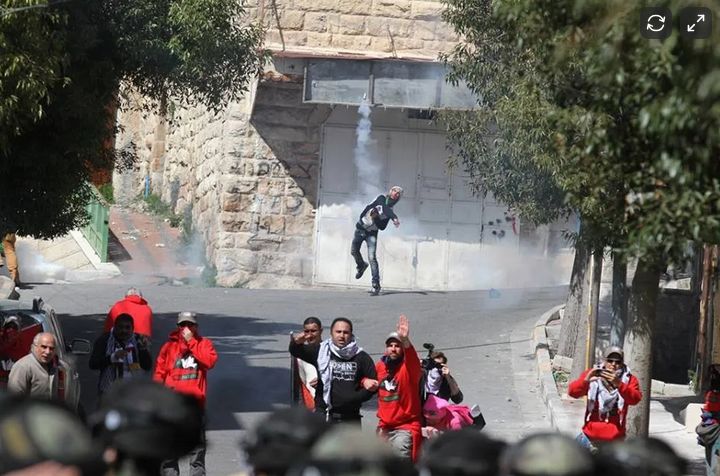
With Issa Amro in Hebron March 2017. Ray McGovern can be seen in the left of the photo after being struck by a gas canister, as a Palestinian youth throws a gas canister back at the Israel border police. Those of us in red sweatshirts were in Palestine as members of a Veterans For Peace delegation standing in solidarity with the Palestinian resistance to Israeli occupation.
Napolitano: They don’t shoot tear gas canisters up in the air the way they do in the U.S.?
Hoh: Some do, but a lot of them fire level. And if that tear gas canister had been up eight inches, it would have hit Ray right in the face. Ray was, I think, 80 years old at that time when he was there with us in the West Bank. But when I saw Issa again, and in that photo I’m locked arms with Issa as we approach that line of border police who are firing at us, when I was there in 2024 in the West Bank in Palestine and I saw Issa in Hebron, Issa told me then that he had been raped. He told me what they had done to him, what [the Israelis] do to them. And it wasn’t just Issa. His colleagues, his compatriots have been raped as well.
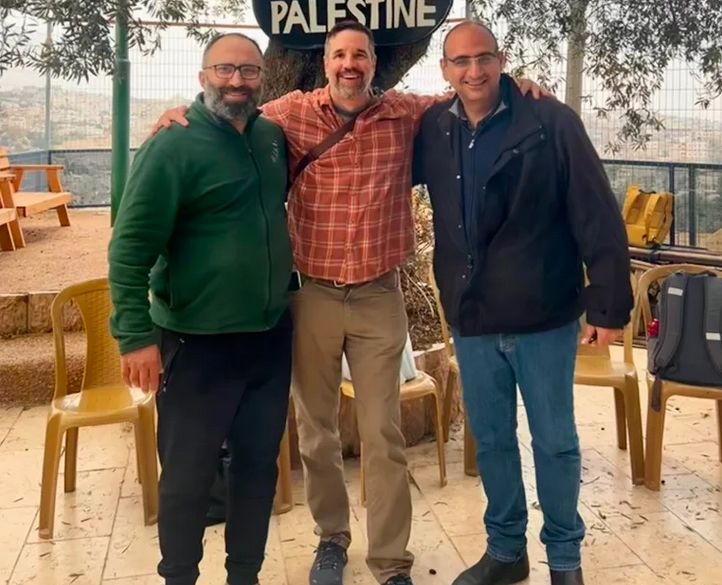
With Issa and Omar in Hebron, Occupied West Bank, Palestine, November 2024. Both of these men are heroes and idols to me. Both of these men have endured apartheid, occupation and cruelty. They have sacrificed so much and risk even more for their families, their communities, their people and their land. These may be the bravest, strongest and most honorable men I have known.
The documentation of this is clear. This existed before October 7th. I think that’s one thing I’m upset with Kristof about, Kristof did not make that clear in his column. You could read it almost as if this is a recent development. It’s not. The systematic torture, including rape and sexual assault on Palestinian prisoners, Palestinian hostages is a better term, has been evident and documented for decades, including on children.
One of the things that’s buried in that story is the report from Save the Children that documents 69% of Palestinian children [arrested by the Israelis are sexually assaulted]…the Israelis just come in the middle of the night and they take these children from their homes.
Both times I was in Palestine, Judge, both times I was in the West Bank in 2017 and 2024, when I spoke with Palestinians, the things that they were most afraid of, the things that they were most fearful of, was what the Israelis would do to their children. And the Israelis will go into villages, they will go into towns. They don’t do it often, because they don’t have to do it often, but once, twice, three times a year they will come into a village and they will raid homes and they will take children away and hold those children for two or three or four days, and they will be tortured. They will be abused. They’ll be humiliated. They’ll be threatened. They’ll be forced to sign confessions in Hebrew that they cannot read because they’re afraid their parents will be tortured or killed — that’s what the Israelis threaten them with.
And as we know from the Save the Children report, two-thirds of Palestinian children who are held hostage by the Israelis are either themselves raped or sexually assaulted, or they witness such rape and sexual assault.* The staggering levels of this — the documentation has been there, the evidence has been there, but what it’s done to these people, the way that the Israelis try to shatter these people, is what any oppressor has done, any occupier has done.
The converse of it is that it creates a reality in which the Palestinians refuse to bend the knee. Despite the immiseration, the murder, the starvation, the Palestinians still will not bend a knee. And I think that is something too that you don’t get from Kristof’s story — this idea that no matter what the Israelis do, they cannot break the will, the spirit, the defiance of the Palestinian people.
But I’m glad that Kristof did write this, that The New York Times published it. I’m afraid that they’re going to pull it, that they’re going to retract it, because they’re under such pressure.
…this is the reality of the Israeli occupation. This is the Israeli state. The idea that the Israeli state doesn’t endorse this, if you’ve had this documentation, if there have been decades of such evidence, if no Israeli soldier or prison guard or settler has ever been arrested, let alone tried, for these types of things.
And if it does occur, as we saw last year when Israeli prison guards were caught on video raping a Palestinian hostage, and when these soldiers were taken to trial, the country erupted. Parliamentarians stormed the prison. And you have on video debate in the Knesset where members are saying to one another, “Of course we’re allowed to rape them. They are nukhba. They are terrorists. They are nothing.” The idea that this isn’t state policy is absolutely insane. Of course it’s state policy. If there’s blanket immunity for doing these types of things, if no one is ever prosecuted or charged or punished and it’s publicly known, then of course it’s state policy. The state lets them do it.
And as well as, of course, the things you hear from not just the right wing, not just the Bezalel Smotrichs and Itamar Ben-Gvirs who endorse these things, Ben-Gvir who walks around with a noose lapel pin on his coat these days, but also the commentary you hear from across the Israeli spectrum, the dehumanization of the Palestinians, the fact that the Palestinians are nothing but animals, that they deserve such treatment…It should be no shock, no surprise to anyone that this is systemic, and it’s deliberate, and it’s purposeful.
Napolitano: Does the public understand and accept this, or is the Kristof article news to them? Just the Israeli public.
Hoh: I think the details may be news to them because by and large the Israeli press, particularly the Israeli Hebrew press, will not speak of such things other than to endorse the punishment of Palestinian detainees or hostages. So other than the overall glow that’s put on this by the Israeli media, how this is necessary, how this is keeping Israelis safe — when I was in Palestine in 2024 and we drove past Ofer Prison, which is the major prison in the central part of the West Bank, it’s right there off the road, you can’t miss it, massive walls — on the side of that prison, this is a major road, and this is an Israeli-only road, a yellow license plate road, it’s an apartheid system. Israelis drive on one road, Palestinians drive on the other. If you’re a foreigner, if you’re some guy from New Jersey, you get to drive on the Israeli road because you’re considered better than the people who are actually indigenous to there, under the Israeli apartheid system. That’s how it works. You and I go there, Judge Napolitano and Hoh, we [can] walk around acting like we own the place.
I’ll tell you one story when we were in Hebron just to illustrate this apartheid. We go to Hebron. I’m with this group, it’s a Christian group called Sabeel, a fantastic organization. People should support it. People should go to Palestine with Sabeel. But we’re in Hebron. We have our Palestinian friend with us, Omar. We’re near the Ibrahimi Mosque, the big great mosque there in Hebron. And there’s a public bathroom. And those of us who are from the United States, from Canada, from the UK, we’re allowed to use the public bathroom. But our Palestinian friend Omar, he’s not allowed to use the public bathroom. That’s apartheid right there.
But as we’re driving by Ofer Prison, just to answer your question, Judge, about the Israeli public’s involvement in this, there’s a huge banner on the side of Ofer Prison that says in Hebrew, “Together we will win.” The communication from that torture site to the thousands of Israelis that drive by that prison every day is that we’re in this together, that the way we win is through imprisoning and torturing these people. That’s the message you take from something like that. I don’t know if [if the Israel public] know the details. I don’t think they understand the picture in color, but they certainly understand it in black and white.
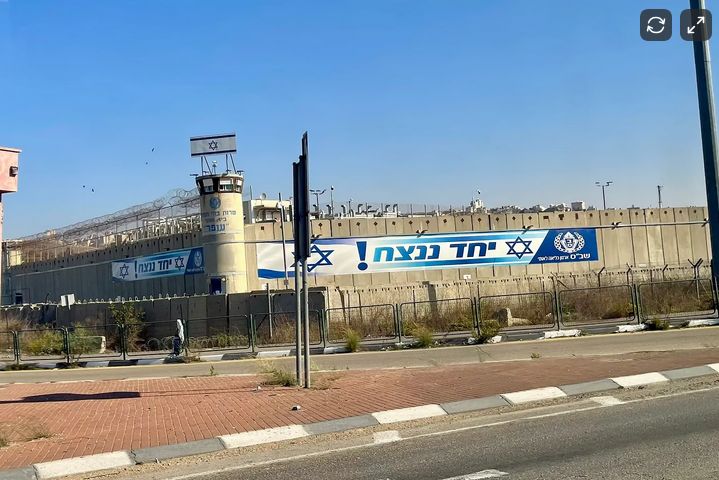
“Together, we will win!” Ofer Prison, Occupied West Bank, Palestine. November, 2024.
Napolitano: Last question: does Netanyahu know that he lost this war? Is he getting desperate?
Hoh: I think he’s getting desperate, Judge, because I think he’s upset with the foot-dragging from the Americans, but also he realizes that the most political pressure he’s had on him, aside from the fact that he’s corrupt and should be in jail, the most political pressure we’ve seen exerted on Netanyahu from his opponents has come from the ceasefire with Iran, and even more so the ceasefire, put that in quotes, because as the United Nations said in the last three days, the Israelis have carried out 1,300 airstrikes [and attacks] in Lebanon and killed dozens and dozens and dozens of people. But the pressure that Netanyahu is feeling politically right now comes from his opposition, who are decrying and criticizing him for this, again, quote, ceasefire, unquote, in Lebanon particularly. So this war, which was very popular and is still very popular in Israel, was meant to ensure Netanyahu’s success in this year’s elections. The elections have to occur by October. I recall reading the idea was they’d move the elections up to June, and this way the war would happen, the war would be won, and Netanyahu would sweep back in. And now he’s got this political opposition, again, not just based upon his corruption, not just based on his criminality, but based upon the fact that he is seen as in league with ceasefires with Iran and Lebanon.
Netanyahu* really wants to conquer Lebanon. He really wants to complete the conquest of southern Syria. He wants to destroy Syria and Iran, and then he wants to be able to wrap it all up so that they can annex the West Bank and finish off Gaza. He really does believe in this project. He really does believe in this war. So he wants to see victory on his terms, but he also has this very real domestic political pressure on him, because the question isn’t whether the war went well — it didn’t. The question seems to be why the war is not continuing, and that’s what the Israeli public wants.
Napolitano: Well, Matt, these are difficult things to discuss, but you made them informative and profound, and I’m deeply grateful to you. Thank you, my dear friend.
Hoh: Thank you, Judge. All the best.
Napolitano: If you have a strong stomach, you can find this article by Nick Kristof and read it in tomorrow’s New York Times or today’s digital version, but emphasis on strong stomach.
*This is not only Netanyahu’s vision for Greater Israel, but the near entirety of any individual, organization or institution with any political significance or power in Israel.
In my comments to Judge Napolitano, I reference a Save the Children report. The report I cite is the July, 2003 Save the Children report, which documents the detention and abuse of children in Israeli prisons months before the October 7 attacks. In that 2023 report, Save the Children found 69% of Palestinian children had been strip-searched (the American Bar Association defines strip-searching a child as sexual abuse), while reporting other forms of sexual violence had increased against Palestinian children. In 2014, Save the Children reported 40% of Palestinian children had experienced sexual abuse in Israeli prisons. Kristoff, in his NYT story, refers to a newer Save the Children report, which documents that more than half of Palestinian children taken prisoner or hostage by the Israelis have reported rape or sexual assault. Since 2000, and again, prior to October 7, 2023, Israel abducted 500-700 Palestinian children a year, often in the raids on Palestinian homes I referenced in my comments to Judge Napolitano.
This knowledge of what the Israeli occupation does, and has done, to the Palestinian people leads to the question of what you would do if these were your children?
How could there not be resistance to such indignity and humiliation, to such cruelty and such depravity, and to such terrorism and such evil?
How could there not have been the intifadas, and how could there not have been the October 7th attack?
I’m not going to offer the question of why we as Americans support such crimes and horrors, because that answer is simple. We do so because the United States is an empire and those indignities and humiliations, those cruelties and depravities, and those terrors and evils are what empires do, if not directly, then by proxy.
Reprinted with permission from Matt’s Thoughts on War and Peace.
Matthew Hoh is the Associate Director of the Eisenhower Media Network. Matt is a former Marine Corps captain, Afghanistan State Department officer, a disabled Iraq War veteran and is a Senior Fellow Emeritus with the Center for International Policy. He writes at Substack.