Reprinted from Bracing Views with the author’s permission.
Note: A few of you may recall that I created a Substack specifically to address technology and war. Today, I posted the article below. It seemed important enough to share with a wider audience here at Bracing Views.
*****
It’s possible that Russia, if pushed hard enough, could use nuclear weapons against Ukraine or against those countries that are arming Ukraine and supplying it with intelligence. That’s perhaps the most alarming military scenario facing the world in the immediate future. Can possible nuclear escalation be defused?
Cool and wise heads must prevail, but in the USA such heads are in short supply, notably at the upper reaches of government.
Anyhow, below are the notes I taught from in the 1990s when I addressed the nuclear question (a nice euphemism for potential Armageddon). Since then, the USA has committed to modernizing its nuclear triad at a cost of roughly $2 trillion over the next three decades. “Modernization” includes a new ICBM (the Sentinel), a new stealth bomber (the B-21 Raider), and a new SLBM-firing submarine force (the Columbia-class).
It’s yet another case of a technological wargasm – one that could truly end the world, at least for humans as well as many other species on this planet.
And who knew that forty years after Ronald Reagan’s Strategic Defense Initiative, otherwise known as “Star Wars,” an even more ambitious missile defense system known as “Golden Dome” would be proposed by Donald Trump? It may end up costing more than a trillion dollars without providing much in the way of defense.
The cost of nuclear weapons and related defensive systems continues to mushroom like a 50-megaton hydrogen bomb. I guess someone is profiting, notably Northrop Grumman.
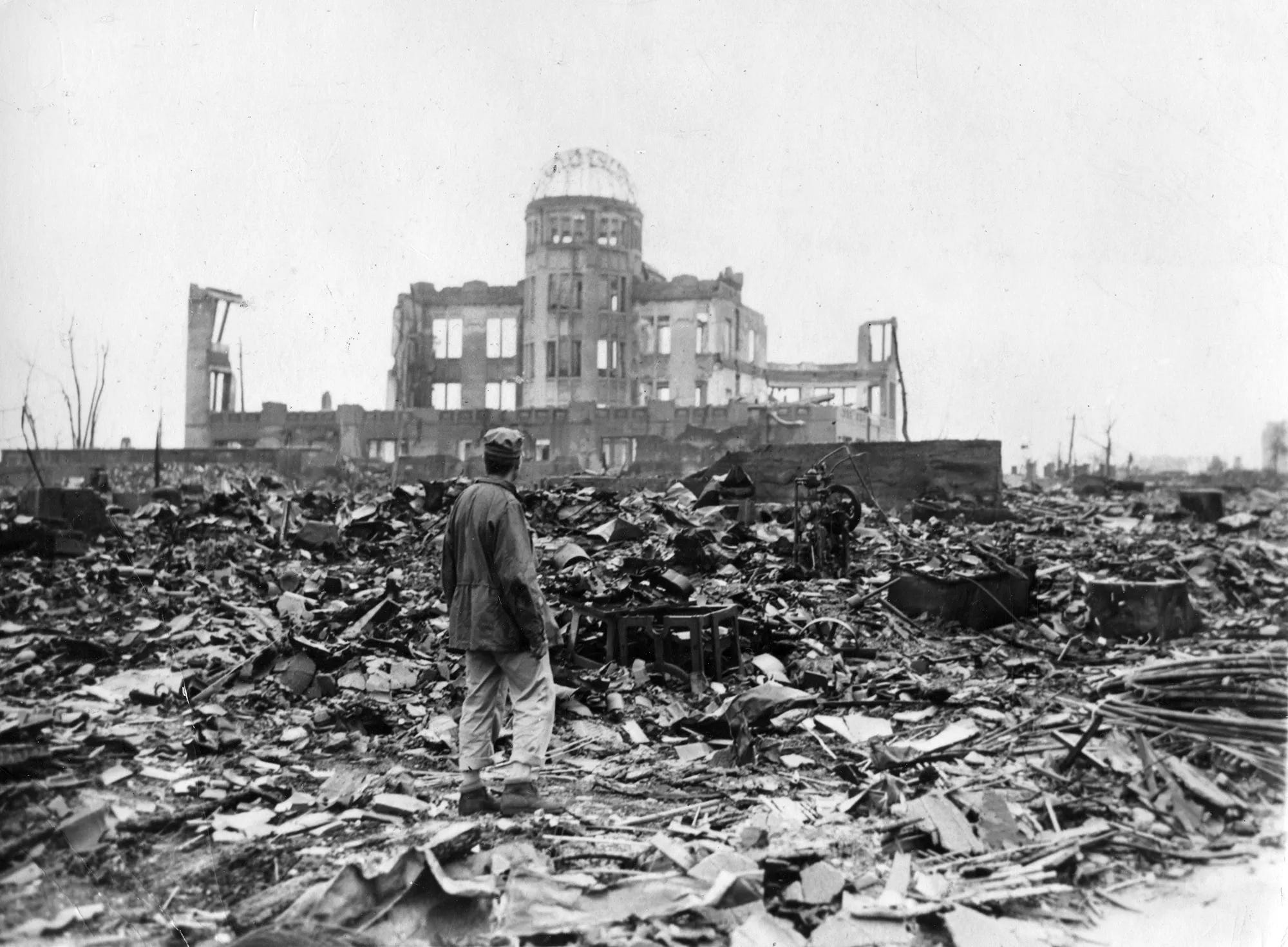
Hiroshima, 1945, after a relatively small fission (or atomic) bomb was dropped on it. Nuclear warheads today are generally 10 to 100 times more powerful, and Russia and the USA have thousands of such warheads.
Nuclear War and Technology, April 1999
Two schools of thought with respect to nuclear weapons after WWII:
- nukes are no different than any other weapons
- nukes are qualitatively different; they alter the fundamental nature of war
Why might nukes be different in both degree and kind? Nuclear weapons as strictly political weapons due to fear of escalation and medical effects, e.g. radiation. Poison the air, soil, nuclear winter.
Robert McNamara has strongly asserted that “Nuclear weapons serve no military purpose whatsoever. They are totally useless-except only to deter one’s opponent from using them.” And according to Fred Kaplan, author of The Wizards of Armageddon, “Even after 30 years of thinking about the unthinkable, no one knows how to fight and win a nuclear war. The rational analysts have been unable to make the bomb conform to human proportions.”
But threat of nukes might be useful in deterring an opponent from using chemical or biological weapons, or when national survival is at stake.
How much is enough to deter an opponent? Just ten percent of our nuclear arsenal could destroy every military target in Russia: every city, sixty percent of industry and 90 million Russian citizens.
Development of nukes after WWII focused primarily in three areas:
- making low-yield, tactical nukes
- maximizing blast while minimizing radiation, or vice-versa
- miniaturization
Hydrogen bomb fuses hydrogen nuclei into helium, thereby releasing huge amounts of energy. Also eliminates key disadvantage of fission bombs: fissionable material is scarce, but H-bomb based on nature’s most abundant element.
Questions to consider
What do the “missile gap,” the “window of vulnerability,” and the “civil defense gap” tell us about the nature of the nuclear dynamic between the U.S. and the Soviet Union? In considering the “window,” recognize the US philosophy of the Triad, and that roughly 50% of our deterrent is based at sea, while 75% of Russia’s deterrent is land-based ICBMs.
Why did a nuclear arms race happen? Jerome Weisner, science advisor to Presidents Kennedy and Johnson, has suggested that “on the whole we were racing with ourselves. We’d invent a weapon, then we’d invent a defense against it, then we’d defend the next weapon because the Russians would have built what we’d invented. We’ve really been pacing the thing, and we’ve been doing it for thirty years.” So mistrust and a technological imperative have driven the nuclear arms race. O’Connell agrees that weapons acquisition has almost uniformly been driven by the rule of symmetry.
Is a defense against nuclear weapons, i.e. “Star Wars,” possible? Is it desirable in that the existence of an effective defense system might increase the chances of a country going to war, of launching a first strike? Or are the Russians more fearful of our gaining a huge lead in military technologies through our research in SDI? Is Global Protection Against Limited Strikes (GPALS) feasible and desirable?
Have nuclear weapons put an end to total war? Wasn’t war for Vietnam and Iraq (nearly) total? Have nuclear weapons changed war at all?
What is a destabilizing nuclear system? Why might the Pershing II and MX missiles be considered destabilizing systems? MX as a first-strike weapon:
What really deters the Soviet Union is not the idea that we can destroy their silos, but the idea that we can destroy their conventional military forces, their industry, and everything they have built – and you don’t need accurate missiles to do that.
Can we eliminate nuclear weapons? Are the Catholic Bishops correct in saying that deterrence is an immoral policy, one that we should strive to change?
According to the International Physicians for the Prevention of Nuclear War,
The first illusion is that nuclear deterrence is an ethical policy. The essence of nuclear deterrence is the threat to use instruments of indiscriminate destructive power against an adversary. On the basis of this policy, responsible governments are prepared to kill hundreds of millions of innocents who are being held hostage. The horror is obscured by its magnitude, by the sophisticated technology ever readied to accomplish the slaughter and by the aseptic Orwellian language crafted to describe the attack, “delivery vehicles” produce an “exchange” in which the deaths of untold millions are called “collateral damage.”
The moral depravity of such a policy can be best appreciated by reducing its scale, removing the high technology and abandoning sanitized words. Would people accept a policy which forced their national leaders to threaten to pour gasoline on 10 young children of an adversary nation and burn them to death?
But would the end of nuclear deterrence simply make the world safer for conventional wars? Isn’t the key feature of a stable deterrence that neither opponent should have a rational motive to launch first?
O’Connell emphasizes the corrosive effects of deterrence: “that a political structure founded on the threat of random and ultimate violence should have a corrosive effect upon everything it touches” and he quotes William McNeill’s assertion that “Perhaps the most fundamental shift of the postwar decades was a widespread withdrawal of loyalty from constituted public authorities.” O’Connell further observed that the “automation of random death and destruction can be seen to epitomize the inhuman ends of the arms competition and the ultimate removal of all vestige of the heroic from warfare.”
Has strategy governed the development of nuclear weapons, or has strategic doctrine had to struggle to keep pace with new technical capabilities? “Missile Envy” and missiles as phallic symbols. Any validity or cogency to this idea?