Reprinted from Bracing Views with the author’s permission.
The Pentagon has failed eight consecutive financial audits. For decades it has been unable to account for trillions of dollars. It has not won a major war since World War II. That is not a record of excellence. It is a record of entrenched failure.
Naturally, President Trump’s answer is to give it another $500 billion in next year’s budget.
If enacted, that would drive annual U.S. military spending north of $1.5 trillion. The math is almost too neat: U.S. GDP hovers around $30 trillion; five percent of that is $1.5 trillion. Somewhere along the way, the arbitrary idea that “defense” spending should equal 5 percent of GDP hardened into dogma. A considered strategy no longer informs budgets. Arbitrary numerology does.
Did the Pentagon request an extra half-trillion dollars? No. Has the administration identified a new existential threat that requires it? No. There is no grand strategy unveiled to justify this “surge.” Just a number — large, round, politically expedient.
An institution that cannot pass an audit is not prepared to manage another half-trillion dollars. Pouring money into a system riddled with cost overruns, duplicated programs, and strategic confusion does not produce security. It produces contractors’ profits and future disasters.
Let’s be honest about what this really is. The national security state — the blob, the military-industrial-congressional-intelligence-media-academia-think tank complex — is already the most powerful force in Washington. When you add “defense,” nuclear weapons, intelligence, veterans’ programs, and homeland security, it consumes well over half of federal discretionary spending. It is the unofficial fourth branch of government, and arguably the first in power.
Few presidents confront it. Dwight D. Eisenhower warned about the military-industrial complex — and even he presided over huge Cold War budgets. John F. Kennedy spoke of peace while deepening involvement in Vietnam. Lyndon B. Johnson escalated that war catastrophically. Barack Obama accepted a Nobel Peace Prize and then defended the necessity of permanent American war. Presidents learn quickly: you appease the Pentagon or you risk political ruin.
And so Trump does what presidents do. Even as he talks of peace, he feeds the war machine.
We are told this is about safety. That peace comes only through overwhelming force. That America must dominate every domain — land, sea, air, space, cyberspace — indefinitely. That garrisoning the globe is synonymous with freedom. That “exceptional” nations do not generate blowback.
Yet two decades in Iraq and Afghanistan ended not in triumph but exhaustion and retreat. Each failure somehow justifies a larger budget. Nothing succeeds like failure.
In a functioning democracy, military spending would be tied to actual defense. It would be scrutinized, debated, constrained. Instead, military failure yields medals and ribbons. Audit failure yields budget growth. Strategic stalemate yields expansion. The larger the disappointment, the louder the demand for more money and authority.
When an institution grows more powerful no matter how poorly it performs, accountability has died. When elected officials dare not meaningfully challenge it, civilian control becomes theater. Call it what you will, but a republic that cannot rein in its military establishment is drifting toward a system where the sword outweighs the ballot and proves mightier than the pen.
As Joe Biden once said, “Show me your budget, and I’ll tell you what you value.” A $1.5 trillion military budget tells us that war — or at least preparation for it — sits at the center of national life.
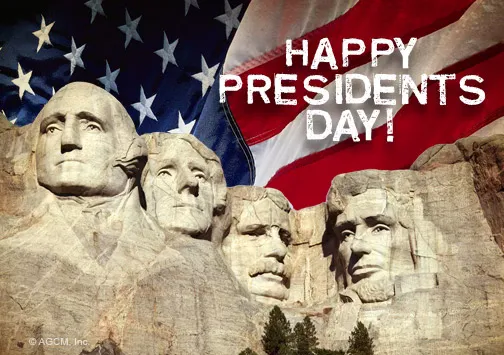
Perhaps not so happy
On Presidents’ Day, it is worth recalling that George Washington surrendered military power to constitutional authority. That was the founding act of the republic. The test of any president is whether he sees himself as bound by law — or as a ruler who commands legions.
Empires require Caesars. Republics require restraint. The colossal size of Trump’s proposed war budget suggests which path he (and America) is choosing.