We must go back in history to understand the split between Sunni and Shi’a Islam before we can understand the animosity between predominantly Sunni nations like Saudi Arabia and Shi’a Iran today. Please suffer through the names and dates.
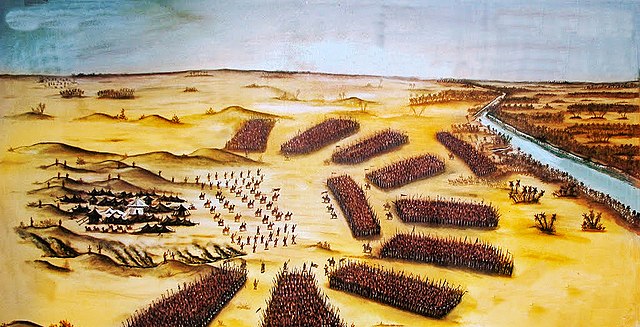
This painting depicts the Battle of Karbala (680 CE), showing the small camp of Husayn ibn Ali and his followers on the left, surrounded by the much larger, highly organized forces of the Umayyad caliph Yazid. The nearby river, likely the Euphrates, highlights a central tragedy of the event – Husayn’s group was cut off from water for days before the final assault. Vast troop formations closing in emphasize the overwhelming imbalance of power, as Husayn and his small band, including family members, faced near-certain death. The scene captures the moment of impending destruction that, in Shiʿa belief, represents not just a battle but a profound act of moral resistance and martyrdom in the face of injustice.
The prophet Muhammad (peace be upon him) is traditionally understood to have died in 632 CE. In the decades after the Prophet Muhammad’s death, disputes over leadership divided the Muslim community, with Shiʿa Muslims holding that religious authority belonged to the Prophet’s family, beginning with Ali ibn Abi Talib.
After years of conflict and the rise of Umayyad rule in Damascus under Muawiya I, power was transformed into a hereditary system and passed to his son Yazid ibn Muawiya.
The following brief history is crucial in understanding the religious undercurrents behind the Iran war.
Imam Ḥusayn, the grandson of the Prophet Muhammad, refused to pledge allegiance to Yazid ibn Muawiya. This is not obscure stuff! It matters today.
In Shiʿa belief, Yazid was an illegitimate and tyrannical ruler whose brutality, impiety, and injustice stood in direct violation of the moral principles of the Qur’an and the example of the Prophet’s family.
Allegiance to Muawiya would have meant legitimizing corruption and oppression. Ḥusayn’s stance is understood as a moral obligation, rather than a bid for political or military power.
Imam Ḥusayn left Mecca (in Saudia Arabia today) after receiving letters from people in Kufa (in Iraq today) asking him to lead them against the ruthless Yazid. However, by the time he approached Iraq, those supporters had been crushed by Yazid’s men.
Ḥusayn and a small prayerful group of family members and devotees, including women and children – were intercepted and forced to stop in the desert of Karbala.
On the 10th of Muharram (Ashura), June 25–26 this year, Ḥusayn’s camp faced a vast army sent by Yazid’s authorities. One by one, his companions and family members were killed.
Ḥusayn was ultimately killed at Karbala after refusing to legitimize Yazid’s rule. Although he did not seek war and was vastly outnumbered, he stood in principled opposition and was drawn into a fatal confrontation. In Shiʿa belief, his death is understood as martyrdom (shahāda) – a conscious sacrifice for truth and justice.
This is among the greatest events in all of world history, yet largely absent in the western mind.
Religious scholars compare Husayn’s martyrdom to the crucifixion of Jesus.
Husayn’s martyrdom at Karbala endures today as a powerful emotional and religious symbol of resistance to tyranny and a moral line that must not be crossed.
Perhaps 15% of all Muslims today are Shi’a. The rest are Sunni. Iran, Bahrain, Azerbijan, North Yemen, and Southern Lebanon are predominantly Shi’a. Doesn’t it make more sense now? (Except for the Bahrain part).
Today’s standoff between Saudi Arabia and Iran stems from the Saudi embrace of Wahhabism. This tradition vehemently rejects practices central to Shiʿa practices like shrine veneration and intercession
In Shiʿa Islam, intercession (shafāʿa) is the belief that the Prophet Muhammad and his family – especially figures like Ali ibn Abi Talib and Husayn ibn Ali – can plead with God on behalf of believers. This intercession is understood to occur only by God’s permission, as these figures are seen as spiritually close to God but not divine. It’s like Christians who pray to saints or to Mary.
From a Shiʿa perspective, rightful authority in Islam did not pass to political and military rulers, but remained within the family of the Prophet – beginning with Ali ibn Abi Talib and continuing through a line of divinely guided Imams.
These Imams are not regarded as prophets, but they are viewed as holy interpreters of the Qur’an and guardians of the faith. This belief bestows great importance to Husayn’s martyrdom at Karbala as an ethical stand that continues to shape Shiʿa actions and belief.
Ali ibn Abi Talib was the first Imam. His elder son, Hasan ibn Ali, was the second Imam. Husayn ibn Ali was the third Imam.
Muhammad al-Mahdi, (Mahdi), is the son of the eleventh Imam, Hasan al-Askari. According to this strongly held belief, he was born in the 9th century (around 869 CE) and became Imam as a child. Mahdi was described as being very young, sometimes characterized as “a boy” or “about twelve.”
These accounts are similar to stories of Jesus with great wisdom in the Temple in Jerusalem at 12 years of age.
Shiʿa belief holds that shortly after inheriting the Imamate, Mahdi entered a state known as the Occultation (ghayba), a divinely ordained concealment from the world. This occurred in two phases: an initial period of limited contact through appointed representatives, followed by a longer “Major Occultation” that continues to the present. During this time, he is believed to be alive but hidden, sustaining a spiritual role even in absence.
In Twelver Shiʿa belief, Muhammad al-Mahdi is expected to reappear openly at a time of widespread injustice and moral disorder, ushering in a restoration of truth and justice. His return is often associated with Mecca, where he will publicly call humanity back to the true path and assume rightful leadership. He will not act alone: traditions describe him as being joined by a small, devoted group of followers – often numbered symbolically as 313 – and, most significantly, by Isa ibn Maryam, (Jesus, son of Mary) who will support his mission and affirm his authority. Together, they are understood to defeat oppression and fulfill the moral struggle embodied in events such as the Battle of Karbala, bringing history toward a final realization of justice.
In contrast, the Saudi religious tradition, rooted in Sunni Islam and shaped by the teachings of Muhammad ibn Abd al-Wahhab, rejects the idea of divinely appointed Imams and does not accept the Shiʿa doctrine of a hidden, living Mahdi. While acknowledging Karbala as a tragic historical event, it does not grant it the same central theological significance, and it opposes many devotional practices associated with the veneration of the Prophet’s family. From a Shiʿa viewpoint, these positions amount to a rejection of the spiritual authority of the Prophet’s family and the enduring legacy of Karbala.
Neither Shi’a nor Sunni Muslims claim that Muhammed is God. They believe there is no god but God, and Muhammad is the messenger of God. They greatly revere Jesus as a prophet but they reject the notion that he is the “Son of God.”
Since Vatican II Christians have transformed their thinking around Islam. For instance, the Catechism of the Catholic Church (1992), §841, states, “The plan of salvation also includes those who acknowledge the Creator, in the first place amongst whom are the Muslims; these profess to hold the faith of Abraham, and together with us they adore the one, merciful God, mankind’s judge on the last day.”
Pat Elder (pelder@militarypoisons.org) is the Director of Military Poisons, www.militarypoisons.org an organization that focuses on the contamination caused by the U.S. military at bases around the world. Pat has been focused on per-and poly fluoroalkyl substances, known as PFAS. Pat has worked on mass protests in Washington since 2001. He serves on the Board of World BEYOND War. He has also served on the board of the National Network Opposing the Militarization of Youth, NNOMY. Pat taught at the Islamic Education Center in Potomac, Maryland where he learned to appreciate the many facets of Islamic history and culture.